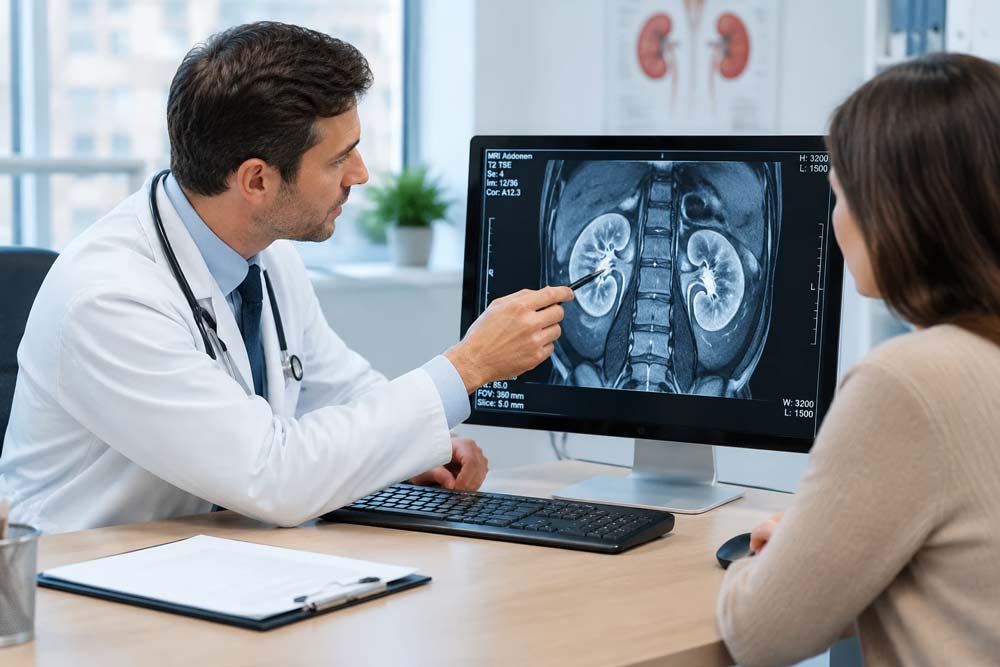
Understanding the connection between kidney cysts, polycystic kidney disease, MRI scans and genetic risk.
Imagine having an MRI scan for back pain or another concern and discovering that your report mentions kidney cysts. Are these cysts dangerous? Could they affect kidney function? Could they run in your family? Many kidney cysts are harmless, but their number, appearance and distribution sometimes provide clues about an inherited condition. An incidental view of the kidneys on a scan performed for another reason may not provide the same assessment as dedicated kidney imaging.
What are kidney cysts?
Kidney cysts are fluid-filled sacs within or on the kidneys. Simple cysts are common, especially with age, and often need no treatment. Radiologists consider their number, location, size, internal appearance, any solid components, and whether the kidneys are enlarged. These features help distinguish simple cysts from complex lesions and inherited cystic patterns.
When could kidney cysts be genetic?
Autosomal dominant polycystic kidney disease (ADPKD) is an inherited disorder in which numerous kidney cysts develop and can enlarge over time. It is most commonly associated with pathogenic variants in PKD1 or PKD2. PKD1-related disease is often more severe on average, but progression varies widely. Other genes can also be involved.
An affected parent with a typical autosomal dominant disease-causing variant has a 50% chance of passing it to each child. However, a person may have ADPKD without a known family history, so family history alone cannot establish or exclude the diagnosis.
Can MRI detect polycystic kidney disease?
Ultrasound is often the first imaging test for suspected ADPKD. MRI may be useful if ultrasound is inconclusive or more detailed assessment is needed. MRI provides detailed images without ionising radiation and can help assess cyst burden and kidney size. In people with confirmed ADPKD, MRI-derived total kidney volume, adjusted for height and interpreted alongside age and disease pattern, can help estimate risk of progression in appropriate clinical settings.
MRI alone cannot identify a specific gene variant. Imaging findings must be interpreted alongside kidney function, blood pressure, clinical history and, where appropriate, genetic assessment.
Does finding multiple cysts mean inherited disease?
No. Multiple simple cysts can develop with age, and acquired cystic kidney disease can occur in people with advanced chronic kidney disease. Bilateral numerous cysts and enlarged kidneys may suggest ADPKD, but radiologists must consider alternative explanations and atypical patterns. Some complex cysts need a separate assessment for possible malignancy.
Where does genetic testing fit?
Genetic testing may help when imaging is uncertain, family history is unclear, disease is atypical, or family planning and assessment of relatives are relevant. It is not required for every ADPKD diagnosis. A negative genetic test does not always exclude inherited disease, and a variant of uncertain significance should not be treated as a confirmed pathogenic variant.
Why consult a clinical geneticist?
A clinical geneticist can evaluate family history, review available genetic results, explain inheritance and advise whether further genetic assessment may be appropriate. Genetic counselling or consultation is different from laboratory genetic testing, which may need to be arranged through an appropriate clinical pathway. A nephrologist remains central to managing kidney function, blood pressure and treatment.
What if your MRI report mentions kidney cysts?
The next step depends on the report and your symptoms. Simple cysts may need no further action; unusual or complex findings may require follow-up imaging or specialist review. People with suspected inherited cystic kidney disease should discuss kidney function and blood pressure assessment with their healthcare team. Severe pain, fever with significant illness or other urgent symptoms require prompt medical assessment.
If you are arranging an independent imaging review, this guide explains how to get your MRI images and report from your imaging centre.
How Hospitual can help: two specialist perspectives
Hospitual offers radiology second opinions and online clinical genetics consultations for adults. A radiologist can independently review an existing MRI or CT examination and report, clarifying the cyst pattern and imaging recommendations. A clinical geneticist can discuss whether the history and findings raise the possibility of an inherited disorder, explain existing genetic results and advise on potential next steps. For adults seeking clarification of existing MRI findings, an MRI second opinion through Hospitual provides an independent imaging assessment, subject to case suitability and specialist availability. A straightforward simple cyst does not automatically require a second opinion.
A radiologist helps answer: “What does my scan show?” A clinical geneticist helps answer: “Could this be inherited, and what might it mean for my family?” These are complementary services, not a substitute for nephrology care, genetic laboratory testing, or urgent assessment when needed.
The future of more personalised kidney care
MRI provides information about kidney structure and cyst burden; genetics can help explain an underlying cause. Together with kidney function monitoring and specialist clinical care, these tools can support more informed decisions. The goal is not simply more testing, but a clearer understanding of which information matters for each person.
About Hospitual
Hospitual is a digital healthcare platform providing independent radiology and pathology second opinions and online specialist consultations, including clinical genetics, for adults. Exceptional Care, Instant Access.
Clinical references
- KDIGO. 2025 Clinical Practice Guideline for the Evaluation, Management, and Treatment of ADPKD.
- NIDDK. Autosomal Dominant Polycystic Kidney Disease.
- NIDDK. Simple Kidney Cysts.
- NIDDK. Acquired Cystic Kidney Disease.
Educational information only, not individual medical advice. Hospitual provides non-emergency services for adults.