Understanding Consanguinity: Science Beyond the Taboo
In the field of medical genetics, few topics are as frequently misunderstood as the relationship between consanguinity and genetic risk. Often shrouded in social misconceptions or cultural sensitivities, the clinical reality of consanguineous unions—defined as marriages between individuals related by second-cousin status or closer—requires a balanced, evidence-based perspective. At London Genetics, led by Dr Ehsan Karimiani, we believe that providing clear information about consanguinity and genetic risk is a vital component of modern healthcare in a cosmopolitan hub like London.
Defining Consanguineous Marriage in Modern Genetics
From a clinical standpoint, consanguinity refers to the union of two individuals who share at least one common ancestor. When discussing consanguinity and genetic risk, the primary concern is the increased probability that both partners carry the same recessive genetic variants. While the term is often used interchangeably with “cousin marriage,” medical professionals categorise these relationships by the “coefficient of inbreeding” .
For instance, first cousins share approximately %12.5 of their genetic material. When Dr Ehsan Karimiani consults with families, the focus is not on social judgment, but on calculating these percentages to assess the likelihood of “homozygosity”—a state where a child inherits the same version of a gene from both parents. Understanding the mathematical link between consanguinity and genetic risk helps couples make informed decisions based on data rather than fear.
The Global Prevalence: Why Cultural Context Matters in London
The dialogue surrounding consanguinity and genetic risk is deeply rooted in global practices, with over 1 billion people worldwide living in communities where related marriages are preferred. In many cultures, these unions are favoured for their perceived role in strengthening family bonds, preserving social stability, and maintaining economic continuity.
In the UK, and specifically within the diverse boroughs of London, many families continue these traditions. However, the transition to a Western healthcare environment can sometimes create a “knowledge gap.” Patients may feel hesitant to discuss their family history due to a perceived stigma. At our clinic, we bridge this gap by offering specialised Genetic Counselling in London that is both culturally sensitive and scientifically rigorous. We ensure that traditions are respected while the actual consanguinity and genetic risk are proactively managed through advanced screening.
Genetic Shared Ancestry: How Many Genes Do Cousins Really Share?
To truly grasp the implications of consanguinity and genetic risk, one must look at “Shared Ancestry” through a genomic lens. Every individual carries a handful of “recessive” mutations—genetic variations that do not affect their own health because they have a second, healthy copy of the gene to compensate.
The challenge arises when two partners are biologically related:
-
First Cousins: Share 1/8 of their genes (%12.5).
-
Second Cousins: Share 1/32 of their genes (%3.125).
The closer the biological relationship, the higher the “Prior Probability” that both partners carry the exact same recessive mutation inherited from a common grandparent. This is the fundamental reason why consanguinity and genetic risk are studied so closely; if a child inherits this mutation from both parents, they may develop a genetic condition that had previously been “silent” in the family for generations. By focusing on the underlying molecular biology, we empower couples to move beyond the taboo and focus on the health of the next generation.
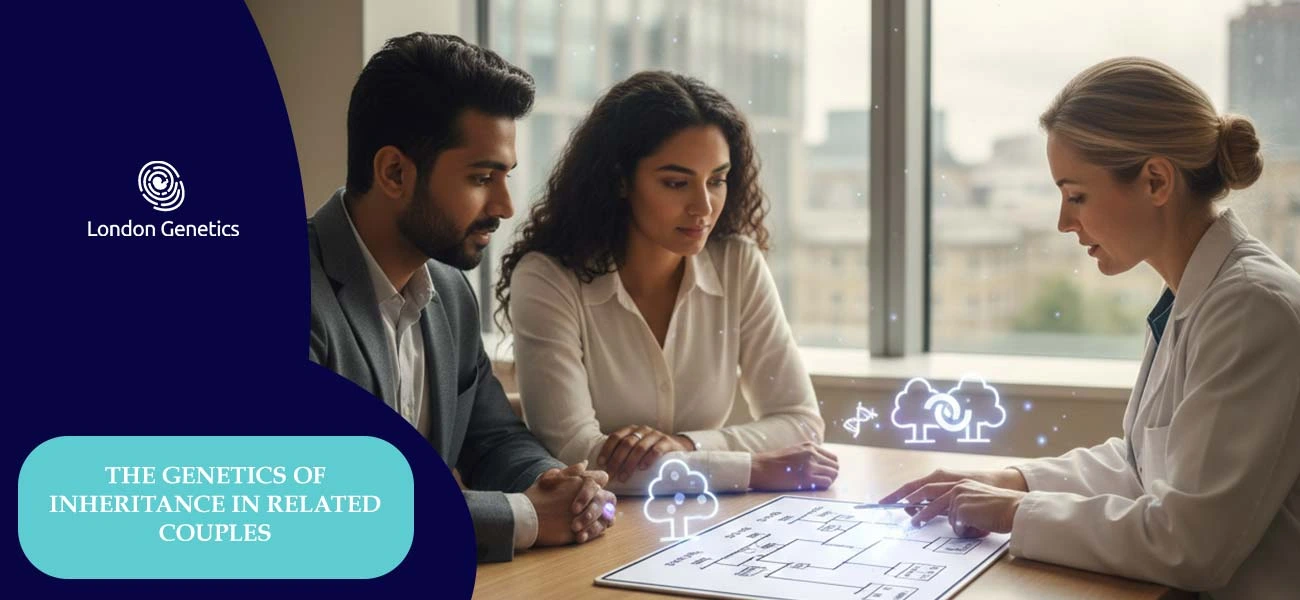
The Genetics of Inheritance in Related Couples
To navigate the complexities of consanguinity and genetic risk, one must understand the biological mechanisms that govern how traits—and conditions—are passed from one generation to the next. In related couples, the primary focus of a clinical geneticist is the concept of “identity by descent” (IBD), where segments of DNA are identical because they were inherited from a common ancestor. This biological overlap is what differentiates the risk profile of related couples from the general population.
Autosomal Recessive Disorders: The Core Concern
The most significant correlation between consanguinity and genetic risk lies in autosomal recessive inheritance. Every individual carries between one and five “lethal” recessive mutations that remain hidden because they are balanced by a second, dominant, healthy copy of that gene. However, when two individuals are related, they are significantly more likely to carry the same hidden mutation inherited from a shared grandparent or great-grandparent.
If both parents pass on the mutated gene, the child will be affected by the condition. While the background risk for a non-related couple to have a child with a significant birth defect is approximately 2–3%, this risk increases for first cousins. This is why many couples ask, “Am I a Carrier of a Genetic Condition?” before planning a family. Identifying these “silent” genes through carrier screening is the most effective way to manage the potential outcomes of autosomal recessive inheritance.
The Probability Factor: Comparing Risks
When we quantify consanguinity and genetic risk, we look at the “Coefficient of Relationship.” This mathematical value helps us predict the percentage of genes two people share.
-
Non-related couples: Their genetic overlap is essentially the population average, meaning the chance of them carrying the exact same rare recessive mutation is statistically very low.
-
First-cousin couples: Because they share grandparents, they have a 1-in-8 chance of sharing a specific genetic variant.
At London Genetics, Dr Ehsan Karimiani uses these probability models to provide couples with a personalised risk assessment. For those already expecting, understanding these probabilities is crucial when considering Genetic Testing in Pregnancy to ensure healthy birth outcomes. It is important to note that consanguinity and genetic risk are not uniform; they depend heavily on the family’s specific medical history.
What is the “Founder Effect” and How Does it Impact Family Health?
A crucial element in the study of consanguinity and genetic risk is the “Founder Effect.” This occurs when a small group of ancestors remains socially or geographically isolated, leading to a higher prevalence of certain genetic variants within that community. In such cases, even distant relatives might share a higher-than-average genetic similarity.
In many communities served by our London clinic, certain uncommon conditions may be more prevalent due to this effect. When a founder carries a recessive mutation, it can be amplified over generations through related marriages. This often leads to the appearance of Rare Genetic Disorders that require specialist diagnostic evaluation. By identifying these patterns, we can offer targeted testing that addresses the specific consanguinity and genetic risk factors unique to your heritage, providing clarity and a path forward for your family’s health.
Common Genetic Disorders: Understanding Consanguinity and Genetic Risk
Navigating the complexities of consanguinity and genetic risk can be a daunting experience for many families. While many children born to related parents are perfectly healthy, there is a statistically higher probability of inheriting specific recessive conditions. Under the expert guidance of Dr Ehsan Karimiani, we categorise these potential outcomes to help families distinguish between mild health variations and serious inherited disorders.
- Mild Blood Conditions: Carriers of traits like Alpha-Thalassemia often show no symptoms, but understanding the consanguinity and genetic risk is vital for family planning.
- Vision & Hearing Variations: Some forms of non-syndromic hearing loss or mild visual impairments are more prevalent when parents share a common ancestor.
- Metabolic Adjustments: Minor inborn errors of metabolism that can often be managed effectively through diet or early lifestyle interventions.
While these conditions require monitoring, they are often manageable when identified early through professional clinical assessment.
Certain manifestations of consanguinity and genetic risk serve as red flags for rare and complex multi-system syndromes:
- Severe Neurodevelopmental Issues: Intellectual disabilities or global developmental delays often require high-level genomic analysis to provide a definitive diagnosis.
- Structural Abnormalities: Rare syndromes affecting bone growth, organ development, or facial features that are linked to identical-by-descent genetic markers.
- Primary Immunodeficiencies: Life-threatening conditions where the body cannot fight infections, frequently associated with high levels of shared ancestry.
If there is a history of unexplained childhood illness, seek medical advice immediately as these indicate a significant clinical genetic mismatch.
- Identifying Risks Early: Rather than waiting for a disorder to manifest, we use Whole Exome Sequencing (WES) to predict consanguinity and genetic risk accurately.
- Targeted Family Panels: Dr Karimiani can recommend specific testing based on your family’s unique geographical and ethnic heritage.
- Diagnostic Peace of Mind: London Genetics provides the clarity needed to make informed decisions about your future pregnancies and family health.
Professional guidance transforms consanguinity and genetic risk from an uncertain worry into a clearly defined and manageable healthcare plan.
Early diagnosis and prevention are the cornerstones of family health.
Don’t wait for a serious condition to manifest in future generations. By utilising our specialist Rare Disease Genetic Counselling, you can distinguish between manageable risks and dangerous complications, ensuring your family’s future is both safe and secure.
Debunking Myths: Facts vs. Fiction in Consanguineous Marriages
When discussing consanguinity and genetic risk, public perception is often divided between extreme alarmism and complete dismissal. At London Genetics, Dr Ehsan Karimiani encounters several recurring myths that can prevent families from seeking the clinical support they need. By separating fact from fiction, we empower couples to make decisions based on genomic science rather than social stigma.
Myth 1: “Our Family is Healthy, So We Don’t Need Testing”
The Fiction: If no one in the extended family has a visible genetic disorder, the couple’s children are not at risk. The Fact: This is perhaps the most dangerous misconception regarding consanguinity and genetic risk. Recessive mutations can be carried silently through many generations without ever manifesting as a disease. A “healthy” family history does not rule out the presence of shared recessive variants. Professional Family Genetic Counselling is the only way to identify these hidden risks before they affect the next generation.
Myth 2: “Genetic Risks Only Apply to First Cousins”
The Fiction: Only marriages between first cousins are subject to significant consanguinity and genetic risk. The Fact: While the “coefficient of inbreeding” is highest among first cousins, the risk persists—albeit at a lower percentage—for second cousins and even beyond in communities with a long history of intermarriage. In cases of “complex consanguinity,” where families have intermarried over several generations, the cumulative consanguinity and genetic risk can be higher than expected. This is why a detailed pedigree analysis by a specialist is essential.
Myth 3: “Genetic Testing Can Always Guarantee a Healthy Baby”
The Fiction: A clear genetic test result means there is zero chance of any health issues. The Fact: While modern science is incredibly advanced, no test can provide a 100% guarantee against all medical conditions. However, understanding consanguinity and genetic risk through targeted screening can eliminate the vast majority of known, high-risk conditions. Our goal at London Genetics is to reduce the risk to the lowest possible level, providing families with “informed peace of mind” rather than absolute certainty.
Myth 4: “Scientific Intervention is Culturally Insensitive”
The Fiction: Seeking genetic advice means you are being told not to marry within the family. The Fact: Clinical genetics is about empowerment, not prohibition. The role of Dr Ehsan Karimiani is to provide the medical facts regarding consanguinity and genetic risk so that couples can plan their futures safely. Whether through pre-marital screening or Prenatal Genetic Counselling, we offer a supportive environment that respects cultural traditions while prioritising the health of your future children.
The Essential Role of Premarital Genetic Counselling
In the journey toward building a family, the premarital stage offers a unique “window of opportunity” for preventive healthcare. When addressing consanguinity and genetic risk, the goal of a premarital consultation is not to discourage marriage, but to provide a clear roadmap for a healthy future. At London Genetics, we believe that informed couples are empowered couples, and early intervention is the cornerstone of modern genomic medicine.
Why Consultation Should Precede Pregnancy
Many couples only consider the link between consanguinity and genetic risk once a pregnancy has already begun. However, seeking advice before conception allows for a much broader range of options and significantly reduces emotional stress. By identifying potential recessive overlaps early, Dr Ehsan Karimiani can guide couples through the most appropriate screening pathways, ensuring that any identified risks are managed proactively rather than reactively.
How Dr Ehsan Karimiani Evaluates Complex Family Pedigrees
A cornerstone of assessing consanguinity and genetic risk is the construction of a detailed family pedigree (a genetic family tree). This process involves more than just listing relatives; it requires a deep clinical understanding of inheritance patterns.
During a session for Premarital Genetic Counselling, Dr Karimiani meticulously maps out health histories across multiple generations. This allows the identification of “clusters” of illness that may indicate a specific shared genetic variant. For related couples in London, this bespoke approach is far more effective than generic “off-the-shelf” DNA tests, as it targets the specific ancestral markers unique to their lineage.
Identifying “Silent Carriers”: The Power of Modern Genomic Screening
The primary scientific challenge of consanguinity and genetic risk is that most carriers of recessive conditions are “silent”—meaning they have no symptoms and no idea they carry a mutated gene. Modern genomic screening has transformed our ability to detect these variants.
At our clinic, we utilise advanced technologies to look for hundreds of different genetic conditions simultaneously. If both partners are found to be carriers of the same variant, we don’t just provide a diagnosis; we provide a plan. Understanding your status regarding consanguinity and genetic risk allows you to explore options such as:
-
Pre-implantation Genetic Testing (PGT): Ensuring only healthy embryos are implanted during IVF.
-
Early Prenatal Diagnosis: Monitoring the pregnancy with precision from the earliest stages.
-
Specialised Neonatal Care: Being prepared with a medical team immediately after birth.
By integrating these advanced scientific tools with compassionate, culturally sensitive care, London Genetics ensures that your path to parenthood is paved with clarity and confidence.
Advanced Genomic Analysis: Managing Consanguinity and Genetic Risk
At London Genetics, we move beyond basic screening to provide definitive answers. By utilising cutting-edge genomic technologies, we offer a precise evaluation of consanguinity and genetic risk. Under the expert clinical guidance of Dr Ehsan Karimiani, we employ the most sophisticated diagnostic tools available in the UK to ensure your family’s future health is protected.
By choosing an advanced genomic-driven approach, you are utilising the best of modern medicine to safeguard your family. The combination of specialist expertise in London and high-fidelity testing ensures that every aspect of consanguinity and genetic risk is addressed with the highest clinical standards.
Navigating the Emotional and Psychological Aspects
Beyond the molecular biology and statistical probabilities, the intersection of consanguinity and genetic risk is deeply personal. For many couples, the journey toward genetic clarity is accompanied by a complex mix of hope, anxiety, and cultural responsibility. At London Genetics, we recognize that a consultation is not merely a scientific transaction but a supportive experience designed to provide peace of mind.
Dealing with Family Pressure and Cultural Sensitivities
In many communities, discussing consanguinity and genetic risk can feel like challenging a long-standing tradition. Couples may face pressure from extended family members who perceive genetic testing as a lack of trust in the family’s health history. Dr Ehsan Karimiani provides a safe, confidential, and non-judgemental space where these concerns are addressed with the utmost respect for your cultural background. We believe that protecting your future children’s health is the highest form of family loyalty.
Making Informed Decisions: Autonomy in Genetic Choices
Our role in managing consanguinity and genetic risk is to provide the map, not to choose the destination. Whether couples are seeking premarital clarity or prenatal reassurance, the final decision remains theirs. By providing jargon-free, evidence-based information, we ensure that you are empowered to make choices that align with your values and your vision for your family.
Conclusion: Knowledge is Empowerment
The relationship between consanguinity and genetic risk is a fundamental part of modern preventive medicine. While the word “risk” can be intimidating, the ability to identify, quantify, and mitigate that risk is a remarkable achievement of contemporary genomics.
Through the expert guidance of Dr Ehsan Karimiani at London Genetics, families in London and beyond have access to world-class academic expertise and compassionate clinical care. By choosing to understand your genetic heritage today, you are taking the most proactive step possible toward ensuring a healthy, vibrant future for the next generation.
Managing Consanguinity and Genetic Risk: A Personalised Approach by Dr Ehsan Karimiani
To effectively address consanguinity and genetic risk, clinical data must be paired with expert interpretation and cultural sensitivity. At London Genetics, we provide more than just raw DNA results; we offer a clinical safety roadmap for your family. By combining advanced genomic technology with Dr Ehsan Ghayoor Karimiani’s world-class academic expertise, we ensure that your journey towards parenthood is both scientifically rigorous and focused on long-term health.
The Clinical Pathway to Managing Consanguinity and Genetic Risk:
– Initial Consultation: A comprehensive review of your family pedigree and medical history, utilising genomic insights to identify potential inherited risks.
– Tailored Genomic Testing: Using non-invasive tools like Whole Exome Sequencing (WES) to map recessive variants and optimise your family planning strategy.
– Strategic Interpretation: Dr Karimiani personally translates complex DNA data into an actionable strategy designed to mitigate consanguinity and genetic risk.
– Holistic Support: Navigating complex hereditary concerns with expert guidance, evidence-based certainty, and a supportive, non-judgemental environment.
Optimising Your Family’s Health Outcomes:
Choosing to understand consanguinity and genetic risk through London Genetics means accessing a seamless transition from cutting-edge research at UCL to direct clinical care. Our patient-centred approach ensures that your genetic findings are managed with the highest degree of medical accuracy and strict confidentiality, adhering to the most rigorous British healthcare standards.
The Next Step Toward Genetic Certainty:
Knowledge is the foundation of a healthy future. Whether you are planning your marriage or seeking answers during pregnancy, taking a proactive approach to consanguinity and genetic risk will provide the clarity and safety your family deserves. Book a consultation today to start your journey with biological certainty.