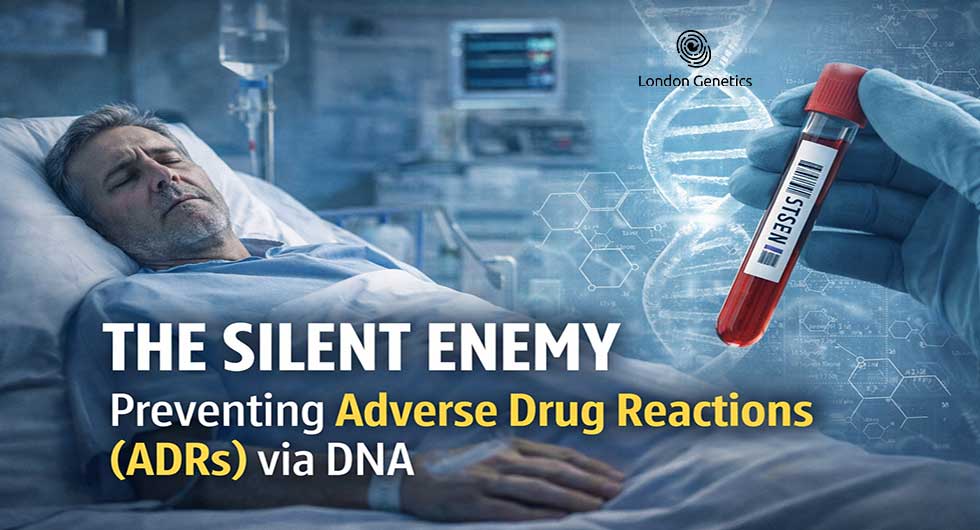
Introduction: The Hidden Risk in Your Medicine Cabinet
For many Londoners, the daily routine involves a trip to the medicine cabinet. Whether it’s a prescription for hypertension, a statin for cholesterol, or a course of antidepressants, we trust these treatments to make us better. However, a sobering reality lies beneath the surface of modern medicine. In the UK, Adverse Drug Reactions (ADRs) account for approximately 6.5% of all hospital admissions, placing a staggering burden on the NHS and, more importantly, on the lives of patients and their families.
ADRs are often described as the “Silent Enemy.” Unlike a simple rash or a mild stomach upset, these reactions can be debilitating, leading to long-term health complications or even life-threatening emergencies. They occur not because the medication is “bad,” but because of a fundamental biological mismatch.
This is where Pharmacogenomics steps in as a revolutionary beacon of patient safety. By moving away from the outdated “one-size-fits-all” approach, we can now use your unique DNA to predict how your body will process specific chemicals. Instead of the traditional—and often risky—process of trial and error, we provide a scientific roadmap to ensure your prescriptions are as unique as your thumbprint.
At London Genetics, we believe that no patient should have to gamble with their wellbeing. Our Medication Compatibility Testing is designed to identify these risks before they manifest, providing you with the peace of mind that your treatment is both safe and effective.
Why “One-Size-Fits-All” Prescribing Is Outdated
Modern medicine is undergoing a fundamental shift.
The long-standing assumption that a medication effective for the majority will work for everyone is no longer compatible with what we now understand about human genetic diversity—particularly in a city as diverse as London.
Conventional prescribing models are based on population averages derived from clinical trials.
While effective for some, this approach ignores the fact that individuals metabolise and respond to medications in profoundly different ways.
As a result, two patients receiving the same drug and dose may experience completely different outcomes—ranging from optimal benefit to severe side effects or no therapeutic effect at all.
These differences are driven by genetic variation in enzymes responsible for drug metabolism,
transport, and receptor sensitivity.
Pharmacogenomic testing identifies how your body processes specific medications,
revealing whether a drug is likely to be effective, require dose adjustment,
or pose an increased risk of adverse reactions—before treatment even begins.
The traditional trial-and-error approach—prescribing, waiting, adjusting, and managing side effects—
is increasingly viewed as outdated and avoidable.
By using Pharmacogenomic Testing in London, clinicians can design treatment plans that are aligned
with an individual’s genetic profile from day one, minimising risk, improving efficacy,
and accelerating clinical outcomes.
Key Takeaway:
One-size-fits-all prescribing belongs to the past.
Pharmacogenomics enables a personalised, evidence-based approach to medication selection,
reducing unnecessary side effects and ensuring treatments are chosen for the individual—not the average.
In modern healthcare, precision prescribing is no longer a luxury; it is the new standard of care.
The Science of Safety: How Your Genes Influence Drug Metabolism
To truly grasp how we can now predict and prevent life-altering Drug Reactions, we must look closely at the body’s sophisticated “chemical processing plant”: the liver. Within this vital organ, a specific family of enzymes known as Cytochrome P450 (CYP450) acts as the primary biological workforce. The fundamental role of these enzymes is to metabolise—or break down—the various medications you take, ensuring they perform their intended therapeutic task before being safely cleared from your system.
However, because every individual’s genetic makeup is unique, these enzymes work at vastly different speeds from person to person. When your DNA causes these enzymes to work too slowly, medication can build up to toxic levels in your bloodstream, which is the leading cause of severe Drug Reactions that often result in hospital admissions across the UK. Conversely, if they work too quickly, the medicine is flushed out before it can even begin to work. By analysing your genetic blueprint, we can move beyond the outdated “trial and error” method of prescribing. This proactive approach allows clinicians to identify high-risk patients before they swallow a single pill, effectively putting an end to the “Silent Enemy” of unpredictable Drug Reactions and ensuring your treatment journey is both safe and scientifically sound.
However, your genetic code dictates the “speed” and “efficiency” of these enzymes. Based on your DNA, we can categorise your metabolic response into four distinct profiles:
-
Ultra-Rapid Metabolisers: Your enzymes work at lightning speed, breaking down the drug before it even has a chance to work. This often leads to treatment failure, a common issue addressed in Psychiatric Pharmacogenetics, where patients may feel their antidepressants are simply not working.
-
Normal (Extensive) Metabolisers: Your body processes medication at the expected rate, usually aligning with standard “off-the-shelf” dosages.
-
Intermediate Metabolisers: Your metabolism is slightly sluggish, which can lead to a build-up of the drug if the dosage is not carefully adjusted.
-
Poor Metabolisers: This is where the risk of the “Silent Enemy” is highest. Your enzymes are significantly impaired, meaning the medication stays in your system far too long.
The danger for Poor Metabolisers is the unintended accumulation of the drug. When the next dose is taken while the previous one is still circulating, it creates a “toxic pile-up” in the bloodstream. This accumulation is a primary cause of severe adverse reactions and drug toxicity. By utilising Medication Compatibility Testing, we can identify these metabolic bottlenecks before you take your first pill, ensuring your treatment is both safe and tailored to your body’s unique pace.
Beyond Prevention: Optimising Treatment Efficacy
Avoiding side effects is only half the story.
True personalised medicine ensures that the right medication actually works—effectively, efficiently, and within your unique biological environment.

Hover over each box to see how DNA-informed prescribing improves treatment outcomes!

Many patients take medications for months—such as painkillers or blood pressure treatments—
without experiencing meaningful improvement.
This is often not due to the medicine itself, but because the drug fails to activate
or reach therapeutic levels within the body’s unique biological and genetic environment.

Some medications require specific enzymes to be converted into their active form.
A well-known example is codeine, which must be metabolised into morphine to relieve pain.
If your genetics classify you as a “Poor Metaboliser” for the relevant enzyme,
even the highest dose may provide little or no benefit—leaving symptoms unchanged.

DNA-informed prescribing allows clinicians to move beyond guesswork
and identify medications that are likely to be effective from the outset.
By understanding your genetic blueprint, doctors can determine the optimal dose—
high enough to work, yet low enough to remain safe—eliminating months of frustration
and ineffective treatment.
Key Takeaway:
Personalised medicine is not just about avoiding harm—it’s about maximising benefit.
DNA-informed prescribing identifies which treatments are “non-starters” and which will deliver
real therapeutic impact, ensuring a faster, safer, and more effective journey toward recovery.
Clinical Application: Common Medications Where DNA Testing is Crucial
The abstract science of genomics has very real, everyday implications for residents across the capital. While pharmacogenomics can theoretically apply to almost any prescription, there are specific medical fields where identifying the risk of adverse Drug Reactions through genetic testing is no longer just a “helpful extra”—it is arguably essential for high-standard, modern care.
In clinical practice, this technology serves as a vital safety net. By ensuring that a patient’s unique genetic profile is compatible with their treatment plan, healthcare providers can proactively eliminate the guesswork that often leads to debilitating Drug Reactions. This shift towards precision medicine ensures that for Londoners managing complex conditions, the focus remains on recovery rather than managing the fallout of a mismatched medication.
Cardiovascular Health (Heart Care)
For those managing heart conditions, the precision of medication is a matter of life and death. Common medications like statins (for cholesterol) and blood thinners (like Warfarin or Clopidogrel) are heavily influenced by your DNA. Certain genetic variations can make you prone to muscle pain from statins or, more dangerously, prevent blood thinners from working correctly, leaving you at risk of clots or strokes.
Mental Health (Psychiatry)
In the realm of mental wellbeing, the “trial and error” approach can be particularly soul-destroying. Many patients cycle through multiple antidepressants or anti-anxiety medications before finding one that works. Psychiatric pharmacogenetics allows us to see how your brain receptors and liver enzymes will interact with SSRIs or mood stabilisers, significantly shortening the time it takes to find a treatment that brings relief.
Pain Management & Gastric Health
As mentioned earlier, the effectiveness of painkillers (analgesics) is often a genetic lottery. Beyond pain, even routine treatments for acid reflux (PPIs) or autoimmune digestive disorders can be optimised. By testing your DNA, we can determine if you are a “Rapid Metaboliser” who needs a higher dose to heal a gastric ulcer, or a “Poor Metaboliser” who might suffer from unnecessary side effects.
By identifying these risks early through Cardiovascular Drug Response Testing, London Genetics ensures that your most vital treatments are never left to chance.

Why London Residents are Turning to Genetic Screening
In a city that serves as a leading global hub for medical innovation, Londoners are increasingly savvy about their healthcare choices. The shift toward personalised medicine in the UK is no longer a futuristic concept—it is a present-day reality available in the heart of the capital, specifically designed to protect patients from unpredictable and harmful Drug Reactions.
Access to World-Class Technology
London is home to some of the most advanced genomic facilities in the world. Residents are moving away from standard, generalised care and seeking out private clinics that offer cutting-edge Pharmacogenomic Testing. By choosing these advanced screenings, patients gain access to a level of precision that was previously reserved for high-level clinical research. This proactive approach allows individuals to identify their genetic predispositions long before they experience any adverse Drug Reactions, right here in the city.
Bridging the Gap: Reports for Your GP
One of the most significant advantages of choosing London Genetics is the clarity and utility of our findings. We provide comprehensive, jargon-free reports designed specifically to be shared with your General Practitioner (GP) or specialist. These reports empower your primary care doctor with actionable data, allowing them to adjust your prescriptions with absolute confidence. When your GP has access to your genetic metabolic profile, the likelihood of you suffering from avoidable Drug Reactions is significantly reduced, ensuring your local healthcare is as informed as possible.
A Lifetime Investment in Safety
Perhaps the most compelling reason for the rise in genetic screening is its long-term value. Unlike many medical tests that only capture a “snapshot” in time, your DNA remains constant. A single pharmacogenomic test provides a permanent reference library for your health, acting as a lifelong shield against severe Drug Reactions. Whether you are prescribed a new heart medication in your 40s or a different treatment in your 70s, you—and your doctors—will already have the blueprint for what works.
Furthermore, as new medications enter the market, your existing genetic data can be re-analysed to prevent future Drug Reactions with next-generation therapies. It is a one-time investment that guarantees a lifetime of medication safety, ensuring that the “Silent Enemy” of toxic Drug Reactions never compromises your quality of life.
Conclusion: Taking Control of Your Healthcare Journey
The shift from traditional, generalised prescribing to DNA-informed medicine marks a defining moment in modern healthcare.
Patients no longer need to endure trial-and-error treatments that may be ineffective—or harmful—simply because they are not aligned with their unique biology.
By embracing pharmacogenomics and understanding your genetic metabolic profile, you can:
- Identify potential adverse drug reactions before they occur
- Move beyond passive treatment and actively advocate for your own wellbeing
- Ensure medications are chosen for safety, effectiveness, and long-term health
From Trial and Error to Precision Care:
– Reveal how your body processes specific medications.
– Avoid drugs that are ineffective or unsafe for your genetics.
– Build a treatment plan designed around your personal biological profile.
Why DNA-Informed Medicine Matters:
Your genetic blueprint provides critical insight into how medications interact with your body.
Whether managing a chronic condition, supporting mental health, or protecting your future wellbeing,
pharmacogenomics offers clarity, confidence, and control—without fear of unexpected drug reactions.
Your Next Step:
Don’t settle for a one-size-fits-all approach that doesn’t fit you.
Take the first step towards safer, more effective treatment by exploring Medication Compatibility Testing
with our expert team at London Genetics.