What Is Personalized Cancer Care?
Understanding a Patient‑Focused Approach to Cancer Treatment
Personalized Cancer Care is an approach to cancer treatment that tailors medical decisions and therapies to the unique characteristics of each patient. Instead of applying the same treatment plan to everyone with a particular type of cancer, this strategy considers a patient’s genetic profile, tumour biology, lifestyle factors, and overall health to determine the most effective treatment options.
Traditional cancer treatments often rely on standard protocols based primarily on the location and stage of the cancer. In contrast, Personalized Cancer Care focuses on the molecular and genetic features of the tumour itself. By analysing these biological details, doctors can identify therapies that are more likely to work for a specific patient while avoiding treatments that may be less effective or cause unnecessary side effects.
A key component of this approach involves advances in genomic science and targeted therapies. Modern cancer care increasingly relies on technologies that analyse tumour DNA, identify specific mutations, and match patients with treatments designed to target those molecular changes. This shift has been strongly influenced by fields such as Oncology Pharmacogenomics, which studies how genetic differences affect a patient’s response to cancer medications.
Several factors are typically considered when designing a Personalized Cancer Care plan:
-
Genetic profile of the tumour
Molecular testing can reveal mutations or genetic alterations that drive cancer growth.
-
Patient genetics and drug response
Research in Pharmacogenomics helps predict how an individual may respond to certain medications.
-
Cancer type and stage
The location, progression, and behaviour of the cancer still play an important role in treatment decisions.
-
Patient health and medical history
Age, overall health, and previous treatments can influence which therapies are safest and most effective.
By integrating genetic data with clinical information, Personalized Cancer Care allows oncologists to develop more targeted and effective treatment strategies. This approach aims to maximise treatment success while reducing unnecessary toxicity, representing an important shift toward more precise and patient‑centred oncology.
How Personalized Cancer Care Differs from Traditional Cancer Treatment
Cancer treatment is evolving from a traditional one‑size‑fits‑all approach toward precision medicine. Personalized Cancer Care focuses on the unique genetic and molecular characteristics of each patient’s tumour, allowing clinicians to select treatments that are more targeted, effective, and better suited to the individual.
Personalized Cancer Care represents a major shift in oncology, moving beyond standard treatment protocols to therapies guided by genetic and molecular insights tailored to each individual.
The Role of Genomics and Biomarkers in Personalized Cancer Care
How Modern Science Steers Treatment with Precision
In the heart of Personalized Cancer Care, genomics and biomarkers play a rather central role, helping doctors understand the cancer’s behaviour at a much deeper level. Instead of relying solely on traditional tests, clinicians now use advanced genetic and molecular tools to identify what makes each tumour unique. This London‑style, modern approach allows treatments to be chosen with far greater accuracy.
Genomics refers to the study of a person’s DNA and the genetic mutations within a tumour. By analysing these changes, specialists can pinpoint exactly which genes are driving the cancer’s growth. This insight is invaluable in deciding whether a patient may benefit from targeted therapies or immunotherapy.
Biomarkers, on the other hand, are measurable indicators that provide clues about how the cancer may behave or respond to treatment. These can include proteins, gene mutations, hormone receptors, or specific molecular signatures found in the blood or tumour tissue.
Here’s how genomics and biomarkers support Personalized Cancer Care:
-
Identifying actionable mutations
Genetic testing can reveal specific mutations—such as EGFR, BRCA1/2, or KRAS—that guide the selection of targeted therapies.
-
Predicting treatment response
Certain biomarkers can indicate whether a patient is likely to respond well to immunotherapy or other advanced treatments.
-
Improving diagnostic precision
Genomic profiling can distinguish between cancer subtypes that look similar but behave very differently.
-
Monitoring treatment effectiveness
Biomarkers found in blood tests, like circulating tumour DNA (ctDNA), help track the cancer’s response in real time.
-
Reducing unnecessary toxicity
When doctors understand a tumour’s genetic makeup, they can avoid treatments unlikely to work, thus sparing the patient from pointless side effects.
By weaving genomics and biomarkers into routine cancer evaluation, modern oncology can deliver care that’s far more tailored and thoughtful. This combination forms the scientific backbone of Personalized Cancer Care, ensuring that each patient receives treatment designed not just for their cancer type, but for the unique molecular fingerprint of their tumour.
Types of Treatments Used in Personalized Cancer Care
Personalized Cancer Care uses genomic testing and biomarker analysis to match treatments with the specific biological characteristics of a patient’s tumour. By understanding genetic mutations, molecular pathways, and individual health factors, clinicians can select therapies that are more targeted, effective, and tailored to each patient.

Key therapies used in personalised oncology.


Key Takeaway:
By integrating genomic insights with advanced therapies, Personalized Cancer Care enables more precise treatment strategies that improve outcomes while reducing unnecessary toxicity.
Benefits of Personalized Cancer Care for Patients
Improving Outcomes Through Individualised Treatment
One of the most significant advantages of Personalized Cancer Care is its ability to tailor treatment strategies to the specific biological characteristics of each patient and their tumour. By using genetic information, biomarker testing, and detailed clinical data, oncologists can design treatment plans that are more precise and potentially more effective than traditional one‑size‑fits‑all approaches.
For many patients, this personalised approach can lead to better treatment experiences and improved clinical outcomes.
• More Effective Treatments
Because therapies are selected based on the tumour’s genetic and molecular profile, Personalized Cancer Care can increase the likelihood that a treatment will work. Targeted therapies and immunotherapies, for example, are chosen specifically to attack cancer cells with certain mutations or biomarkers.
• Reduced Side Effects
Traditional cancer treatments can sometimes affect healthy cells along with cancer cells, leading to significant side effects. Personalised treatment strategies aim to minimise unnecessary toxicity by selecting therapies that are more focused and better suited to the patient’s biology.
• Better Treatment Selection
Genomic testing and biomarker analysis help doctors avoid treatments that are unlikely to be effective. This means patients may spend less time undergoing ineffective therapies and can move more quickly toward treatments that offer greater potential benefit.
• More Informed Decision‑Making
Personalized Cancer Care provides both doctors and patients with deeper insights into the disease. With more detailed information about tumour genetics and treatment options, patients can take a more active role in making informed decisions about their care.
• Potential for Improved Survival and Quality of Life
By matching patients with therapies that specifically target their cancer’s underlying mechanisms, personalised oncology may improve survival rates for certain cancers while also maintaining a better quality of life during treatment.
• Ongoing Monitoring and Adaptation
Another benefit of Personalized Cancer Care is the ability to monitor the cancer’s response to treatment through biomarkers or genomic testing. If the tumour changes or develops resistance, treatment strategies can be adjusted accordingly.
Overall, Personalized Cancer Care represents a shift toward more patient‑centred oncology. By considering the genetic, molecular, and clinical characteristics of each individual, this approach aims to deliver treatments that are not only more effective but also better aligned with the patient’s unique needs.
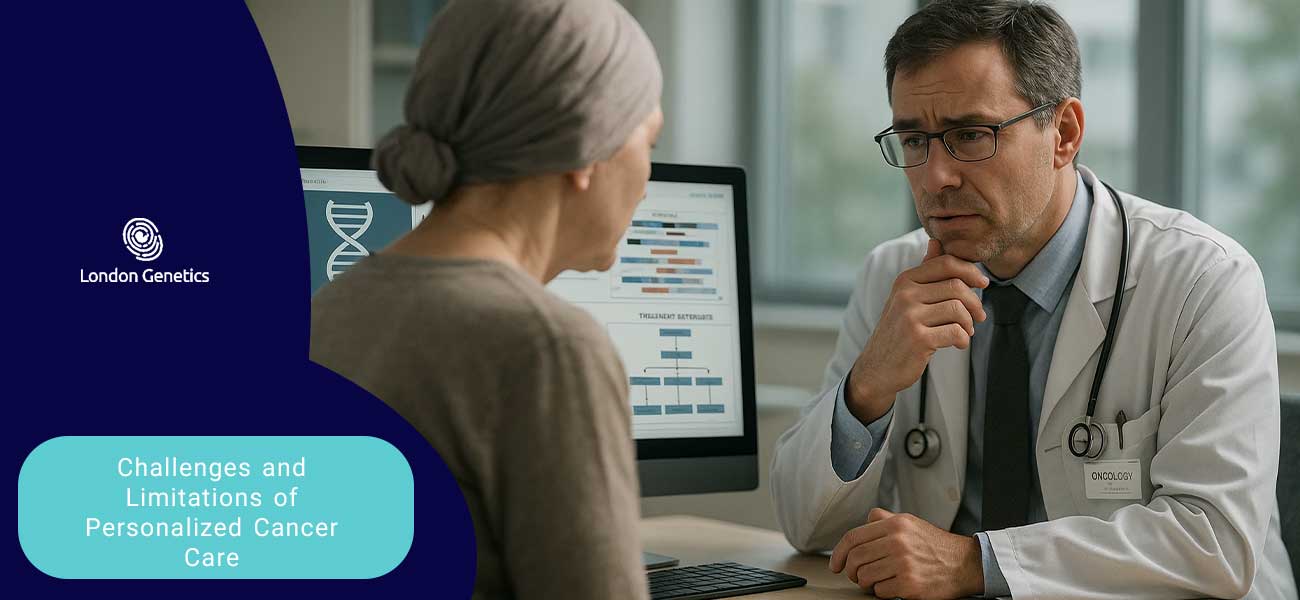
Challenges and Limitations of Personalized Cancer Care
Barriers to Widespread Implementation
While Personalized Cancer Care has transformed modern oncology by enabling more precise and targeted treatments, it is not without its challenges. Despite its promising potential, several scientific, clinical, and practical limitations still affect how widely and effectively personalised approaches can be implemented in routine cancer care.
Understanding these challenges is important for both healthcare professionals and patients, as it provides a realistic perspective on the current state of precision oncology.
• Limited Access to Advanced Testing
Genomic sequencing and comprehensive biomarker testing are essential components of Personalized Cancer Care. However, these technologies may not be widely available in all healthcare systems or regions. In some cases, limited laboratory infrastructure or specialised expertise can restrict access to advanced diagnostics.
• High Cost of Personalised Therapies
Many targeted therapies and immunotherapies used in Personalized Cancer Care are expensive. The cost of genomic testing, specialised drugs, and ongoing monitoring can create financial challenges for healthcare systems and patients, particularly in regions with limited insurance coverage.
• Complexity of Tumour Biology
Cancer is highly complex and constantly evolving. Even with detailed genomic analysis, a tumour may contain multiple mutations or change over time. This biological complexity can make it difficult to identify the most effective treatment or predict how the cancer will respond.
• Limited Targeted Treatment Options for Some Cancers
Although many targeted therapies have been developed, not all cancers currently have identifiable mutations that can be treated with existing drugs. In such cases, patients may still rely on traditional therapies such as chemotherapy or radiation.
• Data Interpretation and Clinical Expertise
Genomic testing can generate large volumes of complex data. Interpreting these results requires specialised knowledge in molecular oncology and bioinformatics. Without appropriate expertise, it can be challenging to translate genomic findings into practical treatment decisions.
• Potential for Treatment Resistance
Even when targeted therapies are initially effective, cancer cells can sometimes develop resistance over time. This means that treatment strategies may need to evolve as the tumour adapts, requiring ongoing monitoring and adjustments in therapy.
Despite these challenges, ongoing research, technological advances, and improved access to genomic medicine continue to expand the possibilities of Personalized Cancer Care. As scientific understanding grows and new therapies are developed, many of these limitations are expected to gradually diminish, making personalised oncology more accessible and effective for patients worldwide.
The Future of Personalized Cancer Care
Personalized Cancer Care represents a major shift in how cancer is diagnosed and treated. Rather than relying only on standardised treatment protocols, this modern approach focuses on the unique genetic, molecular, and clinical characteristics of each patient and their tumour.
By integrating genomic testing, biomarker analysis, and targeted therapies, personalised oncology aims to deliver treatments that are more precise, more effective, and better aligned with each individual’s needs.
Genomics‑Driven Treatment Decisions:
Advanced genetic testing helps identify the molecular drivers of cancer, enabling clinicians to select therapies that directly target the biological mechanisms behind tumour growth.
More Effective and Less Toxic Therapies:
By tailoring treatments to the patient’s tumour profile, personalised approaches can increase treatment effectiveness while reducing unnecessary side effects.
Overcoming Current Challenges:
Barriers such as cost, access to advanced testing, and tumour complexity remain important considerations, but ongoing scientific progress continues to improve accessibility and accuracy.
Rapid Advances in Precision Medicine:
New sequencing technologies, biomarker discoveries, and data‑driven tools are expanding the possibilities for personalised oncology across many cancer types.
Improving Global Cancer Outcomes:
As research continues and precision medicine becomes more widely available, Personalized Cancer Care is expected to play an increasingly important role in improving survival, treatment success, and quality of care for patients worldwide.