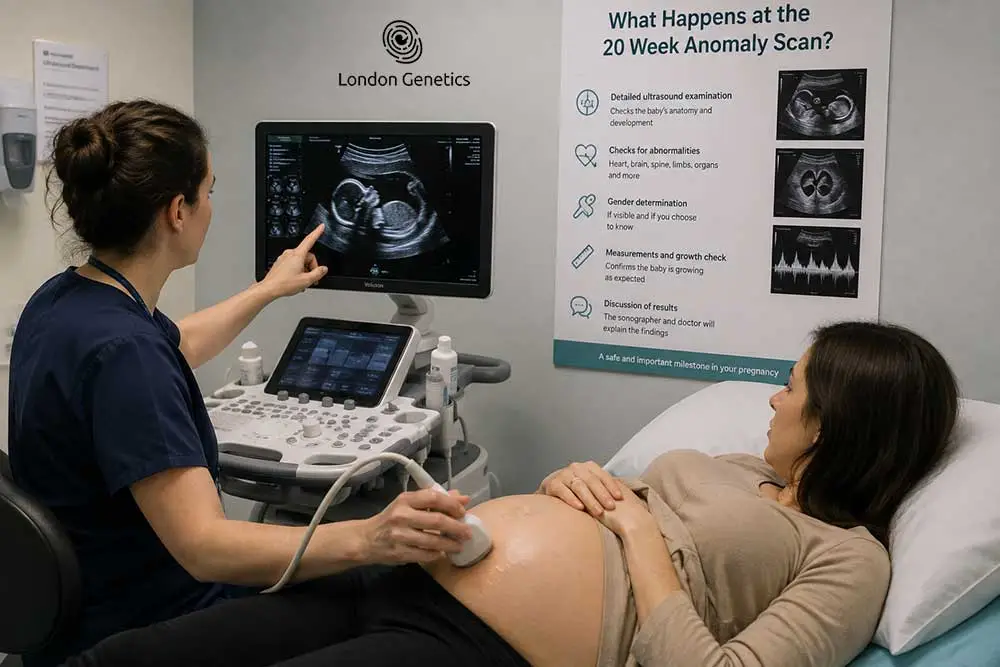
What Is the 20-Week Anomaly Scan?
The 20 Week Anomaly Scan is a routine ultrasound offered during the second trimester of pregnancy, usually between 18 and 21 weeks, with most appointments taking place around the 20-week mark. You may also hear it referred to as the mid-pregnancy scan or anatomy scan.
The main purpose of the 20 Week Anomaly Scan is to assess your baby’s growth and development while checking for any signs of structural abnormalities. It also provides valuable information about your pregnancy, including the position of the placenta, the amount of amniotic fluid, and your baby’s overall wellbeing.
Although this examination is an important part of routine antenatal care, it is a screening scan rather than a diagnostic test. This means it can identify signs that may require further investigation, but it cannot detect every condition or guarantee that a baby has no health concerns.
For most parents, the 20 Week Anomaly Scan is also an opportunity to see their baby in greater detail and gain reassurance that the pregnancy is progressing as expected. If the sonographer notices anything that requires closer assessment, you will be informed about the next steps and any additional tests that may be recommended.
What Does the Scan Actually Check For?
During the 20 Week Anomaly Scan, your baby undergoes a detailed ultrasound examination to assess growth, organ development, and overall wellbeing. The scan is designed to identify many structural abnormalities while also checking important aspects of the pregnancy itself.
The 20 Week Anomaly Scan provides one of the most comprehensive assessments of your baby’s development during pregnancy. While highly effective at detecting many structural abnormalities, it is important to remember that some conditions may not be visible on ultrasound or may develop later in pregnancy.
How to Prepare for Your Appointment
Preparing for your 20 Week Anomaly Scan is usually straightforward, and there is very little you need to do in advance. However, knowing what to expect can help you feel more relaxed and ensure your appointment runs smoothly. Your healthcare provider may give you specific instructions, so always follow the guidance provided by your maternity unit.
Drink Water If Advised
Some hospitals and ultrasound clinics recommend arriving with a comfortably full bladder, particularly if your appointment is earlier in pregnancy. A full bladder can sometimes improve the quality of the ultrasound images.
Before your appointment:
- Follow any instructions provided in your appointment letter.
- Drink the recommended amount of water if requested.
- Avoid drinking excessive amounts, as this may cause unnecessary discomfort.
- If no instructions are given, you can contact your maternity unit for advice.
Wear Comfortable Clothing
Choosing practical clothing can make your appointment easier and more comfortable.
It is recommended to wear:
- A loose-fitting top that can be lifted easily.
- Trousers or a skirt that sit below your abdomen.
- Comfortable shoes, especially if you need to walk through the hospital.
Since the sonographer will apply ultrasound gel to your abdomen, wearing clothing that allows easy access can help the examination proceed more efficiently.
Allow Plenty of Time
Although the 20 Week Anomaly Scan itself often takes around 30 to 45 minutes, the appointment may last longer depending on your baby’s position or if additional images are needed.
It’s a good idea to:
- Arrive 10–15 minutes early.
- Allow extra time for parking or hospital check-in.
- Avoid scheduling important commitments immediately afterwards.
Some babies are particularly active—or asleep in an awkward position—which may mean the sonographer needs more time to complete the assessment.
Bring Your Pregnancy Notes
If you have handheld maternity notes or pregnancy records, bring them with you unless your hospital has advised otherwise.
These documents may include:
- Your NHS or maternity records.
- Previous ultrasound reports.
- Relevant medical information.
- Any referral letters if applicable.
Having these available can help your healthcare team review your pregnancy history if needed.
Consider Bringing Your Partner or Support Person
Many hospitals allow your partner, family member, or another support person to attend the 20 Week Anomaly Scan, although local policies may vary.
Having someone with you can:
- Provide emotional support.
- Share the experience of seeing your baby.
- Help you remember any information discussed during the appointment.
If you plan to bring children, check your hospital’s policy beforehand, as some maternity units have restrictions.
Prepare Any Questions in Advance
It’s perfectly normal to have questions before your scan. Writing them down beforehand can help ensure you don’t forget anything during the appointment.
You might wish to ask about:
- How long the scan will take.
- Whether you can receive printed images.
- If the baby’s sex can be identified.
- What happens if the sonographer notices something unusual.
- When and how you will receive your results.
Stay Calm and Remember the Purpose of the Scan
It’s natural to feel a mixture of excitement and anxiety before the 20 Week Anomaly Scan. For most families, the scan provides reassurance that the pregnancy is progressing normally. In some cases, the sonographer may need extra time to obtain clear images or arrange further assessment if something requires closer examination.
Remember that needing additional tests does not necessarily mean there is a serious problem. Sometimes the baby’s position simply makes it difficult to complete all the routine checks during the first appointment.
Key Preparation Checklist
Before leaving for your appointment, make sure you have:
- ✔ Your appointment letter.
- ✔ Your maternity or pregnancy notes.
- ✔ Followed any instructions about drinking water.
- ✔ Worn comfortable, two-piece clothing.
- ✔ Allowed enough time to arrive without rushing.
- ✔ Prepared any questions you would like to ask your healthcare team.
Being well prepared can help your 20 Week Anomaly Scan go as smoothly as possible, allowing you to focus on one of the most important milestones of your pregnancy.
What Happens During the Scan?
The 20 Week Anomaly Scan is a safe, non-invasive ultrasound examination that carefully assesses your baby’s development. Understanding what happens during the appointment can help you feel more relaxed and prepared for the experience.
The 20 Week Anomaly Scan is one of the most important routine pregnancy assessments. It provides a detailed evaluation of your baby’s development while giving healthcare professionals the information they need to identify any findings that may require further investigation.
What If Something Unexpected Is Found?
Although most 20 Week Anomaly Scan results are reassuring, there are occasions when the sonographer identifies a finding that requires further assessment. This doesn’t necessarily mean your baby has a serious condition. In many cases, the finding may be minor, unclear, or simply require additional imaging because your baby’s position made part of the examination difficult to complete.
If an unexpected finding is detected during your 20 Week Anomaly Scan, your healthcare team will explain the results carefully and discuss the most appropriate next steps. Depending on the nature of the finding, you may be referred to a fetal medicine specialist for a more detailed ultrasound examination, or offered further investigations to better understand what’s been seen.
In some situations, diagnostic genetic testing may be recommended. Unlike screening tests, diagnostic tests are designed to determine whether a specific genetic or chromosomal condition is present. These investigations can provide more definitive answers, helping families and clinicians make informed decisions about pregnancy management, delivery planning, and any specialised care that may be needed after birth.
A range of diagnostic options may be considered depending on the clinical findings, including chromosomal microarray analysis, targeted gene panels, whole exome sequencing, or other genomic investigations. Your healthcare team or a clinical geneticist will recommend the most appropriate test based on your individual circumstances, explaining the benefits, limitations, and possible outcomes before any testing is carried out.
If you’d like to learn more about the available diagnostic options, including when they’re recommended and how they help identify underlying genetic conditions, visit our page on Congenital Abnormalities Genetic Testing. This guide explains the different testing methods, what results may mean, and how genetic testing supports personalised care for both parents and babies.
It’s important to remember that being offered additional tests after your 20 Week Anomaly Scan doesn’t automatically mean your baby has a genetic condition. Many pregnancies that require further assessment ultimately have positive outcomes. The purpose of follow-up investigations is to gather accurate information, so you receive the most appropriate care, support, and guidance throughout your pregnancy.
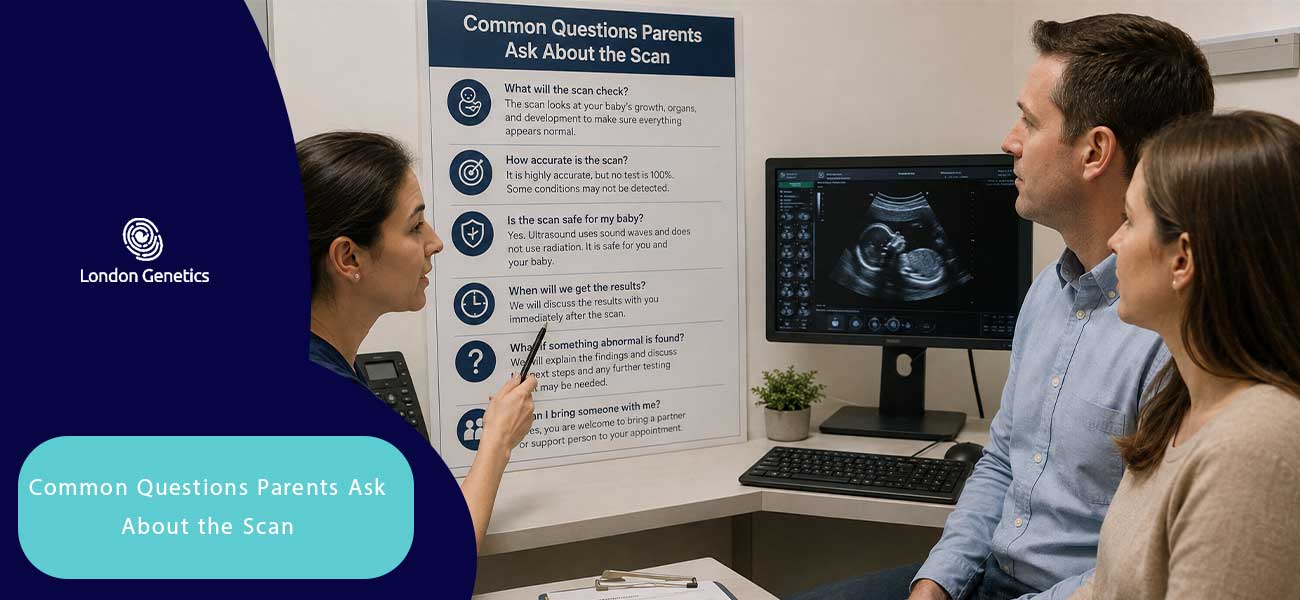
Common Questions Parents Ask About the Scan
It’s completely normal to have questions before your 20 Week Anomaly Scan. For many parents, this is one of the most anticipated appointments during pregnancy, bringing both excitement and uncertainty. Below are answers to some of the questions expectant parents ask most frequently.
Is the 20 Week Anomaly Scan Safe?
Yes. The 20 Week Anomaly Scan is considered a safe and routine ultrasound examination. It uses high-frequency sound waves to create images of your baby and does not involve radiation. Ultrasound has been used in pregnancy for many years and is regarded as safe when performed by trained healthcare professionals.
How Long Does the Scan Take?
Most 20 Week Anomaly Scan appointments last between 30 and 45 minutes. However, the examination may take longer if the sonographer needs additional images or if your baby is in a position that makes certain structures difficult to assess. Occasionally, you may be invited back for a repeat scan if not all the required views can be obtained during the first appointment.
Will I Be Able to See My Baby?
Yes. Throughout the 20 Week Anomaly Scan, you will usually be able to watch your baby on the ultrasound screen while the examination is taking place. Many parents find this to be a memorable and reassuring experience, although there may be moments when the sonographer remains quiet while concentrating on taking accurate measurements.
Can the Scan Tell Me My Baby’s Sex?
In many NHS hospitals and private clinics, it may be possible to identify your baby’s sex during the 20 Week Anomaly Scan, provided your baby is in a suitable position and local policy allows this information to be shared. However, the primary purpose of the scan is to assess your baby’s development rather than determine sex.
What If My Baby Won’t Stay Still?
There is no need to worry if your baby is particularly active—or refuses to move into the right position. This is very common during the 20 Week Anomaly Scan. The sonographer may ask you to change position, walk around for a few minutes, or return later in the appointment to obtain clearer images.
Will I Receive My Results Straight Away?
In most cases, the sonographer will let you know whether the scan appears normal before you leave. If further review is needed, your healthcare team will explain what has been seen and discuss whether any additional scans or investigations are recommended. Remember that needing further assessment does not necessarily mean there is a serious problem.
Can the Scan Detect Every Condition?
No. Although the 20 Week Anomaly Scan is very effective at identifying many structural abnormalities, no screening examination can detect every condition. Some abnormalities may be too subtle to see on ultrasound, while others may not develop until later in pregnancy or after birth. This is why the scan is described as a screening test rather than a definitive diagnostic test.
Key Points to Remember
Before attending your 20 Week Anomaly Scan, it is helpful to keep the following points in mind:
- The scan is a routine part of antenatal care.
- It is designed to assess your baby’s growth and physical development.
- Most scan results are reassuring.
- The appointment usually lasts around 30–45 minutes.
- Additional tests are only recommended if further assessment is needed.
- The scan cannot detect every condition, even when the results are normal.
Understanding what to expect from the 20 Week Anomaly Scan can help you feel more confident and prepared, allowing you to focus on this important milestone in your pregnancy with greater peace of mind.
Summary: Key Takeaways About the 20-Week Scan
The 20 Week Anomaly Scan is one of the most important routine ultrasound examinations during pregnancy. Performed between 18 and 21 weeks, it provides a detailed assessment of your baby’s development while checking for many structural abnormalities and monitoring the overall health of your pregnancy.
For most families, the scan offers reassurance that pregnancy is progressing normally. Although it can identify many conditions before birth, it is important to remember that it is a screening examination and cannot detect every abnormality. If any concerns are identified, your healthcare team will explain the findings and discuss any recommended follow-up investigations.
Book Your Consultation with Dr Karimiani