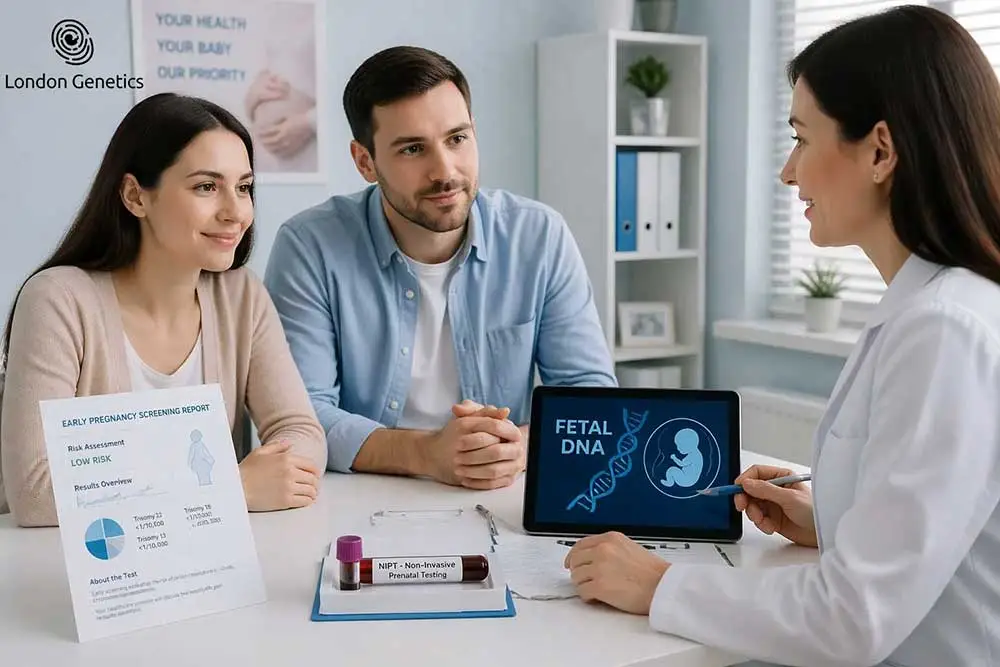
Introduction to Early Pregnancy Screening and Fetal DNA Testing
Pregnancy Screening plays a vital role in modern maternity care, helping healthcare professionals assess the health and development of a fetus during the early stages of pregnancy. These screening approaches are designed to estimate the likelihood of certain genetic or chromosomal conditions, allowing clinicians and expectant parents to make informed decisions about further evaluation and care. In the United Kingdom and many other healthcare systems, early pregnancy screening forms a routine part of antenatal services and supports proactive maternal and fetal health management.
One of the most significant advances in this field is fetal DNA testing, often referred to as non‑invasive prenatal testing (NIPT). This method analyses small fragments of fetal DNA circulating in the mother’s bloodstream, enabling clinicians to screen for specific chromosomal abnormalities without invasive procedures. As part of broader Prenatal Genetic Testing, fetal DNA analysis has improved the accuracy and safety of early pregnancy assessments, offering valuable insights into conditions such as Down syndrome and other chromosomal variations.
The integration of advanced Genetic Testing technologies into pregnancy screening has transformed how potential genetic risks are evaluated. By combining blood tests, ultrasound measurements, and DNA‑based analysis, clinicians can obtain a clearer picture of fetal health while minimising risk to both mother and baby. These developments have strengthened the role of pregnancy screening as an essential component of contemporary obstetric care.
Overall, early pregnancy screening and fetal DNA testing provide expectant parents with important information during the earliest stages of pregnancy. When interpreted carefully and supported by appropriate clinical guidance, these screening methods contribute to more informed decision‑making, improved prenatal care, and better outcomes for families.
Overview of Pregnancy Screening: Aims, Timing, and Key Concepts
Pregnancy screening is an essential part of routine antenatal care, providing early insights into fetal development and potential health concerns. Rather than delivering a definitive diagnosis, screening assesses the likelihood of certain chromosomal, genetic, or structural conditions. By estimating risk levels early in pregnancy, these tests help clinicians and expectant parents make informed decisions about follow‑up investigations and personalised prenatal care.
Pregnancy screening offers an early, structured approach to assessing fetal health risks, helping families and clinicians navigate prenatal care with clearer information and appropriate follow‑up options.
Fetal DNA Testing and NIPT: How It Works and What It Detects
In recent years, fetal DNA testing has become one of the most significant advances in Pregnancy Screening, offering a highly accurate and non‑invasive way to assess the risk of certain chromosomal conditions during early pregnancy. This approach, commonly known as Non‑Invasive Prenatal Testing (NIPT), analyses small fragments of fetal genetic material that circulate naturally in the mother’s bloodstream.
How Fetal DNA Testing Works
During pregnancy, tiny fragments of DNA from the placenta—often referred to as cell‑free fetal DNA (cffDNA)—enter the maternal circulation. From around the 10th week of pregnancy, these fragments can be detected and analysed through a simple maternal blood sample. Laboratory specialists use advanced genomic sequencing and bioinformatics techniques to examine the DNA and determine whether there are abnormal numbers of specific chromosomes.
Because the test only requires a blood sample from the mother, it avoids the risks associated with invasive diagnostic procedures such as amniocentesis or chorionic villus sampling (CVS). This makes NIPT a safer screening option for many pregnancies while still providing highly reliable risk assessment.
What NIPT Can Detect
NIPT is primarily designed to screen for common chromosomal abnormalities, including:
- Trisomy 21 (Down syndrome)
- Trisomy 18 (Edwards syndrome)
- Trisomy 13 (Patau syndrome)
In some cases, expanded panels may also screen for sex chromosome abnormalities, such as Turner syndrome (monosomy X), and may provide information about the fetal sex. Certain advanced tests may also evaluate selected microdeletions, although these are not always part of routine screening programmes.
Role Within Pregnancy Screening
Although NIPT is highly accurate, it is still considered a screening test rather than a diagnostic test. A high‑risk result usually requires confirmation through diagnostic procedures such as CVS or amniocentesis. Nevertheless, the introduction of fetal DNA testing has significantly improved the effectiveness of modern pregnancy screening by providing earlier and more precise risk estimates.
Overall, NIPT has transformed prenatal care by combining advanced genomic technology with a non‑invasive approach, allowing clinicians and expectant parents to gain valuable genetic insights during the early stages of pregnancy.
Genetic and Chromosomal Conditions Screened in Early Pregnancy
Early pregnancy screening provides important insights into fetal development by estimating the likelihood of specific genetic and chromosomal conditions. While these tests are not diagnostic, they help identify pregnancies that may benefit from further, more definitive evaluation. With advances in non‑invasive prenatal testing (NIPT) and improved ultrasound techniques, clinicians can now assess a broader range of conditions earlier and with greater accuracy than ever before.

Early risk assessment supports informed prenatal decision‑making.

Early screening primarily assesses chromosomal abnormalities caused by an atypical number of chromosomes. The most commonly evaluated conditions include:
- Trisomy 21 (Down syndrome): Associated with intellectual disability and characteristic physical features.
- Trisomy 18 (Edwards syndrome): Linked to severe developmental and medical complications.
- Trisomy 13 (Patau syndrome): A rare but serious condition affecting multiple organ systems.
These trisomies represent the central targets of most first‑trimester screening programmes and NIPT.

Some screening methods, particularly NIPT, can identify variations in the number of sex chromosomes. Examples include:
- Monosomy X (Turner syndrome)
- Triple X syndrome (XXX)
- Klinefelter syndrome (XXY)
Clinical features vary widely, and screening provides an early indication for potential follow‑up assessment.

In combination with ultrasound and biochemical screening, early pregnancy assessments may indicate structural concerns such as:
- Neural tube defects (e.g., spina bifida)
- Major congenital heart anomalies
- Abdominal wall defects
These findings are often identified through imaging rather than DNA‑based methods alone.
Key Takeaway:
Early pregnancy screening evaluates a wide spectrum of chromosomal, genetic, and structural conditions. By identifying potential concerns at an early stage, it enables timely counselling, informed decision‑making, and appropriate follow‑up care for expectant families.
Benefits, Limitations, and Accuracy of Modern Pregnancy Screening
Modern Pregnancy Screening has evolved considerably over the past two decades, combining biochemical markers, detailed ultrasound assessment, and advanced DNA‑based technologies. These developments have significantly improved early risk detection for genetic and chromosomal conditions. However, while the benefits are substantial, it is equally important to understand the limitations and realistic expectations of screening tests.
Benefits of Modern Pregnancy Screening
One of the principal advantages of contemporary screening methods is early risk assessment. Conditions such as trisomy 21, trisomy 18, and trisomy 13 can often be identified with a high degree of sensitivity from as early as 10 weeks of pregnancy.
Additional benefits include:
- Non‑invasive testing options, particularly NIPT, which require only a maternal blood sample
- Improved accuracy compared with older serum‑only screening models
- Reduced need for invasive diagnostic procedures in low‑risk cases
- Earlier reassurance for many expectant parents
- Better preparation and care planning when a higher risk is identified
From a clinical perspective, these improvements support safer, more informed antenatal decision‑making.
Limitations of Pregnancy Screening
Despite its strengths, pregnancy screening is not without limitations. Most importantly, screening tests are not diagnostic. They estimate probability rather than confirm the presence or absence of a condition.
Key limitations include:
- False positives, where a test indicates high risk but the fetus is unaffected
- False negatives, where a condition is present but not detected
- Limited scope, as not all genetic or structural conditions are screened
- Biological factors, such as low fetal fraction in NIPT, which may affect reliability
- Maternal factors, including weight, twin pregnancies, or certain medical conditions, which can influence results
Because of these limitations, high‑risk results typically require confirmation through diagnostic testing such as amniocentesis or chorionic villus sampling (CVS).
Understanding Accuracy
When discussing accuracy, it is helpful to distinguish between sensitivity, specificity, and positive predictive value (PPV):
- Sensitivity refers to the test’s ability to correctly identify affected pregnancies.
- Specificity reflects how well the test correctly identifies unaffected pregnancies.
- Positive predictive value indicates the likelihood that a high‑risk result truly represents an affected pregnancy, which depends partly on maternal age and background risk.
For example, NIPT demonstrates very high sensitivity and specificity for trisomy 21, often exceeding 99% in controlled studies. However, PPV can vary depending on population risk factors.
A Balanced Perspective
Modern pregnancy screening offers considerable reassurance and valuable early insight, yet it must be approached with clear counselling and informed consent. Understanding both the benefits and the limitations ensures that parents interpret results appropriately and avoid unnecessary anxiety or false reassurance.
In essence, modern Pregnancy Screening represents a powerful clinical tool—most effective when combined with careful interpretation, appropriate follow‑up, and supportive professional guidance.
Counselling, Informed Choice, and Ethical Considerations for Parents
Modern Pregnancy Screening not only provides medical information but also raises important questions about decision‑making, communication, and ethical responsibility. Because screening results may influence further testing or pregnancy management, appropriate counselling and informed choice are essential components of high‑quality prenatal care.
The Role of Genetic Counselling
Genetic counselling plays a crucial role in helping expectant parents understand the purpose, process, and possible outcomes of pregnancy screening. Before testing, healthcare professionals should clearly explain what the screening assesses, how results are interpreted, and what follow‑up options may exist if a higher risk is identified.
Effective counselling ensures that parents understand that screening tests estimate probability rather than certainty. This distinction helps prevent misunderstanding and unnecessary anxiety while preparing families for potential next steps such as diagnostic testing.
After results are received, counselling also supports parents in interpreting the findings and discussing possible clinical pathways, including additional testing, monitoring, or specialist referral.
Informed Choice and Parental Autonomy
A key ethical principle in prenatal screening is informed choice. Parents should have the opportunity to decide whether or not to undergo screening based on clear, balanced information. This includes understanding:
- what conditions are being screened
- the accuracy and limitations of the tests
- possible follow‑up procedures
- the implications of different results
Respecting parental autonomy means that participation in screening should always remain voluntary, and decisions should be free from pressure or assumptions.
Ethical Considerations in Prenatal Screening
As screening technologies become increasingly sophisticated, ethical considerations continue to evolve. Early access to genetic information can be highly beneficial, yet it also raises complex questions about how such information is used and interpreted.
Some important ethical aspects include:
- Managing uncertainty, particularly when results identify variants or findings with unclear significance
- Ensuring equitable access to screening and counselling services
- Avoiding discrimination or stigma related to genetic conditions
- Supporting parents emotionally as they navigate difficult decisions
Healthcare providers must approach these issues with sensitivity, cultural awareness, and a commitment to balanced communication.
Supporting Families Through Decision‑Making
Ultimately, the goal of counselling in pregnancy screening is not to direct parents toward a particular decision but to support informed and thoughtful choices. When information is presented clearly and compassionately, parents are better equipped to consider their personal values, family circumstances, and medical advice.
In this way, counselling, informed consent, and ethical awareness form a vital foundation for responsible and patient‑centred prenatal screening programmes.
The Future of Pregnancy Screening and Personalised Prenatal Care
Advances in genomic technologies are gradually transforming how pregnancy screening is performed and interpreted. Future screening programmes are expected to move beyond traditional population‑based models toward more personalised risk assessment. By integrating genetic information with maternal age, medical history, environmental factors, and emerging biomarkers, clinicians will be able to provide more tailored evaluations of fetal health.
This personalised approach has the potential to improve early detection of possible health concerns while reducing unnecessary testing for pregnancies that carry a very low level of risk.
Personalised Prenatal Risk Assessment:
Future screening strategies may combine genomic data with maternal health information and other biomarkers to provide more individualised evaluations of pregnancy risk.
More Targeted Testing:
By refining risk estimates, personalised screening approaches could help minimise unnecessary procedures while ensuring that higher‑risk pregnancies receive timely and appropriate diagnostic follow‑up.
Ethical and Clinical Responsibility:
As screening technologies expand, interpreting complex or uncertain findings will require careful clinical judgment and sensitive communication with families.
The Role of Genetic Counselling:
Ongoing investment in genetic counselling and clear clinical guidelines will remain essential to support informed decision‑making and responsible use of advanced prenatal technologies.
Looking Ahead:
The future of pregnancy screening lies at the intersection of genomics, digital health, and precision medicine—offering earlier insights into fetal health, more informed pregnancy management, and improved outcomes for families.