
What Is an Autism Assessment?
An autism assessment is a thorough evaluation carried out by trained specialists to determine whether someone meets the criteria for Autism Spectrum Disorder (ASD). Rather than a single test or quick questionnaire, it’s a comprehensive process that looks at behaviour, communication, and development over time, drawing on multiple sources of information rather than a single snapshot.
In the UK, assessments are typically carried out by a multidisciplinary team, which might include a paediatrician, clinical psychologist, speech and language therapist, and occupational therapist, depending on the person’s age and individual circumstances. This team-based approach helps ensure a well-rounded, accurate picture, rather than relying on the judgement of a single professional.
The purpose of an autism assessment isn’t simply to attach a label. A proper diagnosis opens the door to appropriate support, whether that’s educational adjustments, therapeutic interventions, or simply a clearer understanding of how a person experiences the world. For many families, it also brings genuine relief, offering an explanation for behaviours or challenges that may previously have felt confusing or difficult to make sense of.
Assessments can take place at any age, from early childhood through to adulthood, and the process, while broadly similar in structure, is generally tailored to reflect the person’s age and specific circumstances.
Signs That Might Prompt an Assessment
Recognising the signs that might lead to an autism assessment can vary considerably from person to person, since autism presents differently depending on age, individual traits, and how symptoms are expressed.
Recognising these signs isn’t about labelling someone, but about opening the door to understanding and appropriate support.
How to Get an Autism Assessment in the UK
There are two main routes to accessing an autism assessment in the UK, and understanding both can help you decide which path suits your circumstances best.
The NHS Route
For most people, the process begins with a conversation with a GP or, for children, a health visitor or school SENCO (Special Educational Needs Coordinator). If they agree an assessment seems appropriate, they’ll refer you to a specialist NHS service, sometimes called a Child Development Service for children, or an adult autism diagnostic service for grown-ups.
It’s worth being upfront: NHS waiting times for an autism assessment can be considerably longer than many families expect, sometimes stretching well beyond a year in certain areas, largely due to high demand across the country. It’s still absolutely worth pursuing, as NHS assessments are provided free of charge and follow rigorous clinical standards.
The Private Route
Many families choose to pursue a private autism assessment, either alongside an NHS referral or independently, primarily to avoid lengthy waiting times. Private assessments are typically carried out by qualified clinical psychologists or psychiatrists and can often be arranged within a matter of weeks rather than months.
It’s important to ensure any private provider is properly regulated and that clinicians are appropriately qualified, since diagnoses from reputable private assessments are generally recognised by schools, employers, and the NHS itself.
Which Route Is Right for You?
There’s no single “correct” choice; it largely depends on how quickly you need answers, your financial circumstances, and personal preference. Some families begin with an NHS referral to join the waiting list, while simultaneously exploring private options should waiting become impractical.
What Happens During the Assessment Process
While the exact structure can vary slightly between services, most autism assessments in the UK follow a broadly similar pattern, involving several stages rather than a single appointment.
Throughout the entire autism assessment process, the aim is to build as complete and accurate a picture as possible, rather than reaching a conclusion based on a single interaction or observation.
How Long Does an Autism Assessment Take?
One of the most common questions families ask is simply how long an autism assessment actually takes, and the honest answer is that it varies considerably depending on the route chosen and where in the UK you’re based.
NHS Waiting Times
Referral-to-assessment waiting times through the NHS have grown substantially in recent years, with search interest in “autism assessment” itself recently reaching record levels across the UK, reflecting just how many families are currently navigating this process. In many areas, it’s not unusual for the wait between referral and a first appointment to extend well beyond 12 months, and in some regions, considerably longer still.
The Assessment Itself
Once the process actually begins, the assessment stage typically takes anywhere from a few weeks to a few months to complete, depending on how many appointments are required and how quickly information from schools or other sources can be gathered.
Private Assessment Timeframes
By comparison, a private autism assessment can often be completed considerably faster, sometimes within four to eight weeks from initial enquiry through to a full diagnostic report, since private providers generally have more capacity and fewer competing demands on clinician time.
Why the Wait Matters
Long waiting times aren’t simply an inconvenience; they can mean a considerable delay in accessing appropriate support, whether that’s at school, at work, or within the family more broadly. This is precisely why many families choose to explore the private route, particularly when a child’s needs feel pressing or waiting periods stretch into years rather than months.
Whatever route you take, it’s worth remembering that patience, while difficult, doesn’t affect the accuracy of the eventual diagnosis — a longer wait doesn’t mean a less thorough or less valid assessment.
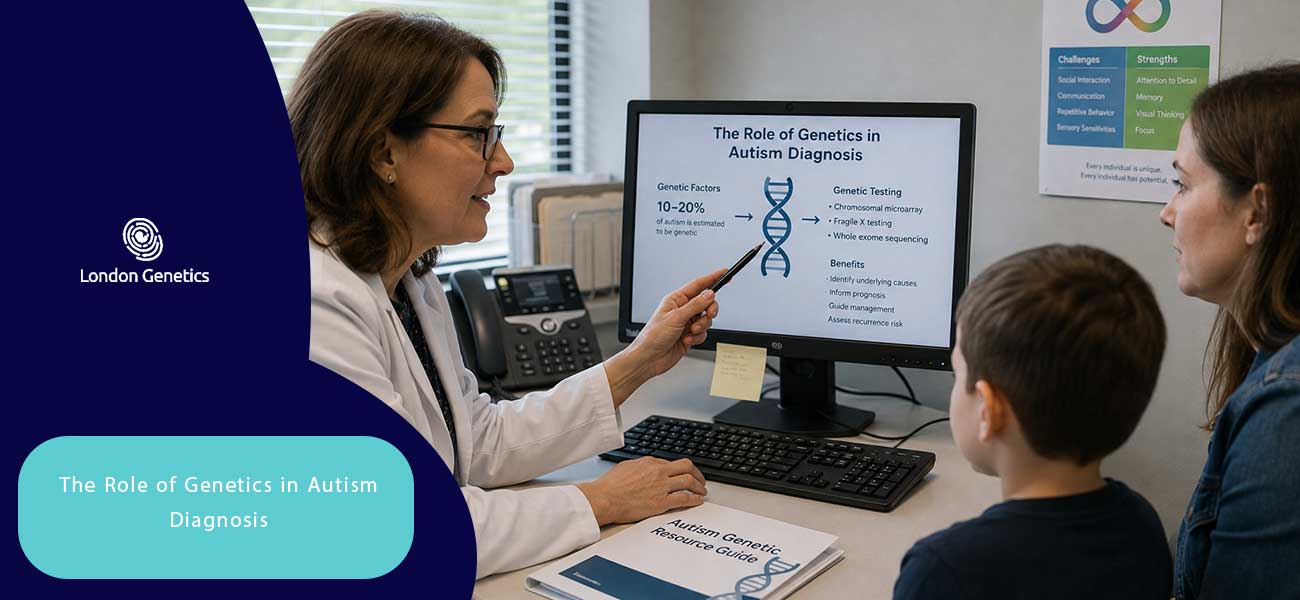
The Role of Genetics in Autism Diagnosis
While an autism assessment itself relies on behavioural observation and developmental history rather than a genetic test, genetics plays a significant, and increasingly recognised, role in the bigger picture surrounding a diagnosis.
Autism Runs in Families
Research consistently shows that autism has a strong hereditary component, with studies of identical twins showing considerably higher rates of shared diagnosis compared to non-identical twins. Families with one autistic child also face a notably higher likelihood of a sibling also being on the spectrum, reflecting just how significant genetic factors are believed to be.
Genetic Testing Doesn’t Replace an Assessment
It’s worth being clear: genetic testing cannot diagnose autism on its own, and an autism assessment remains the recognised route to formal diagnosis. However, genetic testing can identify specific rare mutations or genetic variations associated with autism in some individuals, offering additional context alongside a clinical diagnosis, particularly when other developmental concerns are also present.
Why This Additional Insight Can Matter
For some families, understanding whether a specific genetic factor is involved can help explain co-occurring conditions, clarify recurrence risk for future children, and guide more personalised approaches to therapy and support. It can also, for many parents, offer a sense of explanation, moving from “why” towards a clearer understanding of their child’s unique profile.
Exploring the Genetics Behind a Diagnosis
For families wanting to understand this dimension more fully, Genetics of Autism explores the specific genes and inheritance patterns currently understood to be involved, offering a deeper, complementary layer of insight alongside the clinical autism assessment process itself.
After the Assessment: What Happens Next?
Completing an autism assessment is often a significant moment, but it’s really the beginning of a new chapter rather than an endpoint. What happens next depends largely on the outcome, but there are some common paths worth understanding.
Ultimately, the assessment itself is just one part of a much longer journey, one that, with the right support in place, can lead to genuinely better understanding, accommodation, and quality of life.
Book Your Consultation with Dr Karimiani