Breast Cancer Prevention and Inherited Cancer Risk
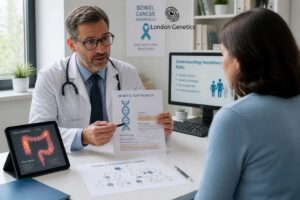
Breast cancer prevention begins with understanding an individual’s overall risk. For some women, risk is influenced mainly by age, hormonal factors and other non-inherited factors, while for others, a significant family history or an inherited genetic predisposition may indicate a substantially higher risk.
This distinction is important because women at increased inherited risk may require a different approach to prevention and early detection. Depending on the underlying risk, this can include personalised surveillance, breast imaging, risk-reducing medication or, in selected high-risk cases, preventive surgery.
Inherited breast cancer risk can also form part of a wider pattern of genetics-related cancers within a family. Breast cancer may occur alongside other cancers associated with inherited cancer predisposition, meaning that assessing the family history as a whole can provide important context when determining an individual’s risk.
For a broader overview of how inherited genetic changes can contribute to different types of cancer, including breast, ovarian, prostate and other cancers, see our guide to Genetics Related Cancers.
The purpose of breast cancer prevention is therefore not simply to identify a genetic variant. It is to understand the individual’s overall level of risk and use that information to determine the most appropriate strategy for prevention and early detection.
| Clinical Feature | Sporadic Breast Cancer | Hereditary Breast Cancer |
|---|---|---|
| Typical Age of Onset | Risk generally increases with age and is more common after menopause, although breast cancer can occur at any age. | Breast cancer may occur at a younger age, particularly in families with a significant inherited predisposition, although the age of onset varies between individuals and families. |
| Familial Pattern | Usually occurs without a clear pattern of early-onset breast or related cancers affecting several generations of the family. | May be associated with a pattern of breast and other related cancers occurring across generations, particularly when cancers develop at younger ages. |
| Tumour Presentation | More commonly presents as a single, unilateral tumour, with the tumour subtype determined by its individual biological characteristics. | There may be a greater likelihood of bilateral or multiple primary breast cancers. Certain inherited predispositions may also be associated with particular tumour subtypes. |
| Genetic Contribution | Usually reflects a combination of age-related, hormonal, environmental and lifestyle factors rather than an established inherited cancer-predisposition variant. | May be associated with an inherited pathogenic variant affecting cancer susceptibility. The specific genetic cause and associated level of risk can vary between individuals and families. |
| Risk to Family Members | Close relatives may still share some background risk through common genetic, environmental or lifestyle factors, but there is usually no established single-gene inheritance pattern. | Where an inherited pathogenic variant is confirmed, close relatives may also have an increased risk. Appropriate relatives may benefit from individualised genetic assessment and risk management. |
| Prevention and Early Detection | Prevention generally focuses on healthy lifestyle measures, participation in routine breast screening and consideration of additional personal risk factors. | Management may involve personalised risk assessment, enhanced breast surveillance, risk-reducing medication or preventive surgery in selected high-risk individuals. |
Other Inherited Risk Factors and Breast Cancer Prevention
BRCA1 and BRCA2 are among the best-known inherited factors associated with breast cancer risk, but they are not the only factors that may contribute to an increased risk. Other inherited cancer-predisposition variants can also influence an individual’s lifetime breast cancer risk, although the level of risk and the appropriate clinical management can vary considerably.
For this reason, breast cancer prevention should not be based on a single gene or genetic result alone. A comprehensive assessment considers the individual’s personal and family history alongside any relevant genetic findings.
How Inherited Risk Can Influence Prevention
When an inherited predisposition is identified, the focus is usually on understanding how that finding changes the individual’s overall breast cancer risk and whether standard screening is sufficient.
Depending on the level of risk, prevention and early-detection strategies may include:
- More frequent or earlier breast screening
- Additional imaging such as breast MRI where clinically appropriate
- Individualised assessment of risk-reducing medication
- Discussion of risk-reducing surgery for selected individuals with substantially increased risk
- Review of other personal and family risk factors
- Ongoing review as clinical circumstances and evidence evolve
Not everyone with an inherited risk factor will require the same approach. Management should be tailored to the individual’s estimated risk, age, family history, previous breast health and personal circumstances.
When Genetic Assessment May Be Relevant
Genetic assessment may be considered when a personal or family history suggests a possible inherited predisposition to breast cancer. Features such as breast cancer at a young age, multiple affected relatives, bilateral breast cancer, male breast cancer or a combination of breast and other related cancers may warrant further assessment.
Where genetic testing is appropriate, the result should be interpreted within the wider clinical context rather than considered in isolation. A genetic finding does not automatically determine whether a person will develop breast cancer, nor does the absence of a recognised variant necessarily mean that hereditary risk has been completely excluded.
For patients with a potentially increased inherited risk, the aim of genetic assessment is therefore not simply to identify a gene. It is to provide a clearer understanding of overall risk and use that information to guide appropriate prevention and surveillance.
For more detailed information about hereditary cancer assessment and genetic testing, see our pages on [Cancer Genetic Testing] and [Targeted Gene Panels].
The next step in breast cancer prevention is to assess the individual’s overall risk and determine whether standard screening or a more personalised surveillance strategy is appropriate.
Family History Red Flags: Who Qualifies for High-Risk Breast Cancer Prevention?
Identifying individuals who qualify for an intensified programme of breast cancer prevention begins with a systematic evaluation of familial pedigree. Certain clinical patterns—termed family history red flags—signal the potential presence of an underlying germline mutation, shifting clinical management from population-level screening to targeted, high-risk surveillance and risk-reducing interventions.
Early-Onset Malignancies (Under 50 Years)
Because breast cancer is primarily an age-related condition, a diagnosis established before the age of 50 serves as a critical indicator of an inherited cancer predisposition. Pre-menopausal diagnoses, along with bilateral primary breast malignancies or multifocal lesions, strongly warrant formal assessment.
When a young diagnosis is present in the lineage, proactive breast cancer prevention protocols are typically initiated up to ten years earlier than the youngest affected relative, allowing early detection modalities to circumvent traditional screening thresholds.
First-Degree Relatives & Multi-Generational Clustering
A consistent clustering of malignancies across direct generations—particularly involving first-degree relatives such as a mother, sister, or daughter—markedly escalates lifetime risk. This multi-generational pattern frequently extends to genetically linked tumours, including epithelial ovarian, fallopian tube, high-grade prostate, or pancreatic cancers.
Assessing the cumulative burden of disease within both maternal and paternal bloodlines ensures that candidates for advanced breast cancer prevention are identified before symptomatic presentation occurs.
Male Breast Cancer & Ancestral Risk Factors
Male breast cancer is an exceptionally rare pathology in the general population, making a single occurrence across the pedigree a major clinical red flag that strongly implicates a high-penetrance gene alteration, notably within BRCA2 or PALB2.
Furthermore, specific ancestral backgrounds—such as individuals of Ashkenazi Jewish heritage—exhibit a substantially higher prevalence of founder mutations. Recognising these distinctive risk determinants allows clinicians to fast-track tailored breast cancer prevention pathways and diagnostic genetic evaluations.
Timely risk stratification transforms clinical outcomes. Recognising early-onset disease, familial clusters, or male breast cancer within your family tree is essential to establishing your clinical risk tier. When red flags are present, entering a structured programme of breast cancer prevention enables personalised surveillance, pharmacogenomic protection, and informed decision-making.
Tailored Surveillance and Early Detection in Breast Cancer Prevention
Standard population screening pathways are designed for baseline risk, typically offering three-yearly mammograms to women aged 50 to 71. However, an effective strategy for breast cancer prevention in women with an inherited predisposition or strong familial clustering requires earlier, more frequent, and technologically advanced imaging protocols. In the UK, clinical guidelines established by the National Institute for Health and Care Excellence (NICE) outline specific surveillance tiers to intercept disease at its earliest, most curable stage.
For individuals stratified into the high-risk category—including confirmed carriers of pathogenic BRCA1, BRCA2, or PALB2 variants—conventional mammography alone is insufficient. Due to higher baseline breast tissue density in younger pre-menopausal women, mammographic sensitivity is considerably reduced. Consequently, high-risk breast cancer prevention surveillance incorporates annual contrast-enhanced breast magnetic resonance imaging (MRI), typically commencing between the ages of 30 and 35. MRI demonstrates superior diagnostic sensitivity in dense glandular tissue, effectively detecting rapidly growing tumours that might otherwise present as interval cancers between routine screenings.
As women advance in age, surveillance protocols transition to combined modalities. Between ages 40 and 50, annual breast MRI is commonly paired with annual digital mammography, providing a dual-modality safety net that assesses both structural parenchymal changes and subtle microcalcifications. Conversely, for individuals with specific genetic alterations such as TP53 mutations (Li-Fraumeni syndrome), surveillance protocols strictly avoid ionizing radiation, relying exclusively on annual contrast-enhanced MRI to minimise secondary radiation-induced malignancy risks.
Determining whether an individual qualifies for this high-surveillance pathway relies on objective risk calculation. Rather than relying on subjective family accounts, clinicians utilize formal statistical algorithms to quantify cumulative lifetime breast cancer risk. To understand how clinical algorithms assess familial pedigree, hormone factors, and tissue density to determine surveillance eligibility, explore our guide to What is the Tyrer-Cuzick Model? Calculating Your Breast Cancer Risk. Through precision risk calculation and tailored UK surveillance protocols, proactive surveillance shifts breast cancer prevention from reactive observation to structured, life-saving clinical management.
Clinical Interventions for Breast Cancer Prevention
For individuals identified as high-risk through genetic evaluation, surveillance is only one component of a proactive strategy. Clinical breast cancer prevention often necessitates active medical or surgical interventions designed to significantly lower the lifetime probability of developing malignancy, guided by a multidisciplinary assessment of your specific risk profile.
 Hover over each box to understand the clinical options!

Selective Estrogen Receptor Modulators (SERMs)

Aromatase Inhibitors

Prophylactic Mastectomy

Risk-Reducing Salpingo-Oophorectomy (RRSO)

Multidisciplinary Team (MDT) Review

Informed Decision-Making
Interventions are highly personalised. There is no “standard” path. Whether through chemoprevention or surgical risk reduction, clinical management is strictly dictated by the gene involved, your age, and your family’s unique pedigree.
Navigating Inherited Risk: Breast Cancer Prevention and Clinical Genetics
For women with a family history of breast cancer or a confirmed inherited risk, prevention should extend beyond identifying a genetic variant. The key is to translate that risk into a personalised plan for breast cancer prevention, surveillance and, where appropriate, risk-reducing strategies. This requires consideration of both sides of the family and the wider pattern of cancers within the family.
At London Genetics, Dr Ehsan Ghayoor Karimiani integrates genetic findings with personal and family history to help determine the most appropriate next steps. Depending on the level and nature of inherited risk, this may include personalised surveillance, further genetic assessment, or discussion of risk-reduction options. The aim is to ensure that genetic information leads to clear and clinically relevant decisions rather than uncertainty.
Inherited cancer risk can also extend beyond breast cancer. Where a genetic predisposition may be associated with several cancer types, understanding the wider implications can help ensure that prevention and surveillance are appropriately coordinated. Further information on the broader relationship between inherited genetic risk and cancer is available in our guide to Genetics Related Cancers.
If you have a significant family history of cancer or have concerns about an inherited risk of breast cancer, a clinical genetics assessment can help clarify your individual risk and identify appropriate preventive measures. Dr Ehsan Ghayoor Karimiani can provide personalised guidance based on your family history, genetic information and individual circumstances.
Frequently Asked Questions About Breast Cancer Prevention
Can breast cancer be prevented if I have a strong family history?
A strong family history does not mean that breast cancer will definitely develop, but it may indicate a higher level of risk. Understanding your personal and family history can help determine whether enhanced surveillance, genetic assessment or other risk-reduction strategies may be appropriate.
Can inherited breast cancer risk come from my father’s side of the family?
Yes. Inherited risk can be passed through either the maternal or paternal side of the family. When assessing breast cancer risk, it is therefore important to consider cancer history across both sides of your family rather than focusing only on your mother’s relatives.
When should I consider genetic assessment for breast cancer risk?
Genetic assessment may be appropriate when there is a significant pattern of breast or related cancers in your family, particularly when cancers have occurred at younger ages or in several close relatives. A clinical assessment can help determine whether genetic testing or additional risk assessment would be useful.
Does having a genetic risk mean I will develop breast cancer?
No. An inherited predisposition can increase the likelihood of developing breast cancer, but it does not mean that cancer is inevitable. Individual risk varies, and prevention and surveillance strategies can be tailored according to personal circumstances and family history.
What can I do to reduce my risk of breast cancer?
Risk reduction depends on your individual level of risk. Depending on your circumstances, it may involve appropriate breast screening, lifestyle measures, closer clinical surveillance or discussion of medical and surgical risk-reducing options. A personalised assessment is important before deciding which approach is appropriate.
How does breast cancer screening change when someone has an increased risk?
Women with an increased risk may require a different surveillance approach from that used for the general population. The timing, frequency and type of screening should be determined according to individual risk factors and clinical recommendations.
Is breast cancer prevention only important after genetic testing?
No. Genetic testing is only one part of assessing breast cancer risk. Personal medical history, family history and other risk factors can also influence prevention and surveillance decisions. A risk assessment can help determine whether genetic testing is appropriate in the first place.
Can my breast cancer risk assessment help protect my family members?
Potentially. Understanding a family’s pattern of cancer can help identify relatives who may benefit from appropriate risk assessment or clinical advice. Where an inherited predisposition is identified, relevant family members may also be offered appropriate genetic counselling or testing.