What is Complementary DNA? A Simple Definition
To understand what complementary DNA, widely known as cDNA, is, it helps to imagine the genetic code as an incredibly vast, unedited library. The standard DNA found inside the nucleus of our cells contains all the master instructions for life. However, a significant portion of this natural blueprint consists of repetitive or non-coding sequences—essentially, genetic “white noise” that doesn’t actually build anything.
This is where cDNA becomes a revolutionary tool. In simple terms, complementary DNA is an artificial, highly condensed version of a gene created in a laboratory setting. Unlike genomic DNA, it contains absolutely no filler; it is a pure, streamlined copy of the exact instructions needed to build a specific protein.
The “Clean Copy” Analogy
Think of genomic DNA as a rough draft of a massive textbook, full of footnotes, blank pages, and lengthy legal disclaimers. When a cell needs to create a protein, it makes a temporary copy of just one relevant chapter—this copy is called messenger RNA (mRNA), and it has all the fluff edited out.
Scientists then take this perfectly edited mRNA chapter and copy it back into the stable format of DNA. The resulting molecule is cDNA. Because it is a direct “complement” to the clean mRNA template, it serves as a flawless, edited blueprint that is ready for immediate action in genetic engineering.
Why Does It Matter to Science?
The creation of cDNA has completely transformed the landscape of genomic research. Without this fumbled, intron-free version of the genetic code, many of the medical breakthroughs we take for granted would be impossible.
-
Readability: It allows researchers to bypass the millions of non-coding chemical bases in the human genome and focus entirely on the active, working genes.
-
Compatibility: Because it lacks complex cellular packaging, it can be easily read and processed by simpler organisms like bacteria, turning them into micro-factories for human medicine.
In short, when you think of cDNA, think of a “master edit”—a functional, highly efficient version of DNA that allows scientists to read, replicate, and utilise the most important instructions life has to offer.
Genomic DNA vs. cDNA: Understanding the Structural Differences
While both genomic DNA (gDNA) and complementary DNA (cDNA) carry genetic instructions using the same chemical alphabet, their internal architectures are fundamentally different, dictated by a complex cellular editing process involving exons and introns.
The core distinction lies in architecture: genomic DNA is raw and contains non-coding introns, whereas cDNA is a pre-edited, intron-free sequence of exons. This streamlined structure makes cDNA an indispensable tool for genetic engineering and biotechnology.
The Process of cDNA Synthesis: How Reverse Transcription Works
In nature, the standard biological flow of genetic information—known as the Central Dogma—moves forward from DNA to RNA, and finally to proteins. However, to create cDNA, scientists must reverse this traffic. This laboratory process is called Reverse Transcription, and it relies on a highly specialized set of enzymes and molecular primers to turn a fragile strand of RNA into stable, workable DNA.
Here is the step-by-step scientific breakdown of how a cDNA strand is synthesised in a laboratory setting:
Step 1: Isolation of Mature mRNA
Before synthesis can begin, scientists must extract pure, mature messenger RNA (mRNA) from the target cells.
-
Because we only want active, protein-coding genes, mature mRNA is the perfect template.
-
Conveniently, mature human mRNA always ends in a long string of adenine bases called a Poly-A tail. This tail acts as a molecular handle that allows scientists to separate mRNA from other types of cellular RNA.
Step 2: Annealing the Primer (The Starting Block)
DNA-building enzymes cannot simply start creating a strand from scratch; they require an existing starting block.
-
Scientists introduce a synthetic primer called an Oligo(dT) primer.
-
This primer is made of a string of thymine bases (T), which naturally bind perfectly to the adenine (A) bases of the mRNA’s Poly-A tail. This binding process is called annealing.
Step 3: First-Strand Synthesis via Reverse Transcriptase
With the primer in place, the star enzyme of the process is introduced: Reverse Transcriptase. This unique enzyme was originally discovered in retroviruses (like HIV), which use it to copy their own RNA genomes into host DNA.
-
The Reverse Transcriptase enzyme moves along the mRNA template strand, reading the bases one by one.
-
It matches free-floating nucleotides (dNTPs) to the RNA template, building a single, complementary strand of DNA directly bound to the RNA.
-
At the end of this step, we are left with an RNA-DNA hybrid molecule.
Step 4: Degrading the RNA Template
Now that the first strand of DNA has been successfully copied, the original, fragile RNA template is no longer needed.
-
An enzyme called RNase H is introduced to the mixture.
-
RNase H specifically targets and degrades the RNA portion of the hybrid molecule, leaving behind a single, isolated strand of complementary DNA.
Step 5: Second-Strand Synthesis (Creating Double-Stranded cDNA)
To be useful in genetic research and cloning, the cDNA must be double-stranded, just like natural DNA.
-
An enzyme called DNA Polymerase I is added to synthesise a second, complementary DNA strand using the first strand as a guide.
-
Finally, DNA Ligase seals any nicks or gaps in the chemical backbone of the newly formed double helix.
                   [Mature mRNA]  ---> (Reverse Transcriptase) ---> [RNA-DNA Hybrid]
                                                                                                                |
                                                                                                       (RNase H)
                                                                                                                |
                    [Double-Stranded cDNA] <--- (DNA Polymerase) <--- [Single-Stranded cDNA]
The Finished Product: A Pure Genetic Tool
At the completion of this elegant cycle, scientists have created a stable, double-stranded cDNA molecule. It is an exact molecular duplicate of the original gene, perfectly optimized for genetic engineering, entirely free of introns, and ready to be inserted into vectors or amplified for deep genomic analysis.
Why is cDNA So Important in Modern Genetic Engineering?
In biotechnology, synthesising cDNA is equivalent to finding a universal translator for the genetic code. Without it, modern genetic engineering would hit a biological brick wall whenever scientists attempt to express complex human or animal genes inside simpler host organisms.

cDNA acts as the ultimate “plug-and-play” tool, allowing complex eukaryotic blueprints to become perfectly compatible with simpler bacterial factories.


Key Takeaway:
cDNA serves as an indispensable tool in genetic engineering by providing pre-edited, intron-free gene sequences. This slashes genetic payload sizes and allows simple host organisms to smoothly manufacture complex proteins.
Key Medical Applications: From Insulin Production to RT-PCR Testing
The development of cDNA technology is not just an abstract triumph for laboratory biology; it is a foundational pillar of modern healthcare. Every day, millions of people worldwide rely on treatments, diagnostics, and vaccines that could not exist without the precise use of complementary DNA.
By stripping away the complex introns from genetic sequences, cDNA has allowed medical science to manufacture life-saving pharmaceuticals and detect deadly pathogens with unmatched accuracy.
1. Mass Production of Recombinant Proteins (The Insulin Breakthrough)
Before the advent of genetic engineering, therapeutic proteins like insulin had to be extracted painstakingly from the pancreas of slaughtered pigs and cows, a process that was inefficient and often caused allergic reactions.
-
The Recombinant Revolution: By isolating the human mRNA responsible for insulin, scientists synthesised its corresponding cDNA and inserted it into harmless laboratory bacteria.
-
The Microbial Factory: Because the cDNA was entirely intron-free, the bacteria read the instructions flawlessly, pumping out pure, bio-identical human insulin.
-
Beyond Insulin: This exact same cDNA plug-and-play method is used today to manufacture Human Growth Hormone (HGH), clotting factors for haemophilia patients, and erythropoietin for severe anaemia.
2. Monoclonal Antibodies and Targeted Cancer Therapies
Modern oncology relies heavily on monoclonal antibodies—highly targeted smart drugs designed to bind to specific receptors on cancer cells.
-
The genetic blueprints for these complex antibodies are engineered and stored using cDNA modules.
-
This allows pharmaceutical facilities to express humanised antibodies in mammalian cell cultures at a massive industrial scale, offering hope to patients undergoing targeted cancer therapies.
3. Diagnostic Testing: The Power of RT-PCR
The phrase “PCR test” became part of global vocabulary during the COVID-19 pandemic, but the specific technology behind detecting RNA viruses is deeply rooted in cDNA synthesis.
-
The RNA Dilemma: Many dangerous pathogens, including Influenza, HIV, and SARS-CoV-2, store their genetic information as fragile, single-stranded RNA. Standard Polymerase Chain Reaction (PCR) machines can only read and amplify double-stranded DNA.
-
The cDNA Bridge: In an RT-PCR (Reverse Transcription Polymerase Chain Reaction) test, a patient’s sample is first treated with the reverse transcriptase enzyme. This converts any viral RNA present into stable cDNA.
-
Definitive Detection: Once converted into cDNA, the PCR machine can rapidly multiply the genetic material millions of times, allowing clinicians to detect even a microscopic trace of infection within hours.
4. Advanced Vaccine Development
The principles of cDNA have also reshaped how we design vaccines. For instance, many viral vector vaccines use modified, harmless DNA structures engineered from cDNA templates to safely teach the human immune system how to recognize and fight off specific viral spike proteins without exposing the patient to the actual live virus.
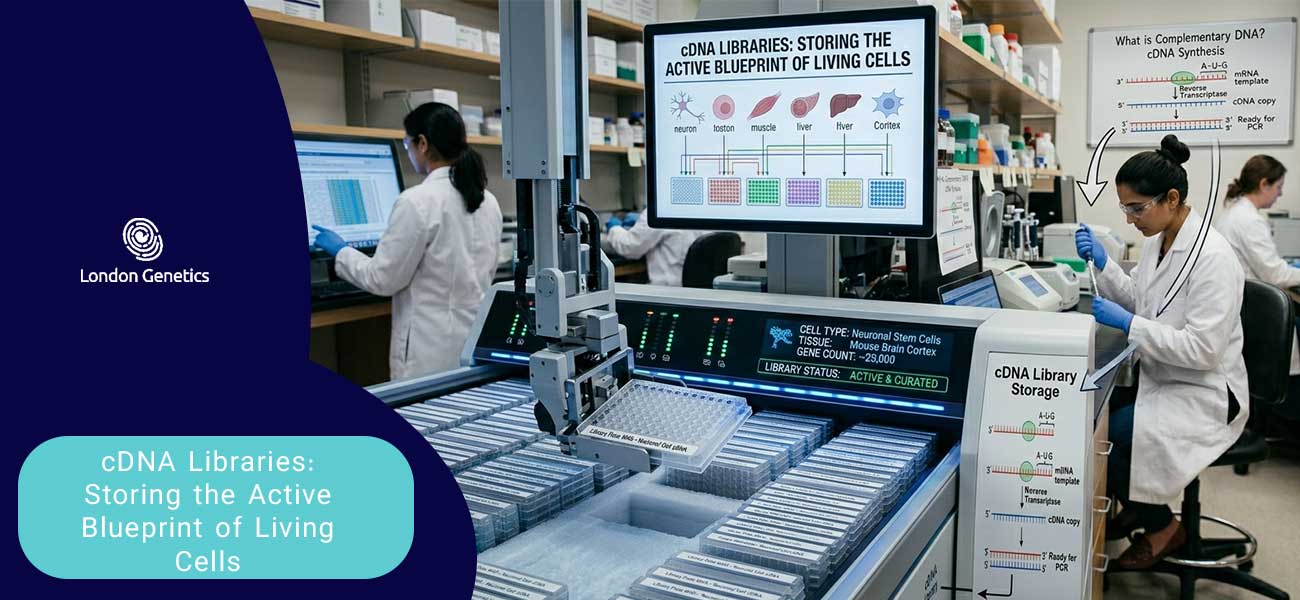
cDNA Libraries: Storing the Active Blueprint of Living Cells
Imagine entering a massive national library, but instead of wandering through millions of unread, archived documents and legal fine print, you enter a special room that only contains the books currently being read by the public that very day. In the world of genomics, this is exactly what a cDNA library represents.
While a genomic library stores every single piece of an organism’s DNA (including all the non-coding introns), a cDNA library is a curated collection of cloned cDNA fragments that represents only the genes actively expressed in a specific cell or tissue at a precise moment in time.
How a cDNA Library is Built
Creating a cDNA library is an exercise in molecular archival. The process follows a structured laboratory workflow:
-
Tissue Isolation: Scientists select a specific tissue of interest—for example, pancreatic cells, a malignant tumour, or developing brain tissue.
-
Extraction and Conversion: All the messenger RNA (mRNA) inside those active cells is extracted. Since mRNA reflects only the active genes, this acts as our raw material. This mRNA is then converted into double-stranded cDNA using the reverse transcription process.
-
Insertion into Host Vectors: These freshly synthesised cDNA fragments are inserted into microscopic carrier molecules called plasmids or bacteriophages (viruses that infect bacteria).
-
Cloning and Storage: The vectors are introduced into a population of host bacteria. As the bacteria divide and multiply, they replicate the human cDNA fragments along with their own DNA. This collection of living, growing bacterial colonies is frozen and stored, forming a permanent, searchable cDNA library.
Why cDNA Libraries are Indispensable to Genomic Research
Genomic DNA libraries are valuable, but searching through them for a specific disease-causing gene is like looking for a needle in a haystack because of the overwhelming presence of non-coding introns. A cDNA library eliminates this noise, offering major advantages:
-
Tissue Specificity: Because gene expression varies across the body, a cDNA library built from heart tissue will look completely different from one built from liver tissue. This allows researchers to study exactly what makes a specific organ or disease tick.
-
Discovering Novel Mutations: In large-scale sequencing projects, comparing a healthy tissue’s cDNA library with a diseased tissue’s library allows scientists to immediately spot faulty proteins and genetic mutations driving conditions like cancer or rare inherited disorders.
-
Bypassing Scale Limitations: It slashes the time and cost of genetic sequencing. Instead of sequencing billions of base pairs of genomic DNA, researchers can focus entirely on the active 1% to 2% of the genome that actually codes for proteins.
A Living Catalog for Modern Diagnostics
Today, cDNA libraries serve as the bedrock for modern functional genomics. They act as a living catalog, allowing international research consortia and biotechnology platforms to pull a pre-edited human gene off the shelf at any time to study its structure, manufacture it as a therapy, or use it to develop targeted diagnostic tools for personalised medicine.
Conclusion: The Quiet Revolution of cDNA
While standard genomic DNA represents the complete, raw archive of life, cDNA is the focused, working manual that biotechnology uses to change the world. By taking the messy, intron-heavy genetic code and refining it into a continuous, readable sequence of exons, complementary DNA has successfully bridged the gap between human biology and microbial manufacturing.
From the quiet rooms of diagnostic laboratories to the global scale of pharmaceutical production, cDNA continues to be an unsung hero in modern medicine. It empowers researchers, accelerates drug discovery, and remains an indispensable tool as science continues to decode the complexities of human health.
Refining the Code:
Transforming fragmented, intron-heavy natural DNA into a streamlined, continuous sequence of coding exons for industrial use.
Bridging Biological Gaps:
Enabling seamless genetic compatibility between complex human biology and efficient microbial manufacturing factories.
Accelerating Drug Discovery:
Serving as a foundational catalyst in modern laboratories to fast-track the research and development of novel biological therapies.
Scaling Biopharmaceuticals:
Powering the global manufacturing of vital, life-saving medicines like recombinant insulin through predictable expression templates.
Decoding Human Health:
Providing an unchanging, high-precision asset in the genomic toolkit to unlock complex cellular pathways and diagnostic solutions.