
Introduction: Why Your Healthy Diet Might Not Suit Your DNA
Imagine sitting down to a meticulously planned, nutrient-dense lunch—perhaps a crisp salad filled with avocado, whole grains, and a side of artisan sourdough. You have spent months fine-tuning your lifestyle, swapping processed snacks for whole foods, yet within an hour of finishing your meal, the familiar, frustrating symptoms return. The persistent abdominal bloating, the sudden wave of afternoon lethargy, and the stubborn brain fog leave you asking the same exhausting question: “How can a diet this healthy make me feel so dreadfully unwell?” If this sounds all too familiar, you are not alone, and the issue is highly unlikely to be a lack of willpower. Instead, you are likely experiencing the hidden friction of genetic food intolerance—a biological reality where your daily menu directly clashes with your inherited cellular blueprint.
                  ┌────────────────────────────────────────┐
                  │   The Modern Dietary Misalignment      │
                  └───────────────────┬────────────────────┘
                                      │
         ┌────────────────────────────┴────────────────────────────┐
         ▼                                                         ▼
┌─────────────────────────────────┐               ┌─────────────────────────────────┐
│     The Standard Healthy Diet   │               │   Your Unique Genetic Blueprint │
│ • Kale, Avocados, Whole Grains  │  VS (Clash)   │ • Specific enzymatic rates      │
│ • Supposed to guarantee health  │               │ • Inherited metabolic limits    │
│ • "One-size-fits-all" approach  │               │ • Unique inflammatory triggers  │
└─────────────────────────────────┘               └─────────────────────────────────┘
For decades, the wellness industry has championed a one-size-fits-all approach to nutrition, operating on the flawed assumption that what is medicine for one individual must be medicine for another. However, cutting-edge molecular science is completely dismantling this narrative. We now understand that your digestive system does not read mainstream health blogs; it reads your DNA. When your body struggles to process specific compounds, it is often because underlying genetic food intolerance has altered your biological machinery, reducing your ability to produce the exact enzymes needed to break down seemingly harmless ingredients.
To truly bridge the gap between what you eat and how you feel, modern clinical medicine has moved away from basic elimination diets and now utilizes the power of a comprehensive DNA diet test. This sophisticated clinical approach relies entirely on Nutrigenomics Genetic Testing to look deep within your chromosomes, mapping out how your body uniquely metabolises nutrients and reacts to potential inflammatory triggers. By uncovering the structural root of your personal genetic food intolerance, we can move away from frustrating guessing games and instead construct an empowered, bespoke nutritional roadmap that respects your biochemistry, protects your gut health, and finally puts an end to chronic digestive distress.
Demystifying the Gut: What Are Genetic Food Sensitivities?
To understand how a specific food triggers an adverse reaction deep within your digestive tract, we must look directly into your cellular biology. The production, strength, and efficiency of your digestive enzymes are entirely dictated by the chemical instructions written in your DNA, meaning that hidden intolerances are often rooted in your inherited genetic code.
Recognising that Genetic Food Sensitivities represent a permanent, structural aspect of your personal biochemistry transforms how you manage your diet. Unlike temporary imbalances, these hardwired predispositions do not vanish over time; pinpointing them through molecular screening allows you to replace guesswork with data and proactively design an optimised lifestyle.
The Immune System vs. The Genome: Sensitivity vs. Allergy
In the vast landscape of online wellness advice, the terms “food allergy” and “food intolerance” are routinely, and incorrectly, used interchangeably. This clinical conflation causes immense confusion for patients attempting to decipher their digestive issues. To successfully manage your gut health, it is critical to understand that a true food allergy and the broader reality of food intolerance genetics are governed by two entirely separate biological networks within your body: the immune system and the genome.
A classical food allergy is an acute, often immediate, weaponised response orchestrated by your immune system. When an allergic individual encounters a trigger—such as peanuts or shellfish—their immune system mistakenly identifies a harmless food protein as a dangerous invader. In response, it floods the bloodstream with a specific antibody called Immunoglobulin E (IgE). This massive IgE release triggers an immediate inflammatory cascade, leading to severe symptoms like hives, swelling, or life-threatening anaphylaxis. This is an immune emergency, not a metabolic failing.
┌────────────────────────────────────────────────────────────────────────┐
│                     ALLERGY VS. GENETIC INTOLERANCE                    │
├───────────────────────────────┬────────────────────────────────────────┤
│  TRUE FOOD ALLERGY            │  GENETIC FOOD INTOLERANCE              │
├───────────────────────────────┼────────────────────────────────────────┤
│ • Driven by Immune System     │ • Driven by Metabolic Genome           │
│ • IgE Antibody Response       │ • Cellular & Enzymatic Deficiencies    │
│ • Immediate, Acute Reaction   │ • Delayed, Cumulative Discomfort       │
│ • Can be Life-Threatening     │ • Triggers Chronic Internal Distress   │
└────────────────────────────────────────────────────────────────────────┘
Conversely, uncovering the facts behind food intolerance genetics reveals that these chronic reactions do not rely on IgE antibodies, nor do they represent an immediate immune emergency. Instead, you are dealing with a clear case of genetic food intolerance—slow-burning, metabolic conflicts caused by structural gaps in your DNA. When you lack the proper genetic instructions to synthesize specific digestive enzymes, the food particle remains unbroken. This leads to localized irritation, chemical fermentation, and delayed systemic symptoms that can surface anywhere from a few hours to a couple of days after ingestion.
The Clinical Distinction: While a food allergy involves your immune system actively attacking a food substance, exploring your food intolerance genetics demonstrates that an inherited genetic food intolerance simply means your digestive system lacks the biological tools to process it.
Because the symptoms of an inherited genetic food intolerance are cumulative and delayed—often presenting as chronic bloating, joint discomfort, or fatigue—they are notoriously difficult to track using standard allergy tests. Identifying them requires looking past the immune system’s antibodies and diving directly into your inherited DNA to see exactly which metabolic tools your body was born without.
The Gluten Blueprint: Celiac Disease and Genetic Susceptibility
Gluten is arguably the most heavily debated protein of the modern era, triggering severe gastrointestinal distress that varies dramatically from person to person. When evaluating these adverse reactions, clinical diagnostics focuses heavily on Celiac disease—a severe autoimmune condition that serves as the ultimate example of how genetic food sensitivities are hardwired into our biology.

Unlocking your HLA blueprint is the only definitive way to understand whether wheat is actively destroying your intestinal anatomy or simply triggering a localized metabolic conflict.


Key Takeaway:
Analysing the complex molecular science behind your immune receptors reveals that structural gluten intolerances are heavily hardwired into your genomic code. Mapping your personal HLA blueprint replaces general dietary trends with empirical screening data, allowing you to safely isolate true autoimmune risks from localized metabolic sensitivities.
Beyond Dairy: The Lactose Intolerance Gene & Caffeine Metabolism
While gluten often dominates dietary headlines, the most common daily friction between our diet and our DNA happens over simpler things: our morning latte. For millions, a splash of cow’s milk or a single cup of espresso can trigger hours of physical distress. These reactions are not random bouts of bad luck; they are classic examples of how genetic food intolerance dictates our body’s ability to process everyday compounds. By looking at the specific genes controlling dairy and caffeine metabolism, we can see exactly why one person thrives on items that leave another in absolute agony.
The Dairy Blueprint: The Lactose Intolerance Gene and Lactase Persistence
Dairy-induced discomfort is perhaps the most widespread metabolic variant on Earth. To digest lactose—the primary sugar found in milk—your small intestine must produce an enzyme called lactase. This production is controlled entirely by the lactose intolerance gene, scientifically classified as the LCT gene.
During infancy, this gene is highly active in almost all humans, allowing us to digest milk. However, as we grow older, a genetic switch located right next to this crucial lactose intolerance gene determines our dairy-drinking future.
                  ┌────────────────────────────────────────┐
                  │      THE LCT GENE DIVERGENCE PATH      │
                  └───────────────────┬────────────────────┘
                                      │
         ┌────────────────────────────┴────────────────────────────┐
         ▼                                                         ▼
┌─────────────────────────────────┐               ┌─────────────────────────────────┐
│     Lactase Persistence (LP)    │               │   Lactase Non-Persistence (LNP) │
│ • LCT gene remains active       │               │ • LCT gene systematically shuts │
│ • Continuous enzyme production  │               │   down after early childhood.   │
│ • Dairy is digested perfectly   │               │ • Triggers severe gut distress  │
└─────────────────────────────────┘               └─────────────────────────────────┘
In individuals with “Lactase Non-Persistence,” the lactose intolerance gene systematically winds down after early childhood. Without the genetic instructions to create lactase, consuming dairy means undigested lactose travels straight to the colon. There, gut bacteria feast on the sugars, causing rapid fermentation that leads to severe bloating, painful cramps, and explosive digestive distress.
Conversely, those with “Lactase Persistence” possess a stable genetic variation that keeps the LCT gene permanently switched on throughout adulthood—a fascinating evolutionary mutation common in populations with historical backgrounds in dairy farming.
The Coffee Blueprint: The CYP1A2 Gene and Caffeine Metabolism
If dairy sensitivity is a battle in the gut, caffeine sensitivity is a battle in the liver. Have you ever wondered why some people can drink a double espresso at 10:00 PM and sleep like a baby, while others experience severe heart palpitations, anxiety, and jitters from just a few sips of green tea? The answer lies squarely within the CYP1A2 gene.
The CYP1A2 gene instructs the liver to produce the primary enzyme responsible for breaking down and clearing caffeine from your bloodstream. Human variations in this specific gene divide the population into two distinct metabolic camps:
-
Fast Metabolisers (The AA Genotype): Individuals who inherit two copies of the optimal CYP1A2 variant clear caffeine out of their system up to four times faster than average. For them, caffeine provides a clean, brief energy boost without any toxic buildup or sleep disruption.
-
Slow Metabolisers (The AC or CC Genotype): Individuals with these variants possess a sluggish enzyme system. Caffeine lingers in their circulatory system for hours, over-stimulating the central nervous system. For slow metabolisers, caffeine behaves more like a toxin than a stimulant, significantly increasing their risk of caffeine-induced anxiety, sleep deprivation, and even long-term cardiovascular strain.
Discovering where you sit on the CYP1A2 and LCT spectrums is a liberating experience. It transforms these frustrating, daily instances of genetic food intolerance from stressful mysteries into manageable biological traits, allowing you to tailor your consumption of dairy and stimulants to match the exact processing speed of your internal organs.
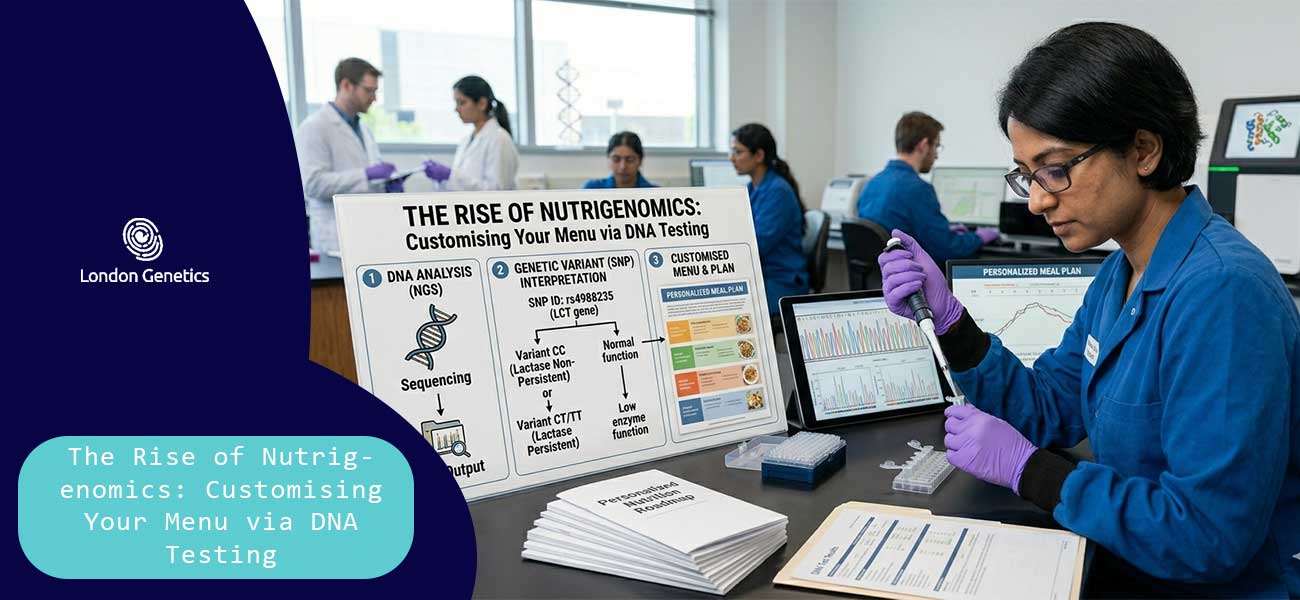
The Rise of Nutrigenomics: Customising Your Menu via DNA Testing
For generations, nutritional advice has been purely reactive. People would experience chronic symptoms, embark on painfully restrictive elimination diets, and try to guess which ingredient was causing their misery. Today, a groundbreaking medical discipline known as nutrigenomics is completely turning this paradigm on its head. Instead of guessing how your body reacts to the outside world, nutrigenomics allows clinicians to look from the inside out. By analyzing how individual genetic variations interact with specific dietary bio-compounds, this field maps out your risks for genetic food intolerance before you even take a single bite, helping us craft an elite genetic nutrition plan.
The true clinical power of this scientific evolution lies in its ability to pinpoint silent, cellular inflammation. When you suffer from an unverified genetic food intolerance, consuming those trigger foods does not always cause immediate, obvious digestive drama. Instead, it can trigger a low-grade, systemic inflammatory response that quietly damages your long-term wellness.
┌────────────────────────────────────────────────────────────────────────┐
│                     THE NUTRIGENOMIC DNA PIPELINE                      │
├────────────────────────────────────────────────────────────────────────┤
│  [DNA Swab] ──>  [Biomarker Mapping] ──>  [Bespoke Diet Formulation]  │
│  High-resolution  Identifies hidden      A tailor-made dietary map    │
│  cellular scan.   inflammatory flaws.    eliminating your unique VUS. │
└────────────────────────────────────────────────────────────────────────┘
Advanced DNA sequencing techniques screen your genome for specific inflammatory biomarkers and enzymatic inefficiencies. Rather than relying on a generalised “healthy eating” checklist, this approach uncovers exactly how your unique body handles oxidants, processes fats, and reacts to hidden dietary irritants.
-
Identifying Hidden Triggers: The genetic screen looks at how your cellular pathways manage oxidative stress and gut barrier integrity, highlighting vulnerabilities that cause chronic fatigue or skin issues.
-
Formulating a Bespoke Diet: Once these genetic markers are mapped, the data is translated into a highly targeted, personal menu. By establishing a professional genetic nutrition plan, your daily fuel is naturally adjusted to fortify your exact metabolic weaknesses.
Ultimately, understanding your personal genetic food intolerance through the lens of nutrigenomics shifts your dietary strategy from a stressful guessing game to an exact science. It allows for the creation of a truly bespoke diet—a structured, clinical genetic nutrition plan that is mathematically tailored to your body’s processing speeds and cellular needs. By aligning your plate with your chromosomes, you effectively remove biological friction from your digestive system, allowing your metabolism to run at its absolute, native peak.
Conclusion: Transforming Your Health with London Genetics
Living with chronic, unexplained digestive issues or systemic inflammation can make your relationship with food feel like a daily minefield. Discovering your unique Genetic Food Sensitivities is not a diagnosis of illness—it is an invaluable piece of biological liberation that allows you to stop spinning your wheels with frustrating, generic elimination diets.
The journey through advanced genomic science should never be walked alone. At London Genetics, we are dedicated to bridging the gap between complex genomic data and your daily dinner plate, replacing commercial guesswork with a highly targeted, scientifically backed nutritional blueprint tailored exclusively to your DNA.
Advanced Diagnostic Auditing:
Utilising cutting-edge nutrigenomics screening to pinpoint the exact genetic variants and inflammatory markers disrupting your gut health.
Clinical Data Contextualisation:
Cross-referencing your genetic predispositions with your active lifestyle, medical history, and personal wellness goals to ensure results carry real-world clinical value.
Bespoke Nutritional Architecture:
Completely removing the guesswork from your daily recovery by designing a highly targeted, DNA-backed nutritional blueprint.
Proactive Genetic Pathway:
Mapping your exact enzymatic and inflammatory caps with high-resolution diagnostics to completely bypass over-the-counter kits and raw data dumping.
Definitive Health Control:
Stepping out of dietary confusion and chronic symptoms to take absolute control of your biological future equipped with elite clinical precision.