Introduction
Human Genetics is a fundamental branch of biological science concerned with the study of genes, heredity, and genetic variation in human populations. It explores the structure and function of DNA, patterns of inheritance, gene expression, and the mechanisms through which genetic information is transmitted from one generation to the next. As a core discipline within modern biomedical science, Human Genetics provides the conceptual and molecular framework for understanding how inherited and acquired genetic variations influence human traits and biological processes.
The study of Human Genetics and health has become increasingly significant in contemporary medicine. Genetic factors play a crucial role in the development of both monogenic disorders and complex multifactorial diseases such as cardiovascular disease, diabetes, and cancer. Advances in genomic technologies have enabled the identification of disease-associated variants, thereby enhancing risk prediction, early diagnosis, and targeted therapeutic strategies. In this context, initiatives such as Genetic Screening Programmes and Population Health Genetics Programs have emerged as essential components of public health systems. These programmes aim to detect genetic susceptibilities within populations, facilitate early intervention, and reduce the overall burden of disease.
Understanding the relationship between Human Genetics and health is therefore vital not only for clinical practice but also for population-level health management. The integration of genetic knowledge into preventive medicine, personalised treatment, and public health policy reflects the growing importance of genetics in shaping healthcare delivery.
The primary objective of this article is to define Human Genetics, examine its foundational principles, and analyse its relationship to human health, with particular emphasis on its role in disease prevention, early detection, and modern healthcare strategies.
Definition and Basic Concepts of Human Genetics
Human Genetics is the scientific discipline that examines the structure,
function, and transmission of genetic information within human populations.
It explores how biological traits are encoded, inherited, and expressed,
and how genetic variation contributes to both normal development
and disease susceptibility.
At the core of Human Genetics lies the gene,
the basic unit of heredity.
Genes are specific sequences of DNA
that contain the instructions necessary
for cellular function and organismal development.
DNA carries the biological blueprint
that determines how cells grow, function,
and respond to their environment.
Within cells, DNA is organised into chromosomes,
highly structured molecular entities located in the nucleus.
Each chromosome contains numerous genes arranged
in precise sequences,
ensuring stable transmission of genetic information
across generations.
Heredity refers to the process by which genetic information
is passed from parents to offspring.
Patterns of inheritance explain how traits
and predispositions to certain conditions
are transmitted across generations,
providing insight into familial disorders
and population-level genetic diversity.
Gene expression is the mechanism through which
genetic information is translated into functional products
within the cell.
It regulates when, where, and to what extent genes are active,
influencing physical characteristics,
physiological processes,
and susceptibility to disease.
Variations in gene expression are essential
to understanding the complex relationship
between genetic constitution and health outcomes.
Key Takeaway:
Human Genetics integrates the study of genes, DNA, chromosomes,
heredity, and gene expression to provide a comprehensive understanding
of how genetic information shapes human biology, development,
and health across generations.
Principles of Inheritance in Humans
Within the field of Human Genetics, the principles of inheritance explain how genetic information is transmitted from one generation to the next and how specific traits or conditions appear within families and populations. A foundational framework for understanding inheritance in Human Genetics originates from the work of Gregor Mendel, whose studies established the basic laws governing the transmission of hereditary traits.
Mendelian principles, as applied in Human Genetics, describe how discrete units of inheritance are passed from parents to offspring according to predictable patterns. These principles form the basis for analysing dominant and recessive traits and for understanding the probability of inheriting particular characteristics or genetic conditions.
In Human Genetics, inheritance patterns are commonly classified as autosomal dominant, autosomal recessive, or sex-linked. Autosomal dominant inheritance occurs when a single altered copy of a gene is sufficient to produce a trait or disorder. Autosomal recessive inheritance requires two altered copies of a gene for the trait to be expressed. Sex-linked inheritance, typically associated with genes located on the X chromosome, demonstrates distinct transmission patterns between males and females. These inheritance models are central to genetic counselling, risk assessment, and clinical diagnosis within Human Genetics.
Another essential principle in Human Genetics involves genetic mutations. Mutations are permanent alterations in the genetic material that may arise spontaneously or due to environmental influences. While some mutations are neutral or even beneficial, others can disrupt normal biological function and contribute to inherited disorders or increased disease susceptibility. The study of mutations in Human Genetics provides critical insight into variation, evolution, and the molecular basis of many human diseases.
Overall, the principles of inheritance constitute a core component of Human Genetics, offering a systematic approach to understanding how genetic traits are transmitted, modified, and manifested in human health and disease.
Human Genetics and Disease
The relationship between Human Genetics and disease is a central focus of modern biomedical research.
Genetic variation influences individual susceptibility to many conditions,
shaping disease onset, progression, and treatment response.
Advances in molecular biology and genomic technologies
have significantly enhanced understanding of disease mechanisms and risk prediction.

Explore how genetics contributes to different types of diseases.

Monogenic disorders result from mutations in a single gene
and typically follow clear inheritance patterns
such as autosomal dominant, autosomal recessive, or sex-linked transmission.
Although individually rare,
these conditions have well-defined genetic causes,
making them highly important in diagnostic genetics and genetic counselling.
Identification of pathogenic variants enables earlier diagnosis,
carrier detection, and, in some cases, targeted treatment strategies.

Multifactorial diseases arise from the combined influence
of multiple genes and environmental factors.
These complex traits involve interactions between genetic predisposition,
lifestyle, environmental exposures, and behavioural influences.
Examples include cardiovascular disease,
type 2 diabetes,
and certain autoimmune or neurodevelopmental conditions.

Cancer often develops due to accumulated genetic mutations
that disrupt normal cellular regulation,
including cell growth, DNA repair, and apoptosis.
Some cancers are linked to inherited genetic variants,
while others result from somatic mutations acquired during life.
Genetic analysis in oncology improves early detection,
risk assessment, targeted therapy development,
and personalised treatment approaches.
Key Takeaway:
Human Genetics plays a fundamental role in understanding disease.
From monogenic disorders to complex multifactorial conditions and cancer,
genetic insights enhance diagnosis, prevention, risk prediction,
and personalised medical care.
Role of Genetics in Modern Medicine
The integration of Human Genetics into contemporary healthcare has transformed modern medical practice, enabling more precise diagnosis, prevention, and treatment strategies. Advances in genomic technologies have strengthened the clinical application of Human Genetics, making it an essential component of evidence-based medicine.
Genetic Diagnosis
Genetic diagnosis plays a pivotal role in Human Genetics, allowing clinicians to identify specific genetic variants associated with inherited disorders. Through molecular testing, including DNA sequencing and chromosomal analysis, healthcare professionals can confirm suspected conditions, determine disease risk, and guide appropriate management. The increasing accuracy and accessibility of diagnostic tools have significantly improved early detection and informed decision-making in clinical settings.
Prenatal Screening
Prenatal screening is another important application of Human Genetics, aimed at assessing the risk of genetic abnormalities before birth. These screening approaches help identify chromosomal disorders and inherited conditions during pregnancy, enabling early counselling and medical planning. By incorporating genetic knowledge into prenatal care, healthcare systems can provide prospective parents with valuable information regarding potential health outcomes.
Personalised Medicine
Personalised medicine represents one of the most significant advancements derived from Human Genetics. This approach tailors medical treatment to an individual’s genetic profile, ensuring more effective therapies with reduced adverse effects. By analysing genetic variations that influence drug metabolism and disease susceptibility, clinicians can optimise treatment plans. The principles of Human Genetics thus support precision healthcare, improving therapeutic efficacy and patient outcomes.
Gene Therapy
Gene therapy is an innovative medical strategy grounded in the principles of Human Genetics. It involves the modification, replacement, or regulation of defective genes to treat or prevent disease. By directly targeting the underlying genetic cause of a disorder, gene therapy offers the potential for long-term or even curative interventions. Ongoing research in this area reflects the expanding therapeutic potential of Human Genetics in addressing previously untreatable conditions.
Genetics and Disease Prevention
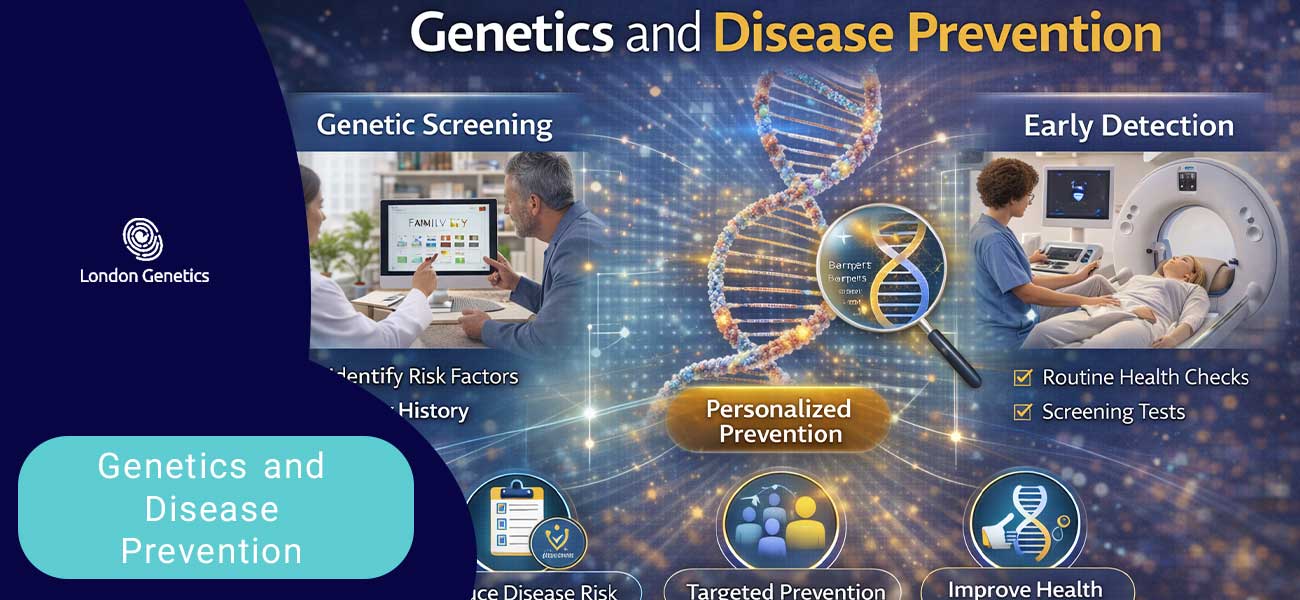
The application of Human Genetics to disease prevention has become an essential component of modern healthcare systems. By identifying genetic predispositions and assessing individual risk profiles, Human Genetics supports proactive strategies aimed at reducing disease incidence and improving long-term health outcomes.
Genetic Risk–Based Prevention
Within the framework of Human Genetics, risk-based prevention involves the identification of inherited genetic variants that may increase susceptibility to specific conditions. Through genetic testing and risk assessment, individuals can be stratified according to their likelihood of developing certain diseases. This information enables the implementation of early monitoring, lifestyle modification, and targeted preventive interventions. The integration of genetic risk data into clinical practice enhances precision in preventive medicine and contributes to more efficient healthcare planning.
Genetic Counselling
Genetic counselling is a vital service in Human Genetics, providing individuals and families with guidance regarding inherited conditions, testing options, and potential health implications. In this process, trained professionals interpret genetic information and explain its relevance in a clear and supportive manner. Genetic counselling facilitates informed decision-making, particularly in cases involving hereditary disorders, reproductive planning, and familial disease risk. By combining scientific knowledge with patient-centred communication, Human Genetics plays a crucial role in empowering individuals to make well-informed health choices.
Conclusion: The Central Role of Human Genetics in Modern Medicine
Human Genetics represents a fundamental pillar of modern biomedical science,
shaping our understanding of the relationship between genetic variation and human health.
Through the study of genes, chromosomes, inheritance patterns, and gene expression,
it has transformed knowledge of both monogenic and multifactorial diseases,
improved diagnostic precision, and supported the development of targeted therapeutic strategies.
The integration of Human Genetics into clinical practice has strengthened preventive medicine,
enhanced risk assessment, and contributed to more effective, evidence-based healthcare delivery.
Its impact extends from individual patient care to population-level health strategies.
Key contributions of Human Genetics include:
- Improved understanding of disease mechanisms
- Enhanced diagnostic accuracy for inherited and complex conditions
- Support for personalised and targeted treatment approaches
- Strengthened preventive and risk-based healthcare models
- Integration into genetic counselling and clinical decision-making
Advancing Technology and Genomic Innovation:
The continued expansion of genomic sequencing technologies,
alongside genetic screening programmes and population-based initiatives,
demonstrates the growing importance of Human Genetics in public health.
These advances enable earlier detection of disease risk,
more precise interventions,
and improved long-term outcomes for individuals and communities.
Modern genomic tools are increasingly integrated into routine healthcare,
bridging research discoveries with practical clinical application.
Future Perspectives:
Looking ahead, Human Genetics is expected to play an even greater role
in personalised medicine, gene-based therapies, and population health strategies.
Ongoing research will deepen understanding of complex genetic interactions,
refine disease prediction models,
and expand equitable access to genetic services worldwide.
As scientific knowledge progresses,
Human Genetics will remain central to the development of innovative,
preventive, and patient-centred approaches in global healthcare.
Why This Matters:
By combining scientific advancement with ethical responsibility,
Human Genetics continues to shape the future of medicine,
supporting accurate diagnosis, targeted treatment,
and evidence-based health policy.
Continued Commitment to Progress:
Sustained investment in research, education, and clinical integration
will ensure that genetic knowledge translates into meaningful benefits
for individuals, families, and populations.