Introduction to the Human Genome Project
The Human Genome Project Explained begins with understanding one of the most ambitious scientific endeavours of the modern era. Launched in 1990, the Human Genome Project set out to map and sequence the entire set of human DNA, providing an unprecedented foundation for Genomic Research around the world.
At its core, the project aimed to uncover how our genetic code shapes human life, health, and hereditary traits. It was initiated not only to advance scientific knowledge but also to deepen our insight into genetic disorders and the biological mechanisms that drive them.
Today, the Human Genome Project remains a landmark achievement because it has transformed the way researchers study the human body, paving the way for breakthroughs in personalised medicine, biotechnology, and the broader field of genetics.
Goals and Objectives of the Human Genome Project
The Human Genome Project was launched with a set of ambitious scientific objectives aimed at transforming our understanding of human biology. Its primary mission was to map and sequence the entire human genome, providing an accurate and comprehensive reference for the three billion DNA base pairs that define human genetic makeup.
The Human Genome Project established a global framework for understanding human DNA, identifying genes, advancing sequencing technologies, and creating open genomic databases that continue to shape modern genetic research.
Timeline and Historical Background
Origins of the Human Genome Project
The Human Genome Project (HGP) was officially launched in 1990, marking the beginning of the largest international collaboration in biomedical science. Its vision was to decode the entire genetic blueprint of human beings — a goal that combined ambition, technology, and cooperation across continents.
International Collaboration
The project involved leading research institutions and governments from around the globe, including:
- United States, through the National Institutes of Health (NIH) and Department of Energy (DOE)
- United Kingdom, led by the Wellcome Trust and Sanger Centre (now the Sanger Institute)
- Japan, France, Germany, and China, contributing key sequencing data and technological support
This global partnership established an unparalleled spirit of scientific unity, paving the way for open sharing of genomic data.
Public vs Private Competition
By the late 1990s, a notable rivalry emerged between the public consortium (led by HGP) and a private company, Celera Genomics, founded by Dr Craig Venter.
- The public initiative focused on open, freely accessible data for all researchers.
- Celera pursued rapid commercial sequencing using new computational methods.
Despite the competition, both sides reached a joint announcement in June 2000, presenting a “working draft” of the human genome — an extraordinary milestone in science.
Completion and Legacy (1990–2003)
- 1990: Official launch of the Human Genome Project.
- 2000: Draft genome released publicly.
- 2003: Project declared complete — two years ahead of schedule.
The completion of the HGP marked the end of a 13‑year effort and the dawn of a new era in genetic and Genomic Research, transforming medicine and biotechnology forever.
DNA Sequencing Technologies Used in the Human Genome Project
The Human Genome Project required powerful technologies capable of reading the three billion letters of human DNA. Achieving this milestone demanded a combination of advanced sequencing methods, automated laboratory systems, and sophisticated computational analysis to interpret massive volumes of genetic data.

Key technologies that made large‑scale genome sequencing possible.


Key Takeaway:
The Human Genome Project combined Sanger sequencing, automated technologies, advanced fragment separation methods, and powerful bioinformatics tools to decode the human genome, paving the way for modern high‑speed sequencing technologies.
Major Discoveries and Scientific Breakthroughs
The completion of the Human Genome Project led to a series of remarkable discoveries that reshaped our understanding of human genetics. By analysing the complete sequence of human DNA, scientists uncovered new insights into gene structure, genome organisation, and the complexity of genetic regulation. These findings became central to what many describe when discussing the Human Genome Project Explained.
Estimated Number of Human Genes
One of the most surprising discoveries was the relatively small number of human genes.
- Early estimates suggested humans might have around 100,000 genes.
- The Human Genome Project revealed that humans actually possess approximately 20,000–25,000 genes.
This finding challenged earlier assumptions that biological complexity must correspond to a larger number of genes.
Structure and Organisation of the Human Genome
The project also provided the first comprehensive map of how the human genome is structured. Researchers discovered that:
- The human genome contains about 3 billion DNA base pairs.
- Genes are unevenly distributed across chromosomes.
- Some regions of the genome are highly active, while others remain relatively quiet.
Understanding this organisation helped scientists study how genes interact and regulate biological processes.
The Role of Non‑Coding DNA
Another major breakthrough involved the discovery that most human DNA does not directly code for proteins.
- Only about 1–2% of the genome contains protein‑coding genes.
- The remaining DNA consists of regulatory elements, repeated sequences, and other non‑coding regions.
Initially dismissed as “junk DNA,” many of these sequences are now known to play important roles in gene regulation, genome stability, and evolutionary processes.
New Concepts in Genetics
The project also introduced new perspectives in genetic science. Scientists began to recognise that:
- Gene expression is influenced by complex regulatory networks.
- Small genetic variations, known as single nucleotide polymorphisms (SNPs), contribute to individual differences and disease susceptibility.
- The interaction between genes and environmental factors is essential in determining many health outcomes.
Together, these discoveries transformed modern biology and laid the foundation for advances in genomics, personalised medicine, and biomedical research.
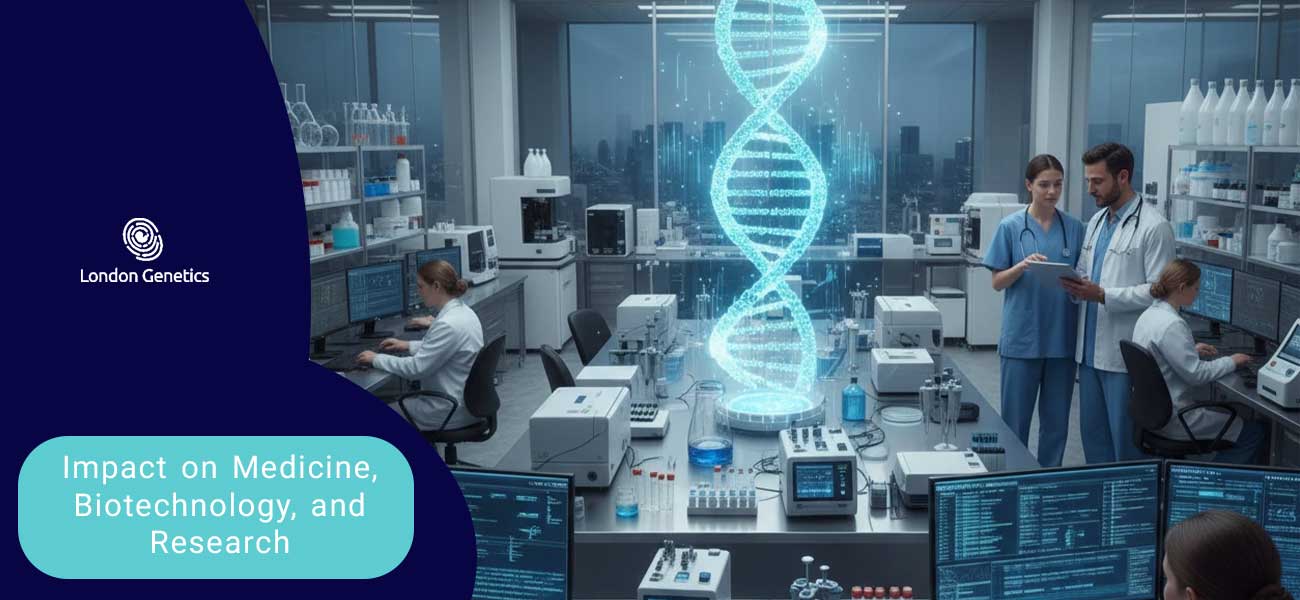
Impact on Medicine, Biotechnology, and Research
The Human Genome Project not only unlocked the full sequence of human DNA but also revolutionised the way we understand, diagnose, and treat disease. Its influence spread across medicine, biotechnology, and scientific research, setting the foundation for an era in which genetics guides clinical decision‑making and medical innovation.
Advances in Personalised Medicine
One of the most significant outcomes was the emergence of personalised medicine.
- With a clearer understanding of genetic variation, doctors can now tailor treatments based on an individual’s unique genetic profile.
- This approach improves treatment effectiveness, reduces adverse drug reactions, and helps predict disease risk long before symptoms appear.
The Human Genome Project Explained shows how this shift from “one‑size‑fits‑all” healthcare to precision‑based care is reshaping modern medicine.
Improved Diagnosis of Genetic Disorders
The project dramatically enhanced the ability to identify and diagnose genetic conditions.
- Thousands of disease‑causing genes have now been mapped.
- Early screening and diagnostic tools allow conditions such as cystic fibrosis, Huntington’s disease, or certain cancers to be detected more accurately and at earlier stages.
- This has opened the door to preventative medicine and better-informed clinical decisions.
Transformations in the Pharmaceutical Industry
Biotechnology and pharmaceutical development have been equally transformed.
- Knowledge of gene targets allows researchers to design drugs that act more precisely on disease pathways.
- Pharmacogenomics—studying how genes affect drug response—has grown directly from the Human Genome Project.
- This leads to more effective treatments, improved safety, and faster development cycles for new medicines.
These advances have made drug discovery more scientific, data‑driven, and efficient than ever before.
Growth of Bioinformatics and Computational Biology
The huge volume of genomic data produced by the project created an urgent need for new analytical tools and computational methods.
- This demand led to rapid developments in bioinformatics, transforming it from a niche field into a core part of modern biological research.
- Powerful algorithms, genome databases, and high‑performance computing systems now drive discoveries in genetics, evolution, microbiology, and personalised healthcare.
Today, bioinformatics forms the backbone of Genomic Research, connecting laboratory science with computational innovation.
Conclusion: The Lasting Impact of the Human Genome Project
The Human Genome Project represents one of the most transformative scientific milestones in modern history. By successfully mapping the complete human genetic blueprint, it revolutionised our understanding of biology, accelerated advances in biotechnology, and opened the door to personalised and precision medicine.
The project not only produced a comprehensive reference of human DNA but also sparked innovations in sequencing technologies, computational biology, and international scientific collaboration that continue to shape modern research and healthcare.
Revolutionising Medical Research:
By decoding the human genome, the project provided scientists with an essential reference for studying how genes influence health, disease, and human development, enabling new strategies for diagnosis and treatment.
Advancing Genetic Technologies:
The technological breakthroughs achieved during the project accelerated the development of modern sequencing methods, making genome analysis faster, more accurate, and far more accessible.
Supporting Personalised Medicine:
Insights from the human genome have helped pave the way for treatments tailored to an individual’s genetic profile, improving the precision and effectiveness of modern healthcare.
Establishing Ethical and Educational Frameworks:
The Human Genome Project also emphasised the importance of ethical considerations, genetic counselling, and responsible use of genomic data, ensuring that scientific progress benefits society responsibly.
A Legacy of Global Scientific Collaboration:
More than two decades after its completion, the project continues to influence genetics, medicine, and biotechnology worldwide—standing as a powerful example of how international collaboration and innovation can transform our understanding of life itself.