Introduction: Decoding the Language of Your DNA
Every cell in the human body contains a highly sophisticated library written in a microscopic chemical language. For generations, this deep biological script remained entirely hidden from view, leaving doctors to guess at the underlying causes of complex conditions. Today, the rise of molecular genetics technologies has completely transformed modern medicine, allowing scientists to step inside the cell and decode this mysterious language with line-by-line precision. Instead of simply looking at the external symptoms of a disease, we can now read the foundational DNA code itself, transforming how we understand, predict, and manage human health from its very origin.
This incredible ability to read our internal code has fundamentally reshaped the landscape of clinical diagnostics. By analyzing the exact arrangement of nucleotides within specific genes, inherited disorders testing has become faster, safer, and infinitely more precise than ever before. This molecular revolution means that families no longer have to endure years of medical uncertainty or repetitive, painful testing to find answers about their health risks. Whether it is uncovering a hidden predisposition to a rare illness or providing clear guidance for prospective parents, decoding the language of your DNA offers an unprecedented level of clarity, empowering individuals to take control of their healthcare with total confidence.
What Is a Molecular Genetics Test? The Science of DNA Reading
To understand the true power of molecular genetics analysis, it helps to imagine your genome as a massive encyclopaedia. While traditional laboratory tests could only look at whole chromosome volumes from a distance, molecular diagnostics zoom in on the micro-level chemical building blocks of life to catch single-letter typos.
Recognising the difference between macro-level chromosome tracking and micro-level DNA sequencing helps patients value the resolution of modern diagnostics. By checking the exact chemical spelling of individual genes, molecular genetics tests offer answers where traditional testing falls short, paving the way for targeted clinical interventions.
How It Works: Inside the High-Tech Molecular Laboratory
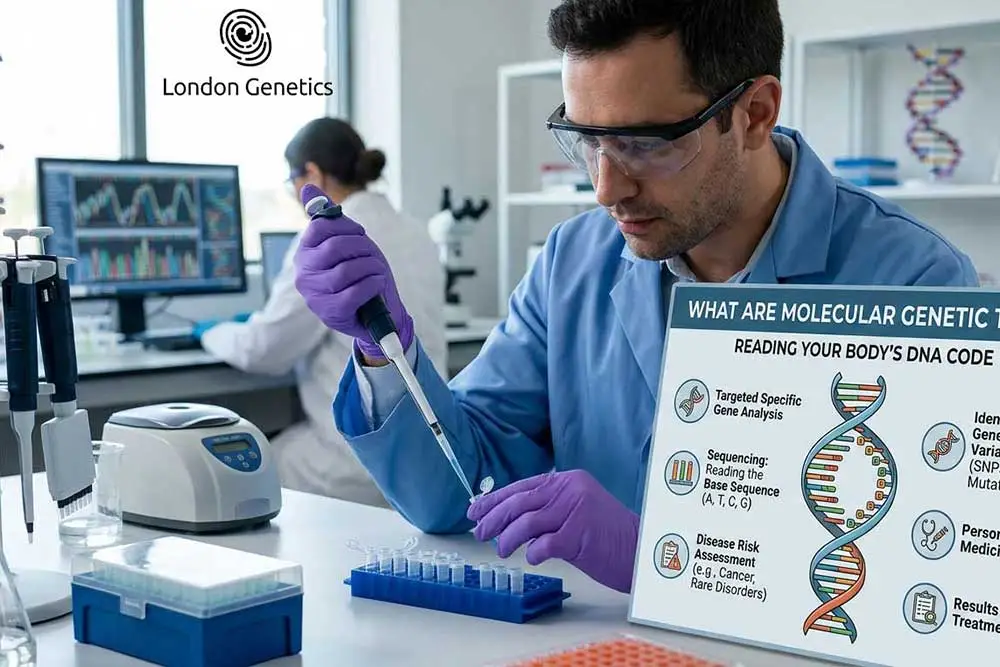
Once your biological sample arrives at a specialized facility, it leaves the everyday world and enters a high-tech environment driven by robotic automation and advanced biochemistry. Many patients wonder how a liquid sample or a dry swab can be translated into a clean digital report on a computer screen. The reality is a fascinating multi-step journey. Inside the molecular genetics laboratory, scientists use state-of-the-art technology to extract, copy, and read your microscopic codes with flawless precision.
The sophisticated laboratory workflow can be broken down into three major scientific phases:
Phase 1: DNA Extraction and Isolation
The first step is freeing the DNA from the collected cells. Whether your sample comes from blood or a simple mouth brush, the cells must be opened up. Technicians use specialized chemical enzymes to dissolve the outer cell membranes, isolating the pure DNA strands away from proteins, fats, and other cellular debris. When this phase is complete, the laboratory is left with a tiny, purified liquid volume containing your raw genetic code.
Phase 2: PCR (Polymerase Chain Reaction) – The Genetic Photocopy Machine
Raw DNA isolated from a sample is often too microscopic to be read directly by sequencing machines. To solve this problem, laboratories utilize an Nobel-prize-winning technology called PCR (Polymerase Chain Reaction).
-
How it helps: Imagine finding a single sentence in a book that is too faint to read. PCR acts as a highly targeted biological photocopy machine.
-
The result: It zeroes in on the specific gene section needed for your analysis and duplicates it millions of times over in a matter of hours. This creates a large, robust signal that the diagnostic equipment can easily detect and analyze.
Phase 3: NGS (Next-Generation Sequencing) – The High-Speed Digital Reader
Once the target DNA has been multiplied, it is fed into an advanced system known as NGS (Next-Generation Sequencing). This is where the actual “DNA reading” happens:
Finally, a team of clinical molecular genetics and bioinformaticians reviews these digital findings. They filter out harmless variations and compile the critical data into a comprehensive medical report, providing you and your physician with an uncompromised look into your biological health.
Beyond the Needle: How a Simple Cheek Swab Powers Molecular Diagnostics
When people hear about high-tech laboratory procedures like PCR and Next-Generation Sequencing, they naturally assume that providing a sample demands large vials of blood drawn from a vein. Fortunately, modern biotechnology has disrupted this assumption, proving that a painless cheek swab provides top-tier genomic material.

Bridging the gap between patient comfort and complex laboratory workflows highlights how non-invasive oral sweeps effortlessly support advanced molecular analysis.


Key Takeaway:
Connecting standard patient comfort with advanced molecular diagnostics proves that clinical accuracy does not require invasive methods. Recognizing that uniform epithelial cells yield pristine genomic data for PCR and sequencing allows individuals to experience premium, high-resolution DNA analysis with complete peace of mind.
Hunting for Answers: Tracking Rare and Inherited Diseases
For patients suffering from mysterious, chronic, or unexplained symptoms, the search for a medical answer can turn into an exhausting, years-long journey known in the medical world as a “diagnostic odyssey.” Families often bounce from doctor to doctor, undergoing repetitive scans and generic blood tests that yield no clear results. This is where molecular genetics testing steps in as a definitive game-changer. By searching for the root biological cause at the DNA level, these advanced tests bypass the guesswork, offering an accurate and rapid conclusion to what often feels like an endless hunt for answers.
The true strength of a clinical molecular genetics evaluation is its unmatched ability to trace and identify a wide array of rare, inherited disorders that are completely invisible to standard medical examinations:
-
Marfan Syndrome: A complex connective tissue disorder that can silently impact the heart, blood vessels, and skeletal system. Because its physical symptoms often overlap with other conditions, a targeted molecular genetics scan of the FBN1 gene is the definitive way to confirm a diagnosis early and prevent dangerous cardiovascular events.
-
Cystic Fibrosis: A severe inherited condition that causes thick, sticky mucus to build up in the lungs and digestive tract. By looking directly at mutations within the CFTR gene, molecular laboratories can diagnose infants within days of birth, allowing for immediate, life-saving therapeutic interventions.
-
Spinal Muscular Atrophy (SMA): A rare genetic disease affecting central nervous system and voluntary muscle movement. Early detection via molecular testing allows clinicians to introduce cutting-edge gene therapies before irreversible nerve damage occurs.
Ending the Uncertainty: The primary clinical value of this technology is not just identifying a condition, but providing closure. When a molecular genetics test confirms the exact mutation responsible for an inherited disorder, it eliminates medical ambiguity, saves families from unnecessary treatments, and opens the door to targeted, personalized clinical care.
By shifting the diagnostic focus from superficial symptoms directly to your unique DNA structure, molecular genetics specialists can provide patients and their physicians with an uncompromised biological map—turning a confusing medical mystery into a clear, actionable plan for lifelong health management.
Carrier Screening and Beyond: Protecting Your Family’s Future
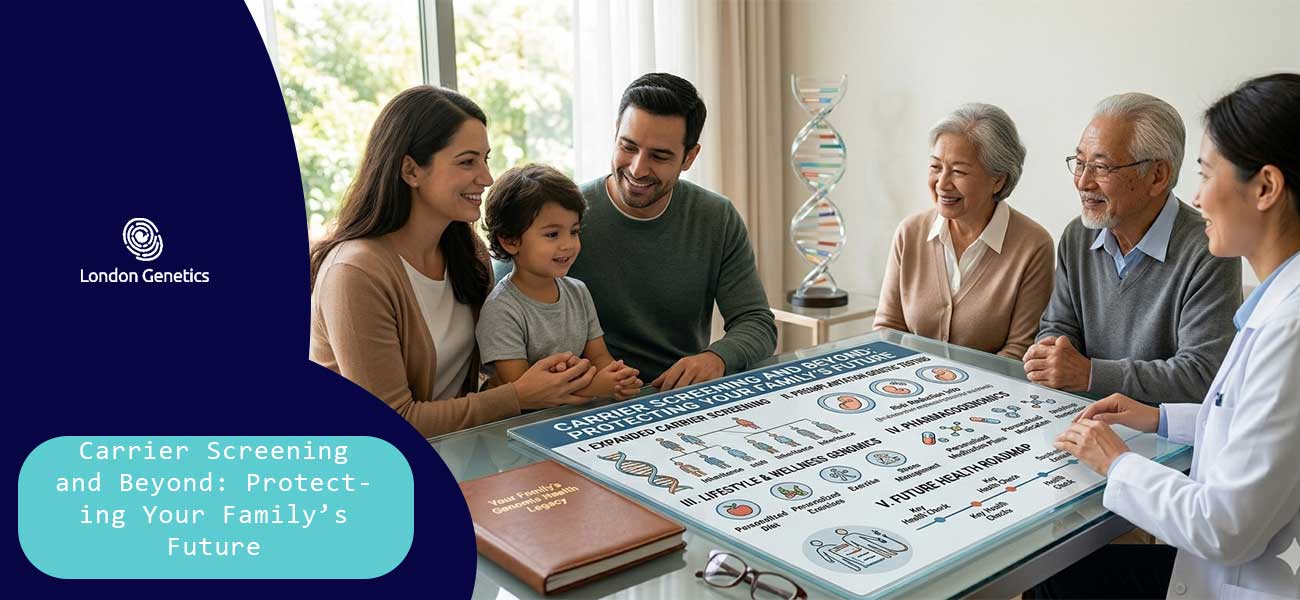
One of the most powerful and preventative applications of modern genomics does not happen during a medical crisis, but rather at the very beginning of a family’s journey. For prospective parents, planning for a healthy child is filled with hope, but it also involves navigating hidden biological variables. Many individuals carry recessive genetic mutations for severe disorders without ever showing a single symptom themselves. Today, advanced molecular genetics carrier screening allows couples to pull back the curtain on their DNA, identifying these hidden risks before pregnancy and taking proactive steps to protect the health of the next generation.
To understand how a molecular genetics carrier screen safeguards a family’s future, it helps to understand the hidden nature of recessive genetic traits:
-
The Silent Carrier Status: A “carrier” is someone who has inherited one changed (mutated) copy of a gene and one normal copy. Because the normal copy compensates, the carrier is completely healthy and usually has no idea they are harboring a genetic mutation.
-
The Mathematical Risk: If both prospective parents complete a molecular genetics test and discover they are carriers for the same recessive condition, there is a 25% chance (1 in 4) with each pregnancy that their child will inherit both mutated genes and be born with the actual disorder.
-
Comprehensive Protection: Modern carrier panels utilize high-resolution molecular sequencing to screen for hundreds of conditions simultaneously, including fragile X syndrome, sickle cell disease, and various metabolic disorders, giving couples a clear, data-driven map of their combined genetic compatibility.
Proactive Options for a Safer Tomorrow
When a molecular genetics evaluation highlights a shared genetic risk, it does not mean a couple cannot have a family. Instead, it empowers them with a variety of modern clinical paths that were completely unavailable to previous generations:
-
Preimplantation Genetic Testing (PGT): Combined with In Vitro Fertilization (IVF), laboratories can screen embryos at the molecular level before implantation, ensuring only those unaffected by the specific inherited disorder are selected for pregnancy.
-
Early Prenatal Diagnostics: Couples can choose to test the fetus early in pregnancy through advanced molecular methods, allowing them to prepare emotionally, financially, and medically for immediate treatments at birth.
-
Specialized Delivery Planning: Knowing a child’s genetic status beforehand allows neonatologists to be standing by in the delivery room with targeted therapies, preventing early disease complications before they even begin.
Ultimately, undergoing a molecular genetics carrier screening is an act of deep responsibility and foresight. It replaces fear of the unknown with actionable medical insight, ensuring that your future family is built upon a solid foundation of clarity, safety, and total peace of mind.
Conclusion: Empowering Your Healthcare with Molecular Precision
The transition from traditional, macro-level medical examinations to deep DNA exploration marks one of the most brilliant achievements in modern healthcare. Looking beyond superficial symptoms to read the exact chemical layout of your genes replaces old, trial-and-error approaches with absolute biological certainty, putting an end to painful diagnostic delays.
This high-resolution precision is actively driving the global revolution toward personalised medicine. Embracing advanced molecular screening means choosing proactive knowledge over uncertainty, allowing you to map out preventative wellness plans and guide families with unprecedented clarity.
Biological Certainty:
Replacing subjective, trial-and-error symptom tracking with definitive, micro-level insights into your unique genomic sequence.
Personalised Medicine:
Empowering clinicians to design targeted therapeutic roadmaps and predict future health vulnerabilities with absolute precision.
Proactive Prevention:
Choosing definitive data over medical uncertainty, shifting your healthcare strategy from reactive treatment to proactive prevention.
Informed Reproductive Choices:
Utilising high-resolution carrier screening to guide family planning and safeguard future generations from rare inherited conditions.
Definitive Frameworks:
Mapping out reliable, long-term wellness plans equipped with precise chemical insights for total peace of mind.