Introduction: Navigating Your Prenatal Testing Options
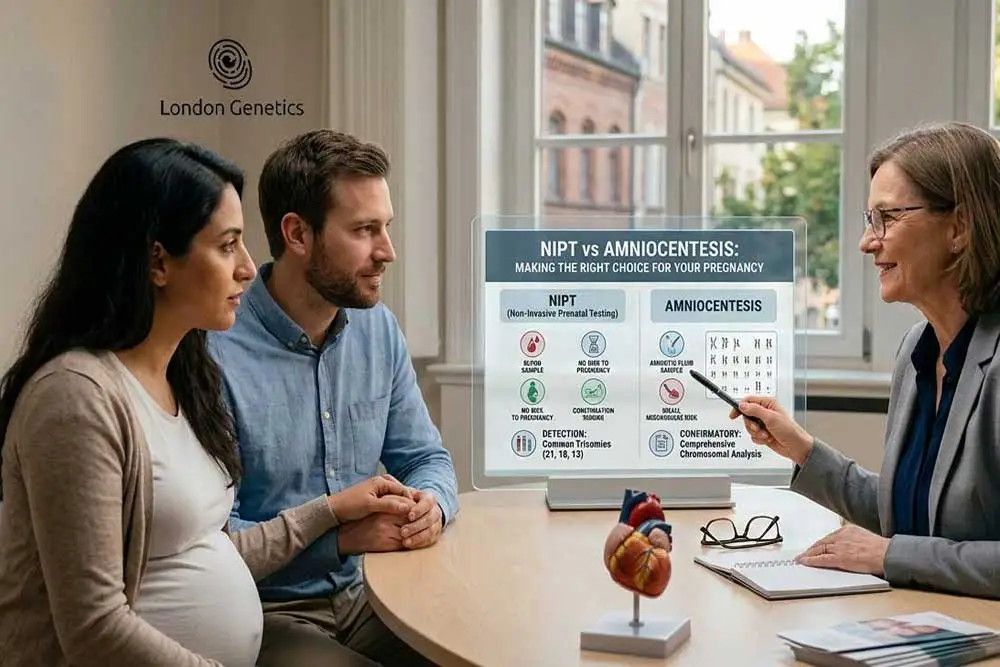
Discovering you are pregnant brings a wave of excitement, but it also introduces a journey filled with important medical decisions. For many expectant parents, understanding the landscape of NIPT vs amniocentesis becomes a central focus when looking for clear answers about their developing baby’s health. Navigating these professional screening and diagnostic pathways can feel overwhelming, especially when you are trying to balance the need for highly accurate answers with the ultimate safety of your pregnancy.
As a cornerstone of modern healthcare, Prenatal Genetic Testing empowers families by replacing clinical uncertainty with reliable, data-driven insights. However, choosing the right path requires a clear understanding of how different assessments work. While some options offer a completely risk-free look at your baby’s DNA, others provide a definitive diagnosis through more detailed medical procedures. By exploring the unique roles, safety profiles, and clinical timings of both non-invasive screening and diagnostic tests, this guide aims to reduce parental anxiety—helping you make an informed, confident choice tailored to your family’s unique needs.
Screening vs. Diagnostic: Understanding the Core Difference
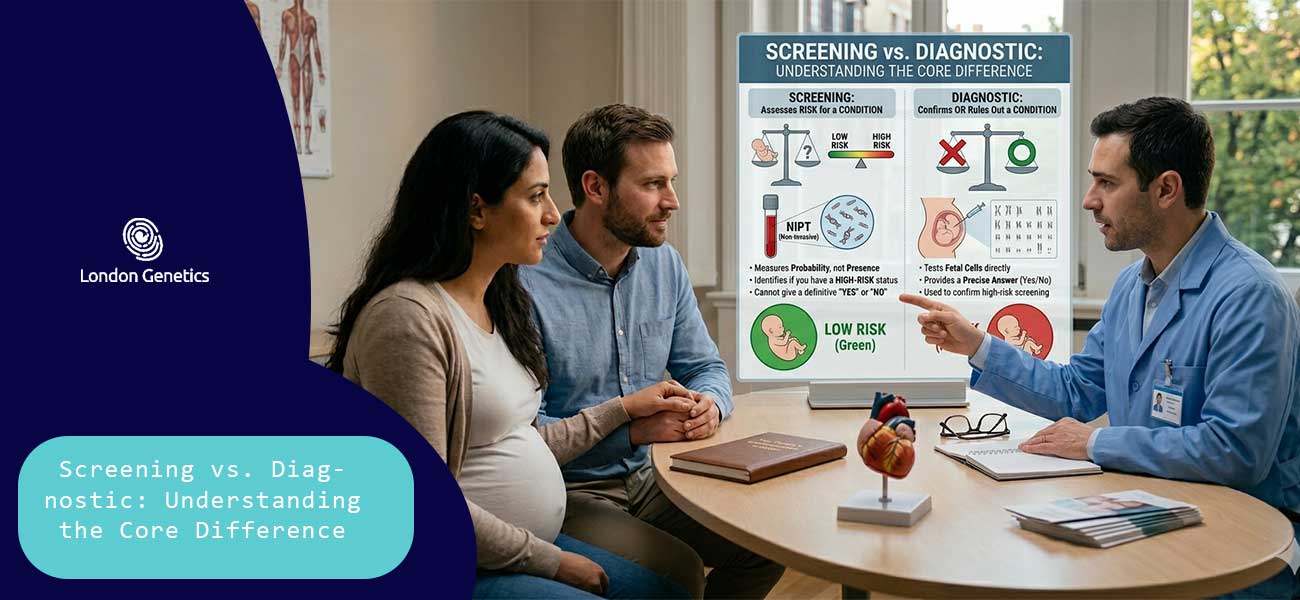
Before deciding on the specific path for your pregnancy, it is absolutely vital to understand that prenatal evaluations are divided into two completely separate scientific categories: screening tests and diagnostic tests. Misunderstanding this fundamental distinction is one of the most common sources of unnecessary anxiety for expectant parents. When evaluating NIPT vs amniocentesis, you are not just comparing two different procedures—you are comparing two entirely different levels of medical certainty.
The biological and clinical differences between these two approaches determine how a doctor interprets your results and what the next steps should be:
-
Screening Tests (The Risk Assessors): A screening test does not look directly at the baby’s actual chromosomes to provide a definitive “yes” or “no” answer. Instead, it calculates the statistical probability or likelihood of a condition being present. It acts as a highly advanced risk filter, identifying whether a pregnancy falls into a “low-risk” or “high-risk” category compared to the general population.
-
Diagnostic Tests (The Rule Makers): A diagnostic test bypasses statistical probabilities entirely. By gathering and analyzing actual cells from the pregnancy, it examines the genetic material directly under a microscope or through deep molecular sequencing. This provides a definitive, concrete answer, confirming with near-absolute certainty whether a specific genetic or chromosomal condition exists.
Screening vs. Diagnostic Framework
To help visualize how these two pillars of healthcare operate, let us look at how they compare across key clinical measures:
| Feature | Screening Tests (e.g., NIPT) | Diagnostic Tests (e.g., Amniocentesis) |
| Primary Purpose | To evaluate the statistical likelihood or risk of a condition. | To provide a definitive, concrete confirmation or exclusion. |
| The Outcome | Results are reported as “High Risk” or “Low Risk”. | Results are reported as a definitive “Positive” or “Negative”. |
| Risk to Pregnancy | Completely non-invasive; zero risk of miscarriage. | Invasive procedure; carries a very small, calculated risk. |
| Clinical Analogy | A wide security net that highlights a potential issue. | A high-resolution camera that captures the exact reality. |
Understanding this core difference helps explain why many clinical journeys begin with a non-invasive screen. If a screening test returns a high-risk result, it does not mean your baby has a genetic condition—it simply indicates that a diagnostic test, such as an amniocentesis, is recommended to find the definitive answer.
What is NIPT? The Safe and Non-Invasive First Step
Non-Invasive Prenatal Testing (NIPT) has completely revolutionised prenatal care over the last decade. Serving as an incredibly precise, gentle, and reliable first line of screening, NIPT evaluates fetal chromosomal conditions from the first trimester without putting the pregnancy at any physical risk.
Recognising the scientific power of cell-free DNA transforms early pregnancy screening from a stressful clinical dilemma into a safe, data-driven pathway. By offering over 99% precision alongside zero risk of miscarriage, NIPT establishes a flawless safety profile that ensures invasive testing is only introduced when genuinely required.
What is Amniocentesis? Reaching a Definitive Diagnosis
While non-invasive screening tools offer an exceptional layer of early reassurance, they cannot provide a definitive medical conclusion. When a pregnancy requires absolute structural and genetic certainty, clinical teams turn to diagnostic procedures. In the debate of NIPT vs amniocentesis, amniocentesis stands as the definitive benchmark for confirming or ruling out chromosomal conditions, providing expectant parents with an uncompromised biological answer.
Understanding how an amniocentesis is performed can help de-mystify the procedure and prepare families for what to expect:
-
The Amniotic Fluid Analysis: The baby floats inside the womb surrounded by amniotic fluid, which naturally contains shed fetal skin cells and biological waste products. By analyzing these active cells, geneticists can map out the baby’s complete karyotype (chromosomal map) with absolute precision.
-
Clinical Timing: An amniocentesis is typically performed during the second trimester, usually between the 15th and 20th weeks of pregnancy. This timing ensures there is an adequate volume of fluid surrounding the baby to sample safely.
-
The Procedure: Under continuous, high-resolution ultrasound guidance, a highly trained consultant inserts a fine, specialized needle through the mother’s abdomen and into the uterus. A small volume of amniotic fluid (about two tablespoons) is gently drawn into a syringe. The entire extraction process takes less than a few minutes.
For Comprehensive Science: Understanding CVS
To ensure complete clinical accuracy, it is important to note that if diagnostic answers are needed earlier in the first trimester, an alternative procedure called Chorionic Villus Sampling (CVS) may be recommended instead.
Performed between the 10th and 13th weeks of pregnancy, CVS extracts a tiny sample of placental tissue (chorionic villi) rather than fluid. Because the placenta shares the baby’s genetic profile, CVS provides the same definitive diagnostic power as an amniocentesis but can be executed earlier in the pregnancy timeline if a high-risk NIPT score or a structural ultrasound scan requires urgent validation.
Evaluating the Risks: The Real Facts on Miscarriage Rates
When expectant parents evaluate NIPT versus amniocentesis, the conversation often hits an emotional wall regarding the fear of miscarriage. While outdated statistics or online forums can cause unnecessary anxiety, up-to-date, evidence-based clinical data reveals that modern diagnostic risks are remarkably low and highly controlled.

Replacing historical misconceptions with official, modern obstetric data allows families to approach prenatal diagnostic options with absolute clinical clarity.


Key Takeaway:
Differentiating between historical anxiety and up-to-date obstetric figures reveals that invasive diagnostics are exceptionally controlled. Integrating a non-invasive NIPT screening protocol first allows families to manage risk seamlessly, ensuring amniocentesis is utilized with clear clinical justification for total peace of mind.
When is Amniocentesis Recommended Over NIPT?
For the vast majority of low-risk pregnancies, a non-invasive blood panel provides all the peace of mind a family needs. However, clinical medicine is never one-size-fits-all. When navigating the complex choice of NIPT vs amniocentesis, it is important to recognize that there are specific clinical scenarios where a screening test is simply not enough. In these vital situations, a medical specialist or genetic counsellor will recommend moving beyond statistical probabilities to seek the absolute structural certainty that only a diagnostic amniocentesis can provide.
Clinical teams typically analyze the factors of NIPT vs amniocentesis and advise undergoing an invasive diagnostic procedure over a non-invasive screen in the following critical circumstances:
-
A “High Risk” NIPT Result: Because NIPT is strictly a screening tool, a high-risk result is not a final medical diagnosis. If your blood panel indicates an elevated risk for Down’s, Edwards’, or Patau’s syndrome, the ongoing framework of NIPT vs amniocentesis dictates that an amniocentesis is requested as the essential clinical next step to officially confirm or rule out the condition.
-
Abnormal Structural Ultrasound Scans: If a routine ultrasound detects physical anomalies—such as congenital heart defects or increased nuchal translucency—the debate of NIPT vs amniocentesis shifts completely. Ultrasound abnormalities suggest a high likelihood of a genetic variant, making a direct amniocentesis highly recommended because standard screening panels cannot decipher structural details.
-
Advanced Maternal Age (AMA): While many women over the age of thirty-five successfully utilize screening methods, the baseline statistical risk for chromosomal anomalies rises significantly with age. For expectant mothers of advanced maternal age, comparing NIPT vs amniocentesis often leads doctors to favor a direct diagnostic test to eliminate any margin of error from the very beginning.
-
Known Family History of Inherited Disorders: If either parent is a known carrier of a specific single-gene genetic mutation (such as cystic fibrosis), standard screening tools cannot trace these intricate inheritance patterns. In these instances of evaluating NIPT vs amniocentesis, an amniocentesis is favored because it allows scientists to target and analyze that exact gene strand directly.
Ultimately, balancing NIPT vs amniocentesis is never about raising alarm; it is about equipping parents and clinical teams with uncompromised, actionable data. Choosing the diagnostic path ensures that if a baby does require specialized neonatal care or immediate medical interventions at birth, an expert medical team is already standing by with a flawless, personalized healthcare plan.
Conclusion: Making an Informed Choice with London Genetics
Deciding how to navigate your prenatal journey is one of the most deeply personal milestones of your pregnancy. Understanding the balance between NIPT versus amniocentesis is not about finding a single “correct” test, but rather about identifying the specific clinical path that aligns seamlessly with your medical history, structural risk factors, and personal peace of mind.
The journey through these complex genomic choices should never be walked alone. At London Genetics, we believe that data is only half the answer; the other half is compassionate, expert guidance from specialised genetic counsellors who help strip away anxiety to review safety profiles in a calm, supportive environment.
Personalised Pathway:
Identifying the specific clinical screening or diagnostic route that aligns precisely with your medical history and unique risk factors.
Expert Guidance:
Stripping away complex medical jargon and clinical anxiety through dedicated one-on-one sessions with specialised genetic counsellors.
Balanced Safety Profiles:
Weighing the timing, accuracy, and capabilities of non-invasive screening against the absolute, definitive certainty of diagnostic testing.
Tailored Biological Maps:
Designing an uncompromised prenatal plan and biological map tailored exclusively to protect your baby’s health and family’s future.
Confident Prenatal Care:
Moving forward into your pregnancy equipped with professional data-driven insights and elite clinical support for total peace of mind.