
Introduction to Pharmacogenetics: Why It Matters in Modern Medicine
Modern medicine increasingly recognises that patients do not respond to medicines in exactly the same way. A treatment that works well for one person may produce little benefit—or even unwanted side effects—in another. Pharmacogenetics seeks to explain these differences by examining how variations in an individual’s genes influence the way their body processes and responds to medications.
Many of these differences arise from genetic variations in enzymes responsible for drug metabolism, transport, or targets within the body. For example, genes involved in the cytochrome P450 enzyme system can determine whether a medicine is broken down quickly, slowly, or at a typical rate. Such variations can significantly affect both the effectiveness of a drug and the likelihood of adverse reactions. By understanding these genetic factors, clinicians can make more informed decisions when selecting treatments and determining appropriate dosages.
In recent years, pharmacogenetic testing has begun to play an important role in several areas of healthcare. One notable example is Cardiovascular Drug Response Testing, where genetic information may help guide the use of medications such as antiplatelet drugs or anticoagulants. Identifying how a patient’s genes affect drug metabolism can help clinicians choose the most suitable therapy and reduce the risk of complications.
Pharmacogenetics is closely related to the broader field of pharmacogenomics, which examines how the entire genome influences drug response. While pharmacogenetics often focuses on specific genes that affect particular medications, pharmacogenomics looks at wider genomic patterns that may shape treatment outcomes. Together, these fields contribute to the growing movement towards personalised or precision medicine.
As healthcare continues to integrate genetic insights into clinical practice, pharmacogenetics is becoming an increasingly valuable tool for improving treatment safety and effectiveness. By tailoring therapies to the genetic characteristics of individual patients, modern medicine moves closer to delivering more precise, efficient, and patient‑centred care.
How Genetic Variations Influence Drug Response
Genetic variation is one of the main reasons why people respond differently to the same medication. Pharmacogenetics examines these inherited genetic differences to understand how they influence drug effectiveness, safety, and optimal dosing in modern healthcare.
Many medicines are processed in the liver by enzymes belonging to the cytochrome P450 (CYP450) family. Genes such as CYP2D6, CYP2C19, and CYP2C9 influence how quickly medications are broken down in the body.
Poor Metabolisers: These individuals process certain drugs slowly, allowing the medication to accumulate and increasing the risk of side effects.
Rapid or Ultra‑Rapid Metabolisers: These individuals break down medications very quickly, which may reduce the drug’s effectiveness.
Genetic differences can also affect proteins that transport drugs into and out of cells. These transport proteins determine how medications move through the bloodstream and reach their target tissues.
Impact on Treatment: If these proteins function differently due to genetic variation, the concentration of a drug at its target site may change, influencing the overall effectiveness of the therapy.
Many medications act by binding to specific biological targets such as receptors, enzymes, or ion channels. Genetic variations in the genes that code for these targets can alter their structure or activity.
Clinical Effect: A medicine that works effectively for one person may produce a weaker response in another individual whose genetic variant changes the drug’s target.
Understanding how genetic variations influence drug metabolism, transport, and drug targets allows clinicians to tailor treatments more precisely—transforming traditional prescribing into personalised medicine that prioritises both effectiveness and patient safety.
The Difference Between Pharmacogenetics and Pharmacogenomics
Although pharmacogenetics and pharmacogenomics are closely related fields, they are not exactly the same. Both study how genetic factors influence the way individuals respond to medications, but they differ mainly in scope, approach, and scale of analysis.
Understanding the distinction between these two terms helps clarify how genetic information is used in modern medicine and personalised treatment strategies.
Pharmacogenetics
Pharmacogenetics focuses on how individual genes or a small number of genes affect a person’s response to a specific medication. This approach typically examines well‑known genetic variants that influence drug metabolism, drug transport, or drug targets.
Key characteristics of pharmacogenetics include:
- Focuses on single genes or limited genetic variants
- Often studies genes involved in drug‑metabolising enzymes, such as the CYP450 family
- Helps determine whether a patient may metabolise a drug too quickly, too slowly, or normally
- Frequently used in clinical testing to guide drug selection or dosage adjustments
- Commonly applied in areas such as cardiology, psychiatry, and oncology
For example, testing for variants in the CYP2C19 gene can help clinicians determine how well a patient may respond to certain antiplatelet medications.
Pharmacogenomics
Pharmacogenomics, by contrast, takes a broader perspective. It examines how the entire genome influences drug response rather than focusing on a single gene. This field often relies on advanced technologies such as genome sequencing, large‑scale data analysis, and bioinformatics.
Key characteristics of pharmacogenomics include:
- Analyses multiple genes or the entire genome
- Uses genomic technologies and large datasets
- Helps identify complex genetic patterns affecting drug response
- Supports the development of precision medicine and targeted therapies
- Often applied in drug discovery, research, and personalised healthcare strategies
Through pharmacogenomics, researchers can identify genetic markers across the genome that predict how groups of patients may respond to certain treatments.
Key Distinction
In simple terms:
- Pharmacogenetics studies the impact of individual genes on drug response.
- Pharmacogenomics studies the influence of the entire genome on medication outcomes.
Both fields contribute significantly to the advancement of personalised medicine, helping clinicians move away from the traditional “one‑size‑fits‑all” approach to drug therapy and towards treatments tailored to each patient’s genetic profile.
Key Genes Involved in Drug Metabolism
Drug metabolism is a critical process that determines how medicines are broken down and eliminated from the body. Much of this occurs in the liver, where specialised enzymes convert drugs into forms that can be more easily removed. In pharmacogenetics, understanding genetic variations in these enzymes helps explain why individuals respond differently to the same medication.

Genetic differences in metabolic enzymes, transport proteins, and drug targets can significantly influence drug safety and effectiveness.


Key Takeaway:
Genetic variations in metabolic enzymes, drug transporters, and molecular targets play a central role in determining how individuals respond to medications. Recognising these differences supports personalised prescribing, reduces adverse drug reactions, and improves treatment effectiveness.
Clinical Applications of Pharmacogenetics in Personalised Therapy
One of the most important contributions of pharmacogenetics is its ability to support personalised drug therapy, where treatments are tailored to the genetic characteristics of individual patients. By analysing specific genetic variants, healthcare professionals can predict how a person is likely to respond to certain medications and adjust treatment plans accordingly. This approach helps improve therapeutic effectiveness while reducing the risk of adverse drug reactions.
Pharmacogenetic testing is increasingly being integrated into clinical practice across several medical fields.
Cardiovascular Medicine
In cardiology, pharmacogenetics can guide the use of medications that prevent blood clots or manage heart disease. Genetic variations may influence how patients metabolise certain antiplatelet or anticoagulant drugs. Through Cardiovascular Drug Response Testing, clinicians can determine whether a patient is likely to respond effectively to a specific medication or whether an alternative treatment may be more suitable. This can be particularly valuable in reducing the risk of treatment failure or complications.
Oncology
Cancer treatment often requires highly targeted therapies, and pharmacogenetics plays an important role in identifying which patients are most likely to benefit from particular drugs. Certain genetic markers can indicate whether a tumour will respond to a specific chemotherapy agent or targeted therapy. In some cases, pharmacogenetic testing also helps predict the risk of severe toxicity, allowing doctors to adjust treatment doses accordingly.
Psychiatry
Psychiatric medications, including antidepressants and antipsychotics, often produce variable responses among patients. Genetic differences in drug‑metabolising enzymes can affect how quickly these medications are processed in the body. Pharmacogenetic testing may help clinicians choose medications that are more likely to be effective and better tolerated, reducing the trial‑and‑error approach that is sometimes associated with psychiatric treatment.
Pain Management
Genetic variations can also influence how patients respond to certain pain medications. For example, some individuals metabolise opioid medicines differently due to genetic variants affecting metabolic enzymes. Pharmacogenetic insights can therefore help guide safer prescribing and improve pain control strategies.
Improving Safety and Treatment Outcomes
Overall, the clinical use of pharmacogenetics supports a more precise and patient‑centred approach to healthcare. By incorporating genetic information into treatment decisions, clinicians can select medications that are more appropriate for each individual’s biological profile. As genetic testing becomes more accessible and integrated into healthcare systems, pharmacogenetics is expected to play an increasingly significant role in advancing personalised medicine.
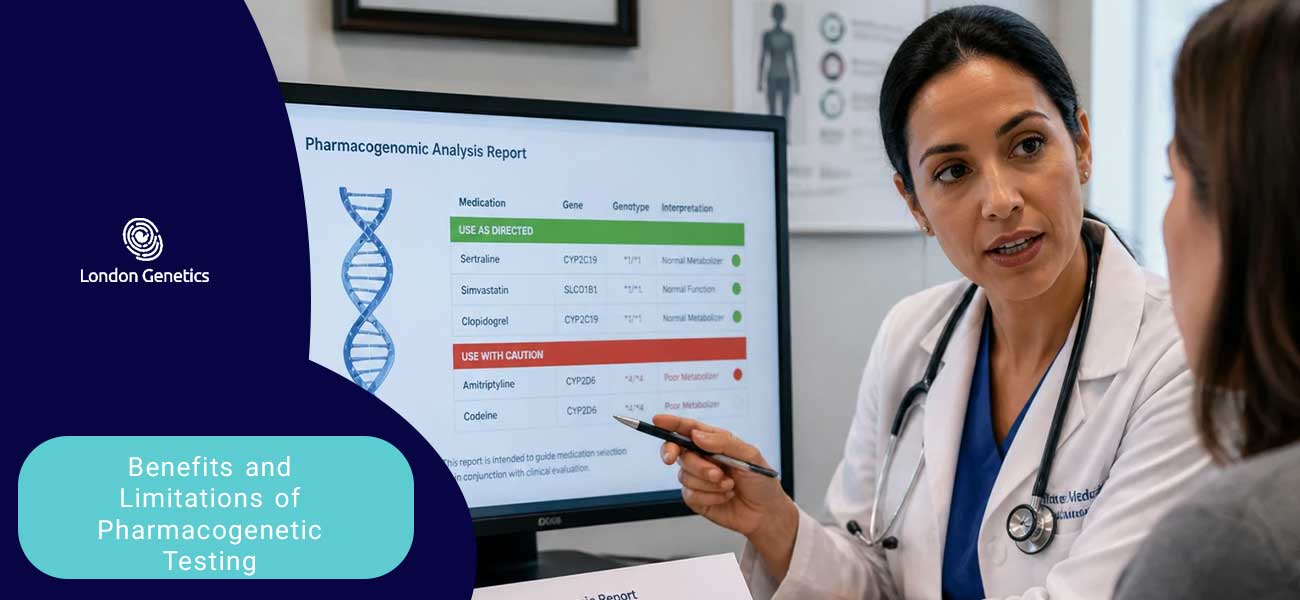
Benefits and Limitations of Pharmacogenetic Testing
Pharmacogenetic testing is becoming an increasingly valuable tool in modern healthcare, helping clinicians understand how genetic variations influence an individual’s response to medications. By analysing specific genes involved in drug metabolism, transport, or drug targets, these tests can provide useful insights that support more personalised treatment decisions. However, while pharmacogenetic testing offers many advantages, it also has certain limitations that should be considered.
Benefits of Pharmacogenetic Testing
Pharmacogenetic testing offers several important benefits for both patients and healthcare providers:
-
Improved drug effectiveness
Genetic information can help clinicians select medications that are more likely to work effectively for a particular patient.
-
Reduced risk of adverse drug reactions
Identifying genetic variants that affect drug metabolism can help avoid medications that may cause harmful side effects.
-
More precise drug dosing
Some genetic differences influence how quickly a drug is metabolised. Pharmacogenetic testing can assist in determining the most appropriate dosage.
-
Support for personalised medicine
By tailoring treatments to a patient’s genetic profile, pharmacogenetics contributes to a more individualised approach to healthcare.
-
Reduced trial‑and‑error prescribing
Genetic insights may help clinicians choose suitable medications more quickly, particularly in fields such as psychiatry and cardiology.
Limitations of Pharmacogenetic Testing
Despite its potential, pharmacogenetic testing also has several challenges and limitations:
-
Incomplete genetic knowledge
Not all genetic factors affecting drug response are fully understood, and many medications are influenced by multiple genes.
-
Influence of non‑genetic factors
Age, lifestyle, diet, liver function, and interactions with other medications can also affect drug response.
-
Limited availability in some healthcare systems
Access to pharmacogenetic testing may still be restricted in certain regions or clinical settings.
-
Cost considerations
Although the cost of genetic testing is decreasing, it may still be a barrier in some cases.
-
Interpretation and clinical integration
Healthcare professionals must be trained to interpret genetic results accurately and apply them appropriately in treatment decisions.
Balancing Benefits and Challenges
While pharmacogenetic testing is not a complete solution for predicting drug response, it provides valuable information that can improve treatment safety and effectiveness. As research advances and genetic technologies become more accessible, the role of pharmacogenetic testing is expected to expand, supporting more precise and personalised approaches to drug therapy in modern medicine.
The Future of Pharmacogenetics in Precision Medicine
As healthcare continues to move towards more individualised and data‑driven approaches, pharmacogenetics is expected to play an increasingly important role in precision medicine. Rather than relying on standard treatments designed for the average patient, this approach aims to tailor medical care according to each person’s genetic profile, lifestyle, and environmental factors. By understanding how genetic variations influence medication response, clinicians can make more informed and personalised prescribing decisions.
The growing integration of genomic technologies into clinical practice is transforming this field. Advances in DNA sequencing have made genetic testing faster, more accessible, and more affordable. In the near future, pharmacogenetic testing may become a routine part of healthcare, allowing relevant genetic variants to be identified before certain medications are prescribed. At the same time, large genomic databases and bioinformatics tools are enabling researchers to link specific genetic variants with drug effectiveness or adverse reactions, refining treatment guidelines and supporting safer therapies.
Advances in Genomic Technology:
Modern sequencing methods are making pharmacogenetic testing increasingly practical for everyday clinical use.
Big Data & Bioinformatics:
Large‑scale genomic databases help researchers uncover patterns between genetic variants and drug responses, improving prescribing guidelines.
Artificial Intelligence Integration:
AI and machine learning can analyse complex datasets, identify gene–drug interactions, and assist clinicians in making evidence‑based decisions.
Innovation in Drug Development:
Pharmaceutical research can use genetic insights to design targeted therapies for specific patient groups, improving trial success rates and safety.
Building a Personalised Healthcare Future:
Although challenges remain—such as standardised guidelines and professional education—pharmacogenetics is steadily becoming a cornerstone of precision medicine, supporting safer, more effective, and individualised treatment strategies.