Introduction to Polymerase Chain Reaction (PCR) and Its Importance in Molecular Biology
The Polymerase Chain Reaction (PCR) is one of the most transformative technologies in modern molecular biology, enabling scientists to amplify tiny amounts of DNA into millions of copies with remarkable precision. Before the development of PCR, analysing genetic material required large quantities of DNA and complex laboratory processes. PCR revolutionised this by allowing researchers to work efficiently with extremely small samples—sometimes even a single molecule.
At its core, the Polymerase Chain Reaction uses repeated cycles of heating and cooling to separate DNA strands, bind short primers, and synthesise new DNA copies using a thermostable DNA polymerase enzyme. This simple yet powerful concept serves as the foundation for countless applications across medicine, biotechnology, and genetic research.
The impact of PCR on molecular biology is extraordinary. It underpins many essential techniques, from cloning and gene expression studies to pathogen detection, evolutionary analysis, and forensic identification. In clinical settings, PCR is vital for diagnosing infectious diseases, identifying genetic mutations, and supporting Genetic Screening Programmes where accurate DNA analysis is essential.
Overall, the Polymerase Chain Reaction has become a cornerstone of modern science. Its speed, sensitivity, and reliability have made it an indispensable tool for laboratories worldwide, shaping the fields of genetics, diagnostics, personalised medicine, and beyond.
Core Principles of the Polymerase Chain Reaction (PCR)
PCR enables rapid, exponential amplification of specific DNA sequences through a precisely controlled series of temperature‑driven molecular steps. These core principles form the foundation of one of the most widely used techniques in molecular biology and clinical diagnostics.
By combining targeted primer design, thermostable enzymes, and controlled thermal cycling, PCR provides a fast, reliable method for generating millions of copies of a specific DNA region—making it indispensable in research, medicine, and diagnostics.
Future Perspectives of Gene Therapy in Precision and Regenerative Medicine
The future of gene therapy is evolving rapidly alongside the progress of precision medicine and regenerative medicine. As genomic technologies, advanced diagnostics, and sophisticated delivery systems mature, gene therapy is expected to become more accurate, more widely accessible, and significantly more effective. These developments are ushering in a new era of healthcare in which treatments are tailored to the unique genetic profile of each patient. Importantly, techniques such as the Polymerase Chain Reaction continue to support this progress by enabling rapid and reliable analysis of genetic material.
Integration with Precision Medicine
Precision medicine aims to personalise treatment by considering an individual’s genetic background, lifestyle, and environmental exposures. Gene therapy forms a central pillar of this approach, as it enables clinicians to directly target the underlying genetic mutation responsible for disease. With tools such as whole‑genome sequencing and the Polymerase Chain Reaction, physicians can identify disease‑causing variants faster and with greater accuracy. This enhanced diagnostic power will support the development of highly personalised gene therapies, particularly valuable for rare genetic disorders where traditional treatments are limited or ineffective.
Advances in Gene Editing Technologies
Emerging gene‑editing technologies are expected to further improve the safety, precision, and therapeutic potential of gene therapy. Techniques such as CRISPR, base editing, and prime editing allow highly accurate genetic corrections with minimal unintended changes. The ongoing refinement of these tools, supported by molecular analyses such as the Polymerase Chain Reaction, will help reduce off‑target effects and increase editing efficiency across a wider range of tissues. These advancements may extend gene therapy applications beyond rare monogenic diseases to more common conditions, including cardiovascular, neurodegenerative, and metabolic disorders.
Role in Regenerative Medicine
Gene therapy is also becoming a transformative force in regenerative medicine, which aims to repair or replace damaged tissues and organs. By combining gene therapy with stem cell technologies, researchers can potentially regenerate functional tissues for patients with degenerative diseases or severe injuries. The Polymerase Chain Reaction plays a crucial role in validating genetic modifications in stem cells, ensuring both safety and precision. Gene‑enhanced stem cells could one day restore damaged heart tissue after myocardial infarction, repair spinal cord injuries, or replace neurons lost in neurodegenerative conditions.
Improved Delivery Systems and Safer Therapies
The future success of gene therapy depends heavily on innovations in delivery technologies. Advanced viral vectors, engineered nanoparticles, and targeted delivery platforms aim to deliver therapeutic genetic material exclusively to intended cell types. This specificity enhances therapeutic outcomes while reducing side effects. Alongside these developments, techniques like the Polymerase Chain Reaction are essential for monitoring vector stability, ensuring correct gene expression, and validating safety profiles. Scaling up manufacturing and creating stable long‑term expression systems will further increase the availability of gene therapies.
Expanding Clinical Applications
As evidence accumulates and regulatory pathways become more streamlined, the number of approved gene therapies is expected to rise considerably. Treatments for rare genetic diseases, certain cancers, and various chronic conditions will increasingly enter routine clinical practice. In the long term, gene therapy may shift healthcare away from chronic disease management toward truly curative interventions that address root genetic causes. Molecular tools such as the Polymerase Chain Reaction will continue to underpin these advances by enabling precise diagnostics, treatment monitoring, and post‑therapy evaluation.
Major PCR Techniques: Conventional PCR, qPCR, and Digital PCR
PCR technology has expanded far beyond its original form, giving rise to advanced methods such as conventional PCR, quantitative PCR (qPCR), and digital PCR (dPCR). Each technique applies the same fundamental principles of amplification but offers distinct strengths suited to different scientific, clinical, and diagnostic applications.

Key methodological differences and applications across PCR techniques.


Key Takeaway:
Conventional PCR, qPCR, and digital PCR each contribute uniquely to molecular biology. From simple detection to real‑time quantification and ultra‑precise measurement of rare targets, these techniques collectively empower research, diagnostics, and high‑resolution genetic analysis.
Applications of PCR in Research, Clinical Diagnostics, and Genetic Medicine
The Polymerase Chain Reaction (PCR) has become one of the most widely used technologies in modern science, owing to its precision, versatility, and ability to detect even minute amounts of DNA. Its applications now span basic research, clinical diagnostics, biotechnology, and advanced Genetic Medicine. Below is a clear, structured explanation of how PCR is applied across these fields, written in British English as requested.
1. PCR in Scientific and Molecular Research
PCR is a fundamental tool in molecular biology laboratories, enabling scientists to explore genetic material with extraordinary depth and accuracy. By amplifying specific DNA regions, researchers can study the structure, function, and regulation of genes with ease.
Key research applications include:
- Gene cloning and recombinant DNA technologyPCR is used to amplify genes of interest for cloning into plasmids or expression systems.
- Mutation detection and genetic variability studiesResearchers can identify single-nucleotide variants, insertions, deletions, and other genetic alterations.
- Evolutionary and phylogenetic analysisPCR enables comparison of DNA sequences across species, supporting evolutionary biology.
- Gene expression analysis (when combined with reverse transcription)RT-PCR allows measurement of RNA levels to study gene activity in cells and tissues.
Overall, PCR has transformed basic research by providing a fast, reliable way to analyse genetic material, even from small or degraded samples.
2. PCR in Clinical Diagnostics
PCR is a cornerstone of modern diagnostic medicine, particularly because of its speed, sensitivity, and ability to detect low levels of pathogens or genetic material. Many diagnostic workflows rely on real-time PCR (qPCR) or digital PCR (dPCR) for precise and quantitative analysis.
Major diagnostic applications include:
- Infectious disease detectionPCR is widely used to diagnose bacterial, viral, and fungal infections (e.g., influenza, HIV, HPV, tuberculosis).
- Viral load monitoringQuantitative PCR measures the amount of viral DNA/RNA in a patient’s sample, guiding treatment decisions.
- Antimicrobial resistance testingSpecific genes associated with resistance can be rapidly detected.
- Cancer diagnosticsPCR can identify cancer‑related mutations, minimal residual disease, and circulating tumour DNA.
Because of its accuracy and rapid turnaround time, PCR is often the first-line method for identifying pathogens and genetic abnormalities in hospital and laboratory settings.
3. PCR in Genetic Medicine and Precision Health
In the field of Genetic Medicine, PCR plays a vital role in detecting inherited and acquired genetic changes. It supports early diagnosis, risk assessment, and personalised treatment strategies.
Important applications include:
- Carrier screening and inherited disorder testingPCR identifies disease-causing variants associated with monogenic conditions.
- Prenatal and neonatal genetic screeningUsed to detect specific genetic mutations or chromosomal abnormalities at early developmental stages.
- PharmacogenomicsPCR helps identify genetic variants that influence how individuals metabolise medications.
- Oncology and personalised therapiesBy detecting tumour-specific mutations, PCR supports targeted therapies and monitoring treatment response.
PCR is also crucial for Genetic Screening Programmes, providing accurate, high‑throughput analysis that helps identify at‑risk populations and support early intervention.
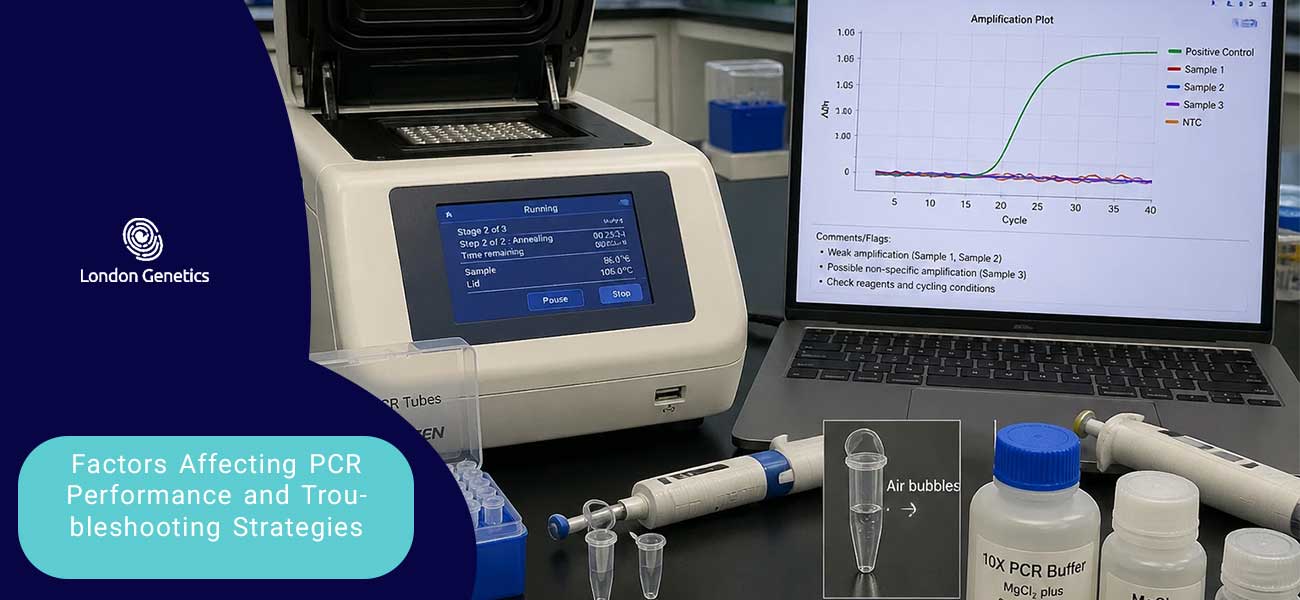
Factors Affecting PCR Performance and Troubleshooting Strategies
Although the Polymerase Chain Reaction (PCR) is a highly reliable and widely used technique, its success depends on careful optimisation of multiple variables. Even small deviations in reaction conditions can lead to weak amplification, non‑specific bands, or complete reaction failure. Understanding the key factors that influence PCR performance is essential for obtaining accurate and reproducible results.
Key Factors Affecting PCR Performance
Template DNA Quality and Quantity
The purity and concentration of the DNA template are critical. Contaminants such as proteins, phenol, ethanol, or haemoglobin can inhibit DNA polymerase activity.
- Too little DNA may produce faint or undetectable products.
- Too much DNA can increase non‑specific amplification.
- Degraded DNA reduces efficiency and yield.
High‑quality extraction methods and accurate quantification significantly improve outcomes.
Primer Design and Concentration
Primers determine the specificity of the PCR reaction. Poor primer design is one of the most common causes of failure.
Important considerations include:
- Appropriate melting temperature ™
- Balanced GC content
- Absence of secondary structures or primer‑dimers
- Specific binding to the target sequence
Excessively high primer concentrations may increase non‑specific products, whereas low concentrations may reduce amplification efficiency.
Annealing Temperature
The annealing temperature must be carefully optimised.
- Too low → non‑specific binding and unwanted products
- Too high → poor primer binding and low yield
A gradient PCR approach is often used to determine the optimal annealing temperature for a new primer set.
Magnesium Ion (Mg²⁺) Concentration
Magnesium ions are essential cofactors for DNA polymerase. However, their concentration must be balanced.
- Insufficient Mg²⁺ reduces enzyme activity.
- Excess Mg²⁺ can increase non‑specific amplification.
Fine‑tuning Mg²⁺ concentration is often necessary when optimising reactions.
Polymerase Selection
Different DNA polymerases offer varying levels of fidelity, speed, and robustness.
- Taq polymerase is cost‑effective but has lower proofreading ability.
- High‑fidelity polymerases are preferred for cloning and mutation analysis.
- Hot‑start polymerases reduce non‑specific amplification.
Choosing the appropriate enzyme depends on the application.
Cycle Number and Reaction Conditions
Excessive cycling can lead to non‑specific bands and background noise, whereas too few cycles may produce insufficient product. Standard reactions typically use 25–35 cycles, but optimisation may be required depending on template abundance.
Common PCR Problems and Troubleshooting Strategies
Even experienced laboratories encounter PCR difficulties. A systematic troubleshooting approach can resolve most issues.
Problem 1: No Amplification Product
Possible causes:
- Incorrect annealing temperature
- Degraded template
- Faulty polymerase
- Incorrect reaction setup
Solution:
Recheck reagent concentrations, confirm primer sequences, optimise annealing temperature, and verify enzyme activity.
Problem 2: Non‑Specific Bands
Possible causes:
- Low annealing temperature
- High Mg²⁺ concentration
- Excess primer
Solution:
Increase annealing temperature, reduce Mg²⁺ or primer concentration, or use a hot‑start polymerase.
Problem 3: Primer‑Dimer Formation
Primer‑dimers appear as small, unintended amplification products.
Solution:
Redesign primers, reduce primer concentration, or use hot‑start PCR to prevent premature primer interaction.
Problem 4: Weak or Faint Bands
Possible causes include insufficient template, suboptimal cycling conditions, or enzyme inefficiency.
Solution:
Increase template concentration slightly, optimise cycle number, or adjust extension time.
Successful Polymerase Chain Reaction experiments require careful attention to reaction components, thermal cycling parameters, and enzyme selection. Most PCR challenges stem from suboptimal optimisation rather than fundamental flaws in the method itself. By systematically adjusting variables such as primer design, annealing temperature, magnesium concentration, and enzyme choice, researchers and clinicians can achieve highly specific, reproducible, and efficient DNA amplification suitable for research, diagnostics, and genetic medicine applications.
The Ongoing Impact and Future of the Polymerase Chain Reaction (PCR)
The Polymerase Chain Reaction (PCR) remains one of the most transformative technologies in molecular biology. Its ability to amplify DNA rapidly, sensitively, and with exceptional specificity has shaped modern research, diagnostics, and genomic medicine. Over decades, PCR has evolved into a versatile platform that continues to meet the advancing needs of science and healthcare.
PCR’s influence spans from foundational genetic studies to precise clinical testing, offering clarity in understanding molecular mechanisms and enabling accurate disease diagnosis. As the field progresses, new PCR‑based innovations are redefining what is possible in both laboratory and clinical environments.
Enduring Strengths of PCR:
Rapid amplification, high sensitivity, and strong specificity allow researchers and clinicians to analyse genetic material with remarkable accuracy and efficiency.
Technological Advances:
Ultra‑fast thermal cycling, digital PCR, CRISPR‑assisted detection systems, and compact lab‑on‑chip platforms are expanding PCR’s speed, precision, and accessibility.
Clinical and Diagnostic Progress:
Enhanced PCR techniques support faster infectious disease diagnostics, improved genetic screening, and more refined approaches to personalised medicine.
Integration with Genomic Medicine:
PCR operates as a bridge between classical molecular biology and modern genomic technologies, supporting high‑throughput analyses and actionable clinical insights.
Future Outlook:
Ongoing innovation promises even greater diagnostic speed and accuracy, enabling healthcare systems to deliver more timely, data‑driven, and personalised interventions across diverse medical fields.