Introduction to Variant Interpretation in Genetic Testing
Variant interpretation is a central component of modern genetic testing, helping clinicians move from simply identifying a genetic change to understanding what that change actually means for a patient’s health. As genetic sequencing technologies become more widely used, especially in areas such as Paediatric Rare Disorders, the volume of detected variants has increased dramatically. This makes accurate and consistent variant interpretation more important than ever.
In a clinical setting, genetic tests often reveal numerous alterations in DNA, but not every variant carries medical significance. Some are entirely harmless, while others may contribute to serious inherited conditions. The role of variant interpretation is to determine which category a particular change falls into by drawing on scientific evidence, population data, laboratory studies, and clinical observations.
This process also ensures that healthcare professionals can provide patients with clear, reliable information. Whether in prenatal screening, cancer genetics, or diagnostic evaluations for complex inherited diseases, high‑quality variant interpretation enables precise diagnosis, informed decision‑making, and better long‑term care planning.
In essence, variant interpretation transforms raw genetic data into meaningful clinical insight, forming the foundation of effective and responsible genomic medicine.
Types of Genetic Variants and Their Clinical Relevance
Genetic variants occur in many forms, each with distinct implications for gene function and human health. Understanding these differences is essential for accurate variant interpretation, as not all variants affect proteins or biological pathways in the same way. Some changes significantly alter gene activity and contribute to disease, while others represent normal genetic diversity with little to no clinical impact.
Differentiating between types of genetic variants is essential for translating genomic findings into meaningful clinical information, ensuring accurate diagnosis and effective personalised care.
Methods and Tools Used for Variant Interpretation
Accurate variant interpretation relies on a combination of scientific methods, computational tools, and curated genomic databases. Because genetic testing can reveal thousands of variants in a single analysis, specialists use structured approaches to determine which variants are clinically meaningful and which are likely benign.
Bioinformatics Analysis
One of the first steps in variant interpretation involves bioinformatics pipelines that process raw sequencing data. These systems identify genetic variants and compare them with reference genomes. Through computational analysis, laboratories can filter variants based on frequency, predicted impact, and known disease associations.
Population and Clinical Databases
Databases play a crucial role in evaluating whether a genetic variant has been previously reported and how common it is in the general population. Some widely used resources include:
- ClinVar – a public database that links genetic variants with clinical significance
- gnomAD (Genome Aggregation Database) – provides large‑scale population frequency data
- HGMD (Human Gene Mutation Database) – contains reported disease‑causing mutations
These databases help specialists determine whether a variant is rare enough to be considered potentially pathogenic.
In Silico Prediction Tools
Computational prediction tools are frequently used to estimate how a variant might affect a protein’s structure or function. While they do not provide definitive answers, they offer valuable supporting evidence during variant interpretation. Common tools include:
- PolyPhen‑2 – predicts possible impact on protein structure and function
- SIFT (Sorting Intolerant From Tolerant) – evaluates whether an amino acid substitution is likely damaging
- MutationTaster – assesses the disease‑causing potential of DNA sequence changes
Functional and Laboratory Evidence
In some cases, laboratory studies are required to confirm the biological effect of a variant. Functional assays can demonstrate how a genetic change influences gene expression, protein activity, or cellular behaviour. This type of experimental evidence strengthens the reliability of variant interpretation, particularly when dealing with rare or newly discovered variants.
Together, these methods and tools form a structured framework that allows clinicians and genetic specialists to evaluate genetic findings systematically and translate them into clinically meaningful conclusions.
ACMG Guidelines and Variant Classification Framework
The ACMG guidelines, established by the American College of Medical Genetics and Genomics, provide a structured, evidence‑based system for interpreting genetic variants. These guidelines are widely adopted in clinical laboratories to ensure that variant classification is consistent, transparent, and scientifically robust. By following this standardised framework, clinicians and genetic specialists can more confidently assess the clinical significance of a detected variant.

A unified approach to interpreting genetic evidence in clinical diagnostics.


Pathogenic (strong evidence of causing disease),
Likely Pathogenic (high probability of disease causation),
Variant of Uncertain Significance (VUS) (insufficient or conflicting evidence),
Likely Benign (unlikely to cause disease),
Benign (strong evidence of no clinical impact).
This structured system helps ensure clarity and uniformity in genetic test interpretation.

Key Takeaway:
The ACMG classification framework ensures that genetic variants are evaluated through a rigorous, evidence‑based process—supporting accurate diagnosis, consistent reporting, and improved patient care in clinical genomics.
Common Challenges in Accurate Variant Interpretation
Accurate variant interpretation is essential for delivering reliable genetic test results, yet the process is often complex and filled with uncertainties. Several scientific, technical, and clinical challenges can influence how confidently a variant is classified and how clearly its impact can be explained to patients and healthcare professionals.
Limited or Conflicting Evidence
One of the most frequent challenges is the lack of sufficient data. Many variants—especially rare or newly discovered ones—have never been reported in scientific literature or clinical databases. In some cases, available evidence may even be conflicting, making it difficult to determine whether a variant is truly harmful or completely benign.
Variants of Uncertain Significance (VUS)
VUS findings are a major source of difficulty in clinical practice. These variants cannot be confidently classified due to limited information about their functional impact. Although a VUS does not confirm disease, it also cannot be ruled out, which can create uncertainty for patients and clinicians.
Inconsistent Database Information
Public and commercial databases are extremely valuable, but they sometimes contain conflicting interpretations from different laboratories. Such inconsistencies can complicate decision‑making and highlight the importance of expert review in variant interpretation.
Challenges with Non‑Coding and Regulatory Regions
While variants in protein‑coding regions are better understood, changes in non‑coding regions—such as promoters, enhancers, or intronic areas—can be more difficult to assess. Their impact on gene regulation may not be immediately clear, and functional testing is often required to understand their relevance.
Limitations of In Silico Tools
Prediction tools provide helpful insights but are not always accurate enough to be used alone. They can misclassify variants or give contradictory results, so their output must be combined with other forms of evidence.
The Need for Functional Studies
Although laboratory experiments can offer strong evidence, they are not always feasible due to cost, time, or technical complexity. As a result, many variants remain without definitive functional data, delaying accurate classification.
Together, these challenges highlight why variant interpretation is a careful, multidisciplinary process—one that requires expertise, high‑quality data, and continuous scientific updates to ensure accurate and clinically meaningful results.
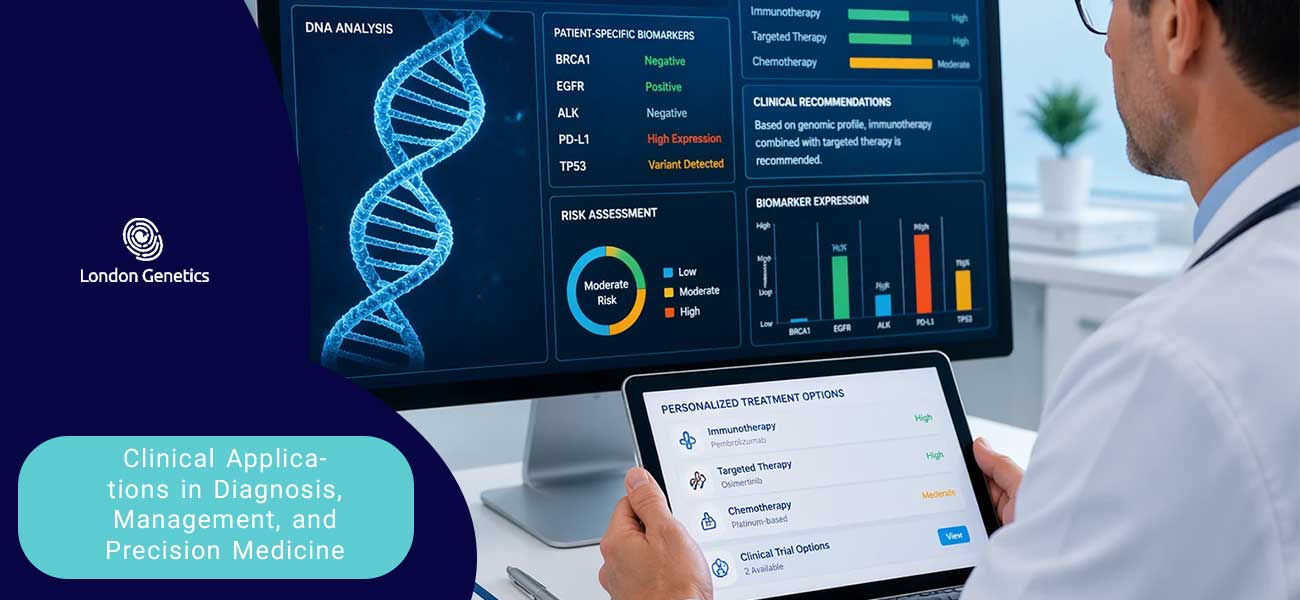
Clinical Applications in Diagnosis, Management, and Precision Medicine
Accurate variant interpretation plays a crucial role in translating genetic test results into meaningful clinical decisions. By identifying whether a genetic variant is associated with disease, clinicians can use this information to improve diagnosis, guide patient management, and support the development of personalised treatment strategies.
Role in Genetic Diagnosis
One of the primary clinical applications of variant interpretation is improving diagnostic accuracy. When a pathogenic or likely pathogenic variant is identified, it can confirm the genetic basis of a disease. This is particularly valuable in conditions with complex or unclear clinical presentations, such as many inherited disorders and paediatric rare disorders, where traditional diagnostic methods may not provide clear answers.
Guiding Patient Management
Interpreting genetic variants also helps clinicians develop more effective management plans. Genetic findings can influence decisions about monitoring strategies, preventive care, and treatment options. In some cases, early identification of a disease‑causing variant allows healthcare providers to implement interventions before symptoms become severe.
Supporting Family Screening and Genetic Counselling
Variant interpretation is essential for evaluating hereditary risk within families. Once a disease‑associated variant is identified, family members can be offered targeted genetic testing. This process, known as cascade testing, helps identify individuals who may be at risk and supports informed reproductive and healthcare decisions through genetic counselling.
Enabling Precision Medicine
In modern healthcare, variant interpretation is a cornerstone of precision medicine. By understanding how specific genetic variants affect biological pathways, clinicians can tailor treatments to the genetic profile of an individual patient. This approach is especially important in fields such as oncology, pharmacogenomics, and rare disease research.
Improving Long‑Term Patient Care
Ultimately, the clinical use of variant interpretation extends beyond diagnosis. It contributes to long‑term patient care by providing insights into disease prognosis, potential complications, and treatment responses. As genomic technologies continue to advance, the clinical impact of accurate variant interpretation is expected to grow, strengthening its role in personalised and predictive medicine.
Conclusion: The Future of Variant Interpretation in Genomic Medicine
As genomic technologies rapidly evolve, accurate genetic variant interpretation is becoming increasingly central to clinical decision‑making. With the widespread adoption of whole‑exome sequencing (WES), whole‑genome sequencing (WGS), and other high‑resolution diagnostic tools, clinicians and researchers now encounter an ever‑growing number of variants—each requiring careful and reliable assessment to determine its clinical significance.
The future of variant interpretation is being shaped by major advancements: expanding global population databases will help clarify the significance of rare variants, while large‑scale clinical data repositories will improve the interpretation of previously unreported findings. Emerging computational technologies, including AI‑driven predictive models, promise faster and more precise classifications, although expert human judgment will remain crucial for final clinical evaluation.
Enhanced Data Resources:
The growth of international population and clinical variant databases will reduce uncertainty, especially for rare or novel variants.
Advances in Predictive Technologies:
Machine learning and AI‑assisted interpretation tools will refine classification accuracy and accelerate the evaluation process.
Collaborative Global Efforts:
Data sharing across laboratories, refined international guidelines, and multidisciplinary teamwork will strengthen the reliability of variant interpretation.
Impact on Clinical Care:
These advancements are especially vital for conditions such as paediatric rare disorders, where accurate and timely diagnosis can significantly influence long‑term outcomes.
The Road Ahead:
The future of variant interpretation will integrate cutting‑edge technologies with expert clinical insight—forming the backbone of personalised, predictive, and preventive genomic medicine worldwide.