
The Gym Frustration: When Hard Work Yields No Rewards
It is an incredibly disheartening experience, isn’t it? You’ve spent weeks putting in the hard graft down the local gym, tracking every single calorie, and skipping your favourite weekend treats, yet the numbers on the scales simply refuse to budge. You look in the mirror expecting a bit of well-earned definition, but everything looks precisely the same. This frustrating plateau leaves millions of people asking themselves the exact same question: “Why am I working out but not seeing results?”
When this happens, the knee-jerk reaction is usually to blame your willpower. You assume you aren’t training hard enough, or that your diet isn’t strict enough, so you push your body to the absolute limit. However, the bitter truth is that you might be stuck in a cycle of working out but not seeing results simply because you are fighting against your own biology. Fitness isn’t a one-size-fits-all equation, and copying a generic routine from a social media influencer or a generic fitness app often leads to a dead end.
If you are utterly fed up with working out but not seeing results, it is time to stop guessing and start looking at your biological blueprint. Your unique genetic makeup dictates exactly how your body metabolises food, builds muscle, and burns fat. By moving away from standardized gym advice and embracing advanced personalised genetics services, you can finally unlock the specific scientific data needed to align your fitness regime with your DNA, transforming your hard work into tangible rewards.
Reason 1: You Are Training Against Your Genetic Muscle Type
If you have been lifting heavy weights for months in hopes of building lean muscle, only to end up feeling completely shattered with nothing to show for it, you are likely fighting a losing battle against your muscle fibres. Sports science has proven that your DNA pre-determines whether your muscles are built for explosive power or long-term endurance.
The underlying philosophy of modern sports science and high-performance wellness lies in replacing reactive training trends with strategic biomolecular foresight. Analysing how individual muscle fibre profiles and ACTN3 pathways interact with exercise volume allows coaching teams to eliminate outdated trial-and-error workout routines. Mapping these specific inherited muscular traits transforms abstract digital sequencing into an unshakeable, personalised blueprint for athletic development and long-term health maintenance.
Reason 2: Your Cardio Intensity Mismatches Your Oxygen Capacity
Go into almost any local gym, and you will hear personal trainers giving everyone the exact same, generic advice: “If you want to shift that stubborn fat, just spend forty-five minutes on the treadmill or smash a brutal HIIT circuit.” It is a classic formula, but it completely ignores a massive physiological reality. Your DNA directly dictates your VO2 Max—the maximum amount of oxygen your body can utilize during intense exercise—and this genetic ceiling is often the hidden culprit when you are working out but not seeing results.
When it comes to burning fat and improving fitness, people’s genetic codes cause them to respond to cardio in vastly different ways:
-
The High-Responder (HIIT-Friendly): Some individuals have a genetic profile that responds incredibly well to High-Intensity Interval Training (HIIT). Short, explosive bursts of maximum effort cause their VO2 Max to skyrocket, kicking their metabolism into overdrive and burning fat for hours after the workout.
-
The Low-Responder (Steady-State Friendly): For others, intense interval circuits leave them feeling proper knackered, heavily fatigued, and chronically stressed. These individuals possess variants that favor low-intensity, steady-state cardio (LISS), such as brisk walking or long, steady cycling, which safely taps into their fat stores without overwhelming their system.
If you are blindly following a trendy cardio routine that clashes with your oxygen capacity, you will find yourself trapped in that exhausting cycle of working out but not seeing results. Putting your body through the wrong type of cardiovascular stress can trigger a spike in cortisol, which actually causes your system to hold onto fat rather than burn it. To break through this plateau, your cardio intensity must be perfectly tailored to your genetic oxygen limits, ensuring every drop of sweat actually counts.

Reason 3: Chronic Inflammation is Sabotaging Your Muscle Recovery
We’ve all heard the old gym cliché, “No pain, no gain.” It’s a mentality that drives many to hit the weights day after day without a break, believing that constant soreness is a badge of honour. However, if you are constantly putting in the hours but find yourself working out but not seeing results, the issue might not be what you are doing inside the gym, but how your body recovers outside of it.
When you exercise, you create microscopic tears in your muscles, which triggers a natural immune response. Your DNA regulates exactly how long this inflammatory response lasts, and it varies drastically from person to person:
-
The Rapid Recoverer: Some individuals possess anti-inflammatory genetic markers that allow their bodies to clear out metabolic waste and repair tissue incredibly fast. They can manage heavy training loads with minimal rest days and still build muscle efficiently.
-
The Prolonged Inflamer: Many people carry genetic variants that cause an over-reactive immune response, meaning their muscles and joints remain chronically inflamed for days after a single session.
If your DNA falls into the latter category and you don’t give your body the extra rest days it biologically requires, you will run into a massive spot of bother. Instead of repairing and growing, your muscles remain in a permanent state of breakdown. Furthermore, chronic inflammation drives up your body’s stress hormones, which sends a signal to your metabolism to actively store fat and break down lean muscle tissue for energy. It is the perfect recipe for a fitness plateau; you end up completely exhausted, chronically sore, and trapped in a loop of working out but not seeing results. To make actual progress, your recovery schedule must be dictated by your genetic immune response, not a generic calendar.
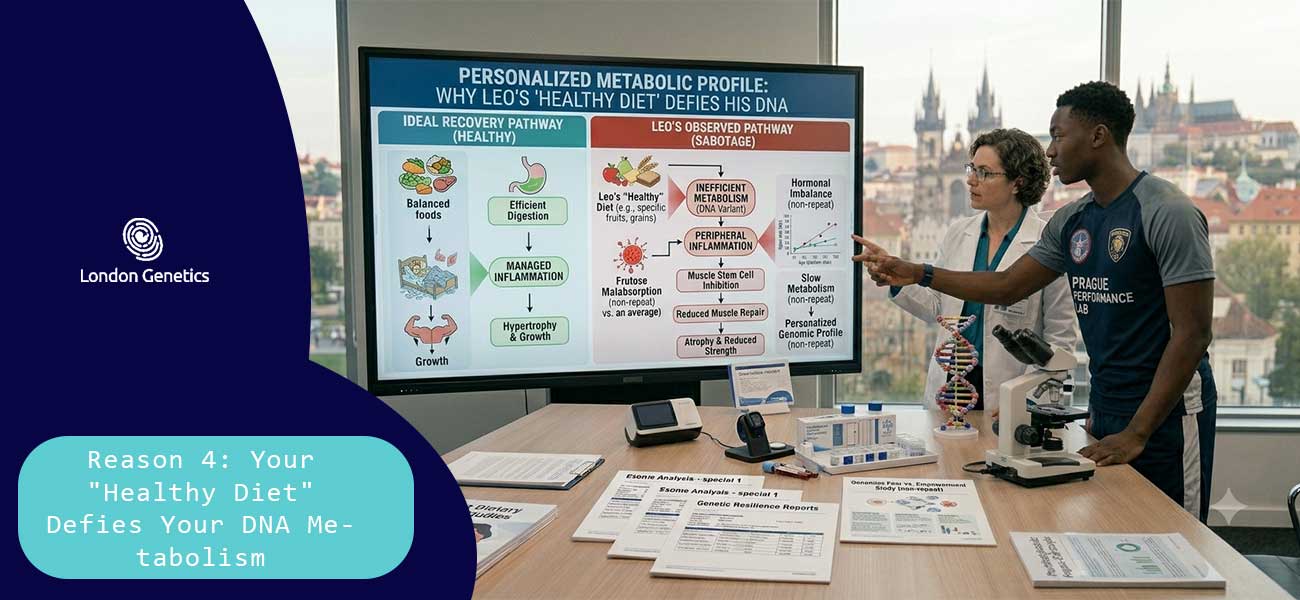
Reason 4: Your “Healthy Diet” Defies Your DNA Metabolism
You’ve likely cleared your cupboards of processed foods, swapped your afternoon biscuits for a spot of salad, and started eating what every health guru claims is the “perfect” clean diet. Yet, despite your incredible discipline, you are still working out but not seeing results. It is profoundly frustrating, but the explanation lies in a cutting-edge field of science known as nutrigenomics—the study of how our individual genetic profiles interact with the food we consume.
The fitness industry loves to push extreme, definitive dietary trends, claiming that either low-carb Keto or low-fat high-protein plans are the ultimate secret to a lean physique. However, your DNA completely rejects these blanket claims. Your genes dictate the exact efficiency of your enzymes and metabolic pathways, essentially deciding whether your body prefers to burn fats or carbohydrates for fuel:
-
The Carb-Efficient Profile: Some individuals carry specific variants of genes like AMY1 (which handles starch digestion) and PPARG. These people have metabolisms that thrive on a higher-complex-carbohydrate diet, using those carbs cleanly for gym performance rather than storing them as fat.
-
The Fat-Efficient Profile (Keto-Friendly): Conversely, others possess genetic markers that make them highly efficient at processing dietary fats, meaning a low-carb, higher-fat approach keeps their energy steady and their weight sorted.
Now, imagine if your DNA is genetically wired to struggle with heavy fat processing while genes such as the ACTN3 gene also influence how your body performs during exercise, yet you force yourself onto a strict ketogenic diet because an internet trend told you to. The result? Your energy will plummet, your training sessions will feel absolutely barmy, and your body will actively resist fat loss. You are essentially putting the wrong fuel into a highly specialised engine. To stop working out but not seeing results, you must abandon generic diet plans and align your macronutrients with the precise metabolic instructions hardwired into your genetic code.
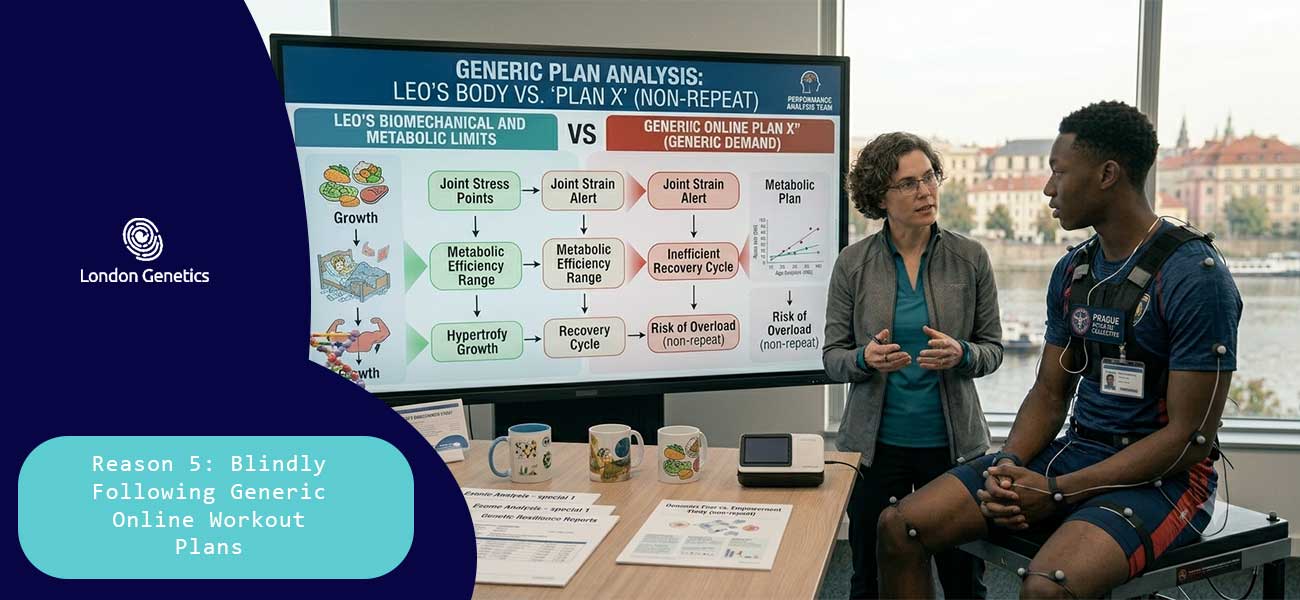
Reason 5: Blindly Following Generic Online Workout Plans
Social media is absolutely flooded with them. You scroll through your feed and see an influencer with a chiselled physique offering their “ultimate 12-week body transformation plan” for a fancy price. It looks convincing, so you buy it, follow it to the absolute letter, and expect that within a few months, bob’s your uncle—you’ll have the exact same results. But here we are again, months down the line, and you are still working out but not seeing results.
This brings us to the fifth, and arguably the most significant, roadblock holding you back: the dangerous myth of the copy-and-paste fitness routine.
When you blindly download a generic online workout plan, you are making a massive gamble with your time and effort. These routines are designed for the “average” person, but biologically speaking, an average person simply does not exist. A workout routine that works wonders for a social media fitness star might be completely daft for your specific body. As we’ve already explored, that trendy routine could be forcing you to train for power when your muscles crave endurance, or pushing you into brutal HIIT sessions when your oxygen capacity actually requires steady-state cardio.
Relying on internet guesswork is the absolute definitive reason why people hit an unbreakable fitness plateau. You cannot expect a generic PDF file or a generic app to know how your specific immune system handles recovery, or how your enzymes process fats and carbs. Continuing down this path means you will stay firmly trapped in the cycle of working out but not seeing results. If you want a body that stands out from the crowd, you have to stop training like the rest of the crowd and start looking at the only blueprint that actually matters—your own.
Overcoming the Plateau with London Genetics
You have spent enough time feeling frustrated, checking the mirror for changes that never arrive, and wondering why you are constantly working out but not seeing results. You do not lack willpower, and you certainly are not afraid of hard work—you have simply been training in the dark. It is time to step out of the guesswork of the local gym and step into the definitive light of sports science.
At London Genetics, we believe your fitness journey should be as unique as your DNA. Through our cutting-edge personalised genetics services, we strip away the generic, copy-and-paste routines and look directly at your biological blueprint, allowing individuals to transition from frustrating, surface-level guesswork to an absolute predictive shield.
Book Your Consultation with Dr Karimiani