
What Is a Family Health History?
A family health history is a record of the health conditions, diagnoses, and other significant medical information affecting your biological relatives. It can include conditions such as cancer, heart disease, diabetes, neurological disorders, and inherited conditions, as well as the age at which they developed. Reviewing these patterns can help identify potential genetic health risks and determine whether further assessment or genetic counselling may be appropriate.
Is your family health history just a list of medical conditions?
Many people view it as a mere catalogue of the past—a record of illnesses that have affected their parents or grandparents. However, at London Genetics, we prefer to look at it differently: your family health history is a powerful, proactive roadmap for your future.
It is vital to recognise that your genetic code is not a fixed script for your life. While genetics provides the blueprint, it is not destiny. The interplay between your genes and the environment—often referred to as ‘nature versus nurture’—means that your health is not solely predetermined. By understanding the patterns in your family history, you gain a unique advantage: the ability to intervene early, make informed lifestyle choices, and seek specialised screening that could alter the course of your health journey. You are not a prisoner to your family history; you can help shape how it affects your future.
Why Your Family Health History Matters for Your Health
Your family health history is perhaps the most cost-effective and accessible diagnostic tool available in modern medicine. When you sit down with your GP, a clear and detailed account of your relatives’ health issues allows for a far more personalised approach to your own care.
Rather than relying on generic health advice, understanding your specific familial background allows you to transition from reactive care—treating symptoms after they appear—to preventative medicine. For instance, if certain conditions such as diabetes, hypertension, or hereditary cancers appear frequently in your family, you and your medical team can implement specific screening programmes long before any symptoms manifest.
However, it is equally important to understand the nuances of what this history actually implies. Not every condition that ‘runs in the family’ is strictly genetic. Some disorders are influenced by shared environmental factors, such as diet, exercise, and lifestyle choices that are passed down through generations. Understanding the difference between these strictly inherited conditions and broader familial patterns is essential for your long-term well-being. To get a clearer picture of these distinctions, we invite you to explore our comprehensive guide to hereditary and familial disorders.
By demystifying your family health history, you empower yourself to make evidence-based decisions, ensuring that you receive the right care at the right time.
How to Build Your Family Health Tree (The Right Way)
Mapping your health history is the first step toward proactive care. A clear, organised record helps your GP identify potential hereditary risks that warrant further investigation.
Start with First-Degree Relatives
Begin by gathering information from those who share approximately 50% of your DNA: your parents, siblings, and children. Their health profiles offer the most significant signal for your own genetic risks. If records are unavailable, try to interview older family members to reconstruct these details.
Ask the Right Questions: Age Matters
Simply noting a condition is insufficient. The critical data point is the age at diagnosis. Early-onset diseases—such as heart disease in one’s 40s or cancers appearing well before the average population age—are strong indicators of a hereditary component rather than general ageing.
Look for Patterns, Not Just Diseases
Search for clustering. Does a specific type of cancer, autoimmune condition, or metabolic issue appear across multiple generations? Recognising these clusters helps you and your GP differentiate between environmental “shared lifestyle” issues and potentially inherited familial disorders that require specialised screening.
Make it a living document. Your health history isn’t a static report; it’s a dynamic tool. Update it as new family health information emerges and bring this summary to your next consultation with your GP or a genetic specialist to ensure you are receiving the most accurate, personalised care.
What to Include in Your Family Health History
When creating your Family Health History, record key information about close relatives, including major health conditions, age at diagnosis and cause of death where known. This information can help healthcare professionals identify patterns that may suggest an inherited or familial health risk.
| Family Member | What to Record | Why It Matters |
|---|---|---|
| Parents | Major illnesses, genetic conditions, cancer history, age at diagnosis and current health | Parents are first-degree relatives and can provide important clues about inherited health risks. |
| Siblings | Diagnosed conditions, age at diagnosis, congenital conditions and major health problems | Patterns among siblings may help identify conditions that could have a genetic component. |
| Children | Birth conditions, developmental concerns, genetic diagnoses and significant illnesses | Childhood or congenital conditions can sometimes provide important information about inherited disorders. |
| Grandparents | Major diseases, cancer history, age at diagnosis and cause and age of death where known | Grandparents can provide information about health patterns across multiple generations. |
| Aunts & Uncles | Major illnesses, cancer diagnoses, genetic conditions and age when conditions developed | Health patterns among second-degree relatives may add context to your overall family history. |
| Other Relatives | Relevant rare diseases, repeated conditions or unusual patterns of illness | Additional information can be useful when assessing a possible familial or inherited condition. |
How to Gather and Document Your Family Health History
Collecting your family health history might feel like a daunting task, but it does not need to be a formal or perfect medical document. Think of it as creating a “family health map.” You do not need to be a medical expert; you simply need to be a gatherer of information.
Here is a straightforward approach to help you build your record.
1. Start with the “Big Three”
You don’t need to record every minor ailment. Focus on conditions that may have a genetic or familial component. Start with first-degree relatives (parents, siblings, and children) and move outwards to second-degree relatives (grandparents, aunts, uncles, and nieces/nephews). For each person, try to note:
- The Condition: What was the illness or health concern?
- Age of Onset: At what age were they diagnosed? (Early diagnosis is often a more significant clue).
- Relationship: Which side of the family does the condition come from?
2. Have the “Difficult” Conversations
It is natural for family members to be protective of their medical history. When speaking with relatives, frame the conversation around proactive health. Explain that you are building this record to help you and your GP make informed decisions about future preventative screenings or care. Approach the conversation with empathy and respect for their privacy.
3. Use Available Resources
You do not have to rely solely on memory. If available, look for:
- Medical Records: Old discharge summaries or clinic letters.
- Death Certificates: These can sometimes clarify causes of death if the information was not clearly discussed while family members were alive.
- Family Stories: While not as precise as medical records, family anecdotes can provide valuable clues about conditions that may have “run in the family” for generations.
4. Create Your Living Document
Your family health history is a “living” document—it should be updated as family members get older or as new health information comes to light. Whether you prefer a simple spreadsheet, a dedicated app, or a handwritten notebook, the format matters less than the consistency. Keep it somewhere accessible so you can easily reference it during your next GP appointment.
Preparing for Your Appointment
When you finally sit down with your GP, you don’t need to present a complex family tree. A simple, organised list of who had what and at what age is usually sufficient.
Pro-tip: If your family history is particularly complex, ask your GP if they can refer you to a genetic specialist service. Sometimes, a professional assessment can help structure that information more formally, which may be beneficial if you are considering genetic testing or need more tailored surveillance.
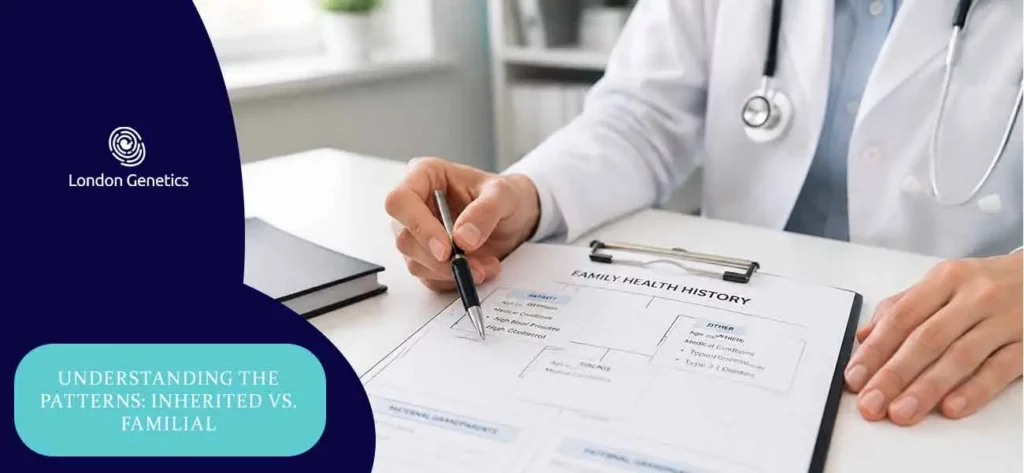
Understanding the Patterns: Inherited vs. Familial
When people notice a condition appearing repeatedly in their family, it is natural to assume it must be inherited. However, that is not always the case. Some conditions are truly inherited, caused by a specific gene change passed from one generation to the next. Others are familial, meaning they appear more often within families because relatives may share not only genes, but also diet, habits, and environmental exposures.
This distinction matters. A family history of type 2 diabetes, for example, may reflect both genetic susceptibility and shared lifestyle factors such as diet, physical activity, and body weight. In contrast, a condition such as cystic fibrosis is inherited in a much more direct way, through specific gene variants.
Understanding whether a condition is inherited or familial helps you and your GP interpret your risk more accurately and decide whether further testing, monitoring, or lifestyle changes may be appropriate.
When to Consult a Genetic Specialist
A detailed family health history can reveal patterns that may need further investigation. Speaking with a genetic specialist can help clarify whether a condition is likely to be inherited, familial, or influenced by other factors.
Genetic assessment does not always confirm a hereditary condition, but it can provide clearer answers, guide next steps, and help you and your GP make more informed decisions about your health.
Taking Control: Lifestyle Changes vs. Genetic Predisposition
Learning that a health condition runs in your family can be daunting, but it is important to remember that your genes are only one part of the picture. A genetic predisposition does not mean that illness is inevitable. Your health is shaped by an interplay between your genetic makeup, your environment, and the lifestyle choices you make every day.
Nature and Nurture Working Together
Most common health conditions are influenced by a complex combination of genetic and non-genetic factors. For instance, while having close relatives with type 2 diabetes or heart disease may increase your baseline risk, these are not fixed outcomes.
Think of your genetic history as a set of initial conditions rather than a predetermined blueprint. While you cannot change your genes, you can significantly influence how those genes are expressed through your environment and lifestyle. By focusing on modifiable factors, you can often mitigate risks or delay the onset of conditions that might otherwise occur earlier in life.
The Power of Lifestyle Choices
Living a healthy life does not erase your genetic history, but it is one of the most effective tools you have for long-term health management. Proactive steps include:
- Prioritising Nutrition: A balanced diet rich in whole foods, vegetables, and lean proteins helps manage weight and supports metabolic health, which is crucial for reducing risks associated with conditions like diabetes and cardiovascular disease.
- Regular Physical Activity: Engaging in consistent exercise strengthens the heart, improves circulation, and aids in maintaining a healthy weight—all of which act as protective factors against many chronic illnesses.
- Avoiding Harmful Habits: Eliminating smoking and limiting alcohol consumption significantly reduces the burden on your body, lowering the risk of various cancers and respiratory conditions.
- Stress Management: Chronic stress can affect your immune system and overall wellbeing. Incorporating mindfulness, adequate sleep, and work-life balance into your routine is an essential part of a preventative health programme.
Prevention Over Cure
It is essential to clarify that a healthy lifestyle is not a replacement for medical guidance. If you have a strong family history of a specific condition, healthy habits should complement—not replace—recommended medical screening.
Knowing your family history allows you and your GP to be more targeted. For example, if there is a history of early-onset bowel cancer in your family, you may be eligible for screening at a younger age than the general population. In this sense, your genetic history becomes a prompt for better medical care rather than a source of anxiety.
Summary: Your Future is Not Defined by Your Genes
The key message to take away is that your genetic background may influence your risk, but it does not define your future. By understanding your family history, you transition from a passive recipient of your genes to an active participant in your health.
When you combine a healthy lifestyle with informed medical surveillance, you are taking the best possible steps to safeguard your wellbeing. Should you have any concerns about your personal risk profile, the best course of action remains speaking with your GP to discuss whether a referral to a genetic specialist is appropriate.
Your Next Step
Your family health history is more than just data—it is a powerful tool for empowerment. While you cannot change your genes, you can certainly change how you manage them. Don’t leave your long-term health to chance; take a proactive step today to secure your future.
Book Your Consultation with Dr Karimiani