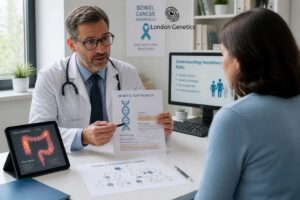
Is Hereditary Cancer?
Cancer can be hereditary, but inherited gene changes account for only a small proportion of all cancers. Most cancers develop over time as a result of ageing, chance DNA changes, environmental exposures and lifestyle factors. In contrast, hereditary cancer occurs when a person inherits a gene variant from one of their parents that increases their susceptibility to certain cancers.
Having an inherited cancer-related gene variant does not mean that cancer is inevitable. It means that the likelihood of developing particular cancers may be higher than in the general population. The level of risk can vary depending on the gene involved, the type of variant, biological sex, age and other personal or environmental factors.
A hereditary pattern may be suspected when cancer affects several relatives on the same side of the family, develops at a younger-than-expected age, or occurs alongside related cancer types. Understanding your inherited cancer risk and family history can help clarify whether a genetic cause may be relevant and whether further specialist assessment should be considered.
It is also important to distinguish between cancers that are hereditary, cancers that appear more often in a family for non-genetic reasons, and cancers that occur sporadically. Recognising this difference is the first step towards making informed decisions about your health and future screening options.
Hereditary, Familial and Sporadic Cancer: What Is the Difference?
Not all cancer occurrences in a family are driven by inherited genetic mutations.
To assess personal risk accurately, clinical geneticists classify cancer patterns into three distinct categories:
sporadic, familial, and hereditary.
Sporadic cancers occur by chance due to acquired mutations over time, driven by ageing, environment, and lifestyle.
There is typically no clear pattern of the same cancer across generations, and diagnosis usually happens at typical older ages.
Familial clustering occurs when multiple relatives develop cancer due to a combination of shared lifestyle, environmental exposures, and subtle polygenic factors.
Unlike single-gene hereditary syndromes, no single identifiable high-risk gene variant is responsible.
Hereditary cancers are caused by a specific inherited alteration in a single gene (e.g., BRCA1, BRCA2, or Lynch syndrome genes).
These variants are present in every cell from birth and confer a significantly higher lifetime risk of specific cancers.
Key Takeaway:
Distinguishing between sporadic, familial, and hereditary cancer is fundamental to clinical risk stratification.
While sporadic cases require standard population screening, true hereditary patterns warrant specialist assessment,
targeted genetic evaluation, and personalised surveillance strategies.
Signs That Cancer May Run in Your Family
Because cancer is a common condition, having a relative with cancer does not necessarily indicate an underlying inherited condition. Most families affected by cancer have sporadic cases. However, specific medical indicators and family history patterns can raise the suspicion of an inherited cancer predisposition.
Recognising these warning signs is critical for determining whether formal clinical risk assessment or targeted genetic investigation is warranted:
- Unusually young age at diagnosis: Developing cancer at an age significantly younger than the typical population average (such as breast or bowel cancer diagnosed before age 50).
- Multiple close relatives with related cancers: Having two or more first-degree (parents, siblings, children) or second-degree (grandparents, aunts, uncles) relatives on the same side of the family diagnosed with the same or biologically linked cancers.
- Clustering of specific cancer combinations: Certain combinations of cancers occurring together across generations—such as breast and ovarian cancer, or bowel, endometrial (uterine), and ovarian cancers.
- Multiple primary cancers in a single individual: An individual developing more than one distinct type of cancer over their lifetime, or bilateral disease in paired organs (such as cancer in both breasts or both kidneys).
- Rare or atypical cancer presentations: Diagnoses of uncommon cancers that strongly suggest an underlying genetic basis, such as male breast cancer, medullary thyroid carcinoma, or adrenocortical carcinoma.
- Known familial gene alterations: A documented pathogenic genetic variant already identified in a blood relative.
If your family history exhibits one or more of these characteristics, a dedicated hereditary cancer risk assessment can evaluate your full pedigree, calculate objective lifetime risks, and outline whether predictive testing or heightened clinical surveillance is recommended.

Common Hereditary Cancer Syndromes
Most hereditary cancers are driven by a defined group of well-characterised genetic syndromes. Each syndrome is associated with specific faulty genes that significantly elevate the lifetime risk of developing particular types of cancer.
Hereditary Breast and Ovarian Cancer (HBOC) Syndrome
HBOC is predominantly caused by inherited pathogenic variants in the BRCA1 or BRCA2 genes, alongside moderate-to-high risk genes such as PALB2, CHEK2, and ATM.
- Individuals carrying a BRCA alteration face a markedly increased lifetime risk of developing breast cancer (often at an earlier age) and ovarian cancer.
- Men with BRCA alterations have elevated risks of male breast cancer and aggressive prostate cancer.
- Identifying these variants early is critical for implementing targeted surveillance protocols, chemoprevention, or surgical options outlined in specialist breast cancer prevention pathways.
Lynch Syndrome (Hereditary Non-Polyposis Colorectal Cancer)
Lynch syndrome is the most common cause of inherited colorectal cancer, caused by alterations in DNA mismatch repair (MMR) genes, including MLH1, MSH2, MSH6, and PMS2.
- It significantly increases the risk of bowel cancer, often diagnosed before the age of 50.
- Lynch syndrome also elevates lifetime risks for endometrial (uterine), ovarian, stomach, and urinary tract cancers.
- Regular colonoscopic surveillance with polyp removal dramatically reduces cancer incidence and mortality for individuals identified with this condition.
Other High-Impact Syndromes
While less common, several other genetic syndromes carry substantial cancer predispositions:
- Li-Fraumeni Syndrome (TP53): A rare condition causing very high lifetime risks of diverse early-onset malignancies, including soft tissue and bone sarcomas, premenopausal breast cancer, brain tumours, and adrenocortical carcinoma.
- Familial Adenomatous Polyposis (FAP – APC): Characterised by the development of hundreds to thousands of precancerous polyps throughout the colon and rectum during adolescence and young adulthood, which inevitably progress to colorectal cancer without timely clinical management.
- Cowden Syndrome (PTEN): Part of the PTEN hamartoma tumour syndromes, predisposing individuals to breast, thyroid, and endometrial malignancies, alongside distinct dermatological features.
What Does a Family History of Cancer Mean for Your Risk?
A family history of cancer does not always mean that an inherited genetic mutation is present.
While family patterns provide essential clues, they must be interpreted within the broader context
of your unique medical and personal history.
Many families share common environments, lifestyle choices, and behaviours—such as diet, physical activity levels, and smoking habits—that can contribute to similar cancer risks among relatives, independent of genetic inheritance.
Having a single relative with cancer often reflects sporadic disease. However, when multiple cases appear across generations or in specific combinations, it increases the likelihood that a shared genetic factor, rather than just shared environment, may be the underlying driver.
Key Takeaway:
Your family history is a powerful starting point for risk assessment, but it is not a diagnosis. Recognising when a family history is “significant”—by identifying clustering, early onset, or specific combinations of cancer—is the essential step to determine whether you need professional clinical risk evaluation.
When Should You Consider Cancer Genetic Counselling?
Genetic counselling is a specialised service designed to help individuals navigate the complexities of their family health history. It is not necessarily about undergoing a genetic test; rather, it is a structured assessment to determine if your family history truly points to a hereditary risk.
You should consider seeking professional genetic advice if you recognise any of the following in your family history:
- Significant patterns: You have a family history featuring multiple relatives with the same or related types of cancer, particularly on the same side of the family.
- Early-onset diagnoses: Cancer has been diagnosed in close relatives at a young age, typically under 50.
- Rare cancer types: There is a history of rare or unusual tumours in your immediate or extended family.
- Uncertainty about your risk: You feel anxious about your personal health outlook due to your family’s history and need objective, evidence-based information rather than speculation.
During a consultation, a specialist will review your full three-generation family pedigree. They will assess whether the pattern suggests an inherited syndrome or if the occurrences are more likely coincidental. Most importantly, a consultation provides the clarity needed to decide if cancer genetic counselling is the right pathway for you, and whether formal predictive genetic testing is clinically appropriate.
Professional guidance transforms uncertainty into a documented, manageable health plan, ensuring that if risk levels are elevated, you have a clear strategy for surveillance and prevention.
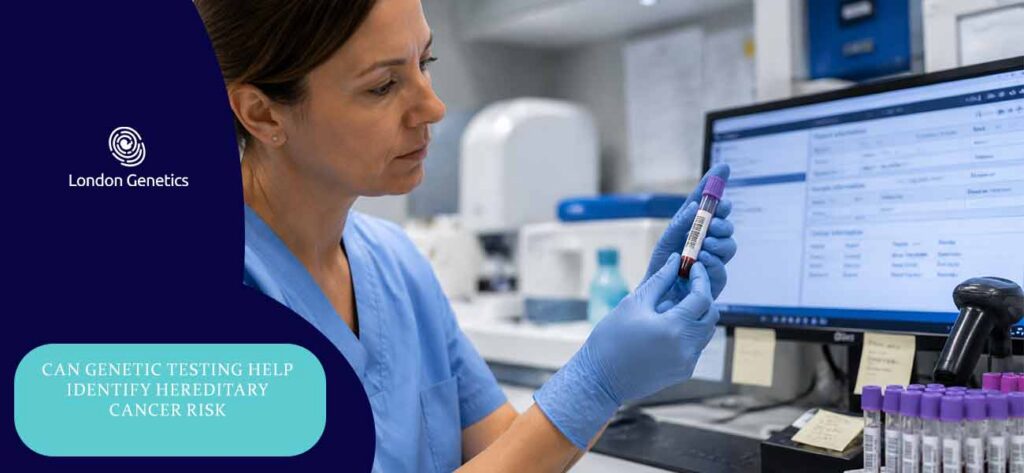
Can Genetic Testing Help Identify Hereditary Cancer Risk?
When a family history suggests a potential hereditary syndrome, genetic testing serves as the definitive tool to confirm or rule out an inherited genetic predisposition. By analysing your DNA—typically through a simple blood or saliva sample—laboratory testing can identify specific pathogenic variants in genes known to increase the risk of cancer, such as BRCA1, BRCA2, or those associated with Lynch syndrome.
Testing is not simply about obtaining a result; it is about obtaining actionable information. A positive finding transforms “suspected risk” into “managed risk,” allowing you and your medical team to implement specific, evidence-based surveillance or preventative measures.
However, genetic results are complex and must be interpreted by a specialist in the context of your specific family pedigree. It is important to note that a negative result for a known family mutation provides peace of mind, but a negative result where no familial mutation has been identified may require further clinical consideration. If you are exploring whether genetic testing for cancer risk is appropriate for your specific circumstances, it is recommended to discuss your family history with a clinical geneticist, who can guide you on the clinical utility, limitations, and potential implications of undergoing such an investigation.
What Can You Do If You Have a Higher Inherited Cancer Risk?
Identifying a higher inherited risk gives you and your clinical team a clear window of opportunity to intervene early. Proactive management plans are structured around three clinical pathways tailored to your specific gene alteration and family pedigree.
| Management Pathway | Clinical Strategy | Primary Clinical Goal |
|---|---|---|
| Enhanced Surveillance | Earlier, more frequent, and specialised imaging protocols (such as annual breast MRI, high-resolution ultrasound, or regular colonoscopies with polyp removal). | Detect precancerous cellular changes or early-stage tumours when treatment is most effective. |
| Medical Chemoprevention | Targeted pharmaceutical therapies (such as selective hormone receptor modulators for breast risk or daily aspirin regimens for Lynch syndrome). | Lower baseline biological risk and actively suppress tumour initiation pathways. |
| Risk-Reducing Surgery | Prophylactic surgical interventions (such as risk-reducing mastectomy or bilateral salpingo-oophorectomy) for defined very-high-risk gene carriers. | Substantially reduce organ-specific cancer risk (often by up to 90–95% in eligible cases). |
| Targeted Lifestyle Optimisation | Weight management, smoking cessation, alcohol limitation, regular aerobic exercise, and anti-inflammatory nutritional plans. | Minimise cumulative environmental stressors and support long-term metabolic health. |
| Cascade Family Screening | Sharing validated genetic information with first-degree relatives to facilitate predictive testing for biological family members. | Empower relatives to assess their personal risk and access timely preventive care. |
Frequently Asked Questions About Hereditary Cancer
If cancer runs in my family, is it certain that I will develop cancer?
No. Inheriting a cancer-related gene alteration increases your statistical susceptibility to particular cancers, but it is not a guarantee that cancer will develop. Disease onset is influenced by a combination of genetics, age, environmental exposures, hormonal factors, and lifestyle choices. Many individuals carrying a pathogenic variant never develop cancer during their lifetime.
Can I inherit a cancer gene mutation from my father as well as my mother?
Yes. Most hereditary cancer predisposition genes—such as BRCA1, BRCA2, and mismatch repair genes associated with Lynch syndrome—are inherited in an autosomal dominant pattern on non-sex chromosomes. This means they can be passed down equally from either your father or your mother, and both men and women have a 50% chance of passing the altered gene to each biological child.
Does a negative genetic test result mean I will never get cancer?
No. A negative test result means that no pathogenic variant was detected in the specific genes analysed. If you were tested for a known variant already identified in your family, a “true negative” result returns your risk level to that of the general population. However, it does not reduce your risk to zero, as sporadic cancers can still develop due to standard age-related, environmental, and lifestyle factors.
What is a Variant of Uncertain Significance (VUS)?
A Variant of Uncertain Significance (VUS) is an identified variation in a gene’s DNA sequence whose clinical impact on cancer risk is currently unknown. It is not classified as pathogenic (disease-causing) or benign (harmless). Clinical guidelines strongly advise that medical decisions—such as prophylactic surgery—should not be made based solely on a VUS result. Over time, as genomic databases expand, most VUS findings are reclassified.
At what age should I seek clinical genetic advice?
If you have a strong family history of cancer, the ideal time to seek advice is prior to the earliest age of onset observed in your family—often recommended 5 to 10 years before the youngest affected relative was diagnosed, or typically starting in your mid-20s for adult-onset syndromes. A clinical geneticist can review your pedigree and determine the most appropriate timeline for evaluation and surveillance.
Understanding Your Hereditary Cancer Risk: Next Steps
Understanding the impact of hereditary cancer syndromes is a vital component of modern proactive healthcare,
fundamentally transforming how early detection, clinical surveillance, and cancer prevention are managed.
While carrying an inherited gene alteration significantly increases susceptibility,
it does not represent an inevitable outcome.
Key insights from modern clinical cancer genetics:
- Only 5–10% of all cancers are caused by high-risk inherited single-gene mutations.
- Genetic risk assessment clarifies whether a family pattern reflects true inherited predisposition or shared lifestyle factors.
- Diagnostic and predictive testing provide clear, actionable insights into personal and familial risk profiles.
- Objective risk awareness empowers individuals to implement tailored surveillance before disease can develop.
Genetics Is One Part of the Broader Picture:
– Environmental factors, lifestyle choices, and biological events all influence lifetime cancer risk.
– Comprehensive prevention combines hereditary risk assessment with optimised lifestyle management and specialist guidance.
– Early risk stratification ensures that heightened surveillance begins well before standard population screening ages.
Empowerment Through Personalised Medicine:
Advances in targeted screening, chemoprevention, and proactive clinical interventions
have dramatically improved outcomes for individuals with high-risk genetic predispositions.
With a structured management plan, individuals carrying hereditary cancer variants have more control,
clearer clinical options, and a far more positive long-term outlook.
Your Next Step:
Consult with a specialist clinical geneticist to evaluate your multi-generation family pedigree,
determine whether predictive genetic testing is clinically appropriate, and establish a personalised
surveillance and prevention roadmap tailored to you and your family.