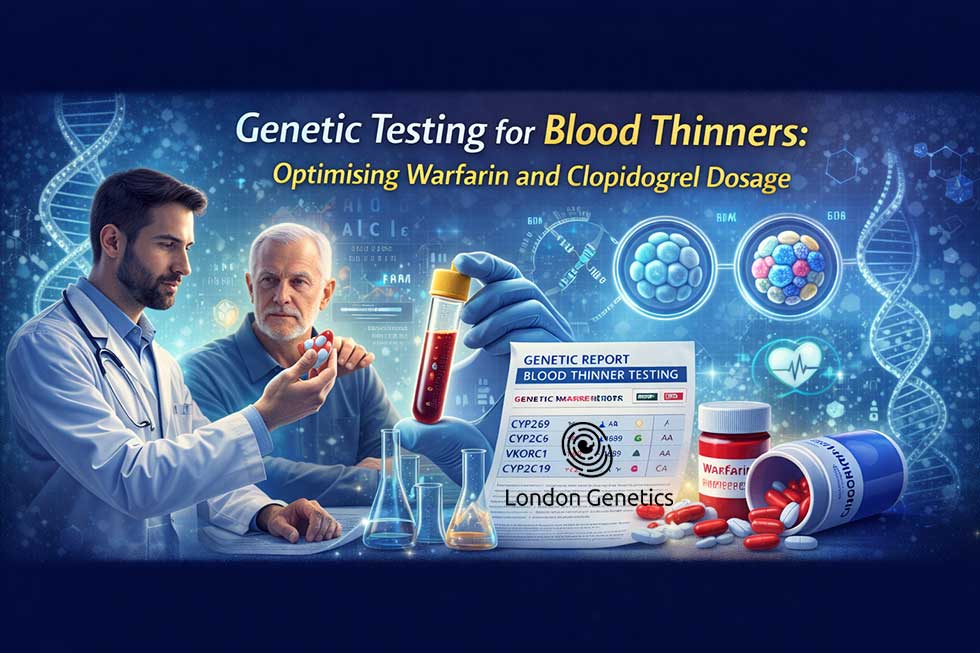
The Science Behind Blood Thinners: Why One Dose Doesn’t Fit All
In the realm of modern cardiology, the traditional “one-size-fits-all” approach is becoming rather obsolete, quite frankly. When it comes to Blood Thinners, what works wonders for one chap might be remarkably ineffective, or even hazardous, for another. This isn’t down to mere luck; it’s rooted deeply in your unique biological makeup.
You see, your body’s ability to process these medications is governed by specific enzymes produced by your DNA. If your metabolism is a bit too “keen” (a rapid metabolizer), the medication might be cleared from your system before it can even prevent a clot. Conversely, if your system is a tad sluggish, the drug can build up to dangerous levels, significantly increasing the risk of unwanted bleeding.
By moving away from the old-fashioned “trial and error” method, Pharmacogenomics allows us to peer into your genetic blueprint. Through specialist Cardiovascular Drug Response Testing, we can determine the precise calibration your body requires. It’s about ensuring your treatment is as bespoke as a Savile Row suit—perfectly tailored to keep you safe and sound.
Genetic Variants and Anticoagulant Response
Your response to blood thinners is not determined by chance alone.
At a molecular level, your DNA acts as an instruction manual
that guides how your liver processes anticoagulant medications.
Even minor genetic variations can profoundly influence
whether treatment is safe, effective, or potentially harmful.
Genes involved in drug metabolism control how quickly
anticoagulants are processed and cleared from the body.
Small genetic changes—known as polymorphisms—
can act like tiny “typos” in this instruction manual,
altering how efficiently the medication moves through the liver.
Some individuals carry variants that cause their bodies
to break down blood thinners too quickly.
In these cases, the medication does not remain in the bloodstream
long enough to prevent clot formation,
leaving patients exposed to an increased risk of thrombosis.
Other genetic variants slow drug metabolism dramatically,
causing anticoagulants to accumulate in the bloodstream.
Without dose adjustment, this prolonged exposure
raises the risk of internal bleeding—
not because the medicine is flawed,
but because the dosage does not match the patient’s genetic profile.
Key Takeaway:
Anticoagulant therapy is most effective when it is genetically informed.
Understanding how your DNA influences drug metabolism
allows clinicians to tailor dosage precisely—
reducing the risk of clots on one end of the spectrum
and dangerous bleeding on the other.
This is a powerful example of how personalised genetics
transforms standard treatment into safer, smarter care.
Clopidogrel (Plavix) and the CYP2C19 Gene: Preventing Treatment Failure
In the world of cardiology, Clopidogrel—often known by its brand name, Plavix—is a bit of a staple, isn’t it? It’s widely prescribed across the UK to prevent strokes and heart attacks. However, there’s a significant “genetic snag” that many patients aren’t aware of. You see, Clopidogrel is a “prodrug,” which means it arrives in your system in an inactive state. It’s your liver, specifically an enzyme called CYP2C19, that must “switch it on” to make it work.
Now, here’s where things get a bit tricky. A fair number of people in the British population are what we call “Poor Metabolizers.” Due to their genetic makeup, their CYP2C19 enzyme is essentially “off-duty.” If you fall into this category, your body cannot effectively convert the medication into its active form. Consequently, even if you’re taking your Blood Thinners religiously every morning, the drug isn’t actually protecting your arteries.
This is a classic case of treatment failure that has nothing to do with the patient’s lifestyle and everything to do with their DNA. For these individuals, a standard dose is simply not enough, or they might require a different class of medication altogether. By identifying this genetic trait early on, we can avoid the devastating consequences of a secondary cardiac event. It’s not just about prescribing medicine; it’s about making sure the medicine actually does what it says on the tin.
Warfarin Sensitivity: Balancing Stroke Prevention and Bleeding Risks
Warfarin remains a cornerstone of anticoagulant therapy,
but it is one of the most challenging medications to dose safely.
Its narrow therapeutic window means that the difference
between preventing a stroke and causing a serious bleed
can be alarmingly small—often requiring frequent blood tests
and repeated dose adjustments.

Hover over each box to see how genetics influence Warfarin response.

Warfarin operates within a very tight safety margin,
where small dose changes can have large clinical consequences.
Too little leaves patients vulnerable to clots and stroke,
while too much dramatically increases the risk
of bruising, internal bleeding, or haemorrhage.

CYP2C9 controls how quickly Warfarin is broken down,
while VKORC1 determines how sensitive the body is to the drug.
Certain genetic variants make patients highly sensitive,
meaning even a typical starting dose
can be excessively potent and unsafe.

Without genetic insight, clinicians must rely on trial and error
during the first weeks of treatment.
DNA-based testing allows a personalised starting dose from day one,
ensuring effective clot protection
without crossing into dangerous bleeding risk.
Key Takeaway:
Warfarin sensitivity is largely written in your genes.
By understanding CYP2C9 and VKORC1 variants before treatment begins,
anticoagulation can be tailored with precision—
reducing unnecessary blood tests,
avoiding dangerous dose swings,
and ensuring stroke prevention is achieved safely and confidently.
Beyond Trials: How Pharmacogenomics Replaces “Trial and Error” in Cardiology
In years gone by, the way we prescribed heart medication was, to put it bluntly, a bit of a guessing game. A patient would be started on a “standard” dose of Blood Thinners, and then we’d simply wait and see. If the patient developed bruising, the dose was lowered; if a clot formed, it was raised. This “trial and error” method is not only rather antiquated but, quite frankly, unnecessarily risky for the patient.
In the heart of London’s medical district, we are moving well beyond these rudimentary trials. By utilizing pharmacogenomics, we can now identify the “Golden Dose” (the optimal therapeutic dose) before the very first pill is even swallowed. Instead of using the patient as a guinea pig to see how they react, we use their genetic data to predict the outcome. This precision ensures that the medication is effective from day one, providing a level of safety that was previously unimaginable in traditional cardiology.
To give you a clearer picture of how this revolutionary shift benefits you, let’s compare the two approaches:
| Feature | The Old “Trial & Error” Way | The Modern Genetic Approach |
| Dosing Strategy | Based on average height, weight, and age. | Based on your unique DNA and enzyme activity. |
| Initial Safety | High risk of side effects or under-dosing in the first month. | Precision-calculated dose to minimize risks from the start. |
| Time to Results | Can take weeks of blood tests to find the right balance. | The “Golden Dose” is identified before treatment begins. |
| Patient Stress | Anxiety over potential bleeding or recurring clots. | Peace of mind knowing the treatment is tailored to you. |
| Cost & Efficiency | Frequent follow-up appointments and dose changes. | Streamlined care with fewer adjustments needed. |
This transition from “best guess” medicine to “data-driven” healthcare is the hallmark of modern London genetics. We believe that when it involves your heart, there is simply no room for guesswork. By understanding how your body interacts with Blood Thinners at a molecular level, we provide a blueprint for a safer, more certain recovery.
The Long-term Benefits of DNA-Guided Cardiovascular Therapy
When we discuss the advantages of genetic testing for Blood Thinners, we aren’t just talking about the first few weeks of treatment. We are talking about a fundamental shift in your long-term health trajectory. The peace of mind that comes from knowing your cardiovascular regime is anchored in hard science, rather than guesswork, is truly invaluable. For patients across London and the UK, this proactive approach to Blood Thinners translates into a significantly higher quality of life, free from the constant “shadow of doubt” regarding medication safety.
One of the most profound long-term benefits is the drastic reduction in hospital readmissions. When Blood Thinners are dosed precisely from the outset, the likelihood of an emergency visit due to major haemorrhaging or a secondary ischaemic stroke plummets. This is a cornerstone of preventive genetic testing, as it shifts the focus from managing crises to preventing them altogether. By avoiding these clinical setbacks, patients can maintain their daily routines, careers, and social lives without the looming fear of sudden medical complications.
Furthermore, the economic argument for this approach is quite compelling. While some may view genetic screening as an upfront cost, it is, in fact, a savvy investment. By getting the dosage of your Blood Thinners right the first time, you bypass the spiralling costs of corrective treatments, repeated laboratory monitoring, and the potential loss of income during recovery from medication side effects. It is a prime example of how personalised medicine in London is setting a new global standard for efficient, patient-centred care.
Ultimately, DNA-guided therapy ensures that your treatment remains “fit for purpose” for years to come. As you age or your lifestyle changes, having that foundational genetic data allows your consultant to make swift, informed adjustments to your Blood Thinners. It’s not just about surviving a cardiac event; it’s about thriving afterwards, knowing that your heart health is being managed with the utmost precision that modern science can muster.
Taking Control of Your Heart Health at London Genetics
If you or a loved one are taking Blood Thinners—or are about to begin treatment—
there is no need to accept the uncertainty of trial-and-error dosing.
At London Genetics, modern cardiovascular care means using your DNA
to guide safer, more precise treatment decisions,
replacing guesswork with personalised confidence.
With pharmacogenomic insight, you can:
- Understand exactly how your body processes Blood Thinners
- Reduce the risk of bleeding or clotting caused by incorrect dosing
- Move forward with treatment backed by genetic certainty
A Simple, Non-Invasive Testing Process:
– Quick and painless cheek swab—no needles or hospital stays.
– Easy “swab and send” collection completed from the comfort of home.
– Advanced genomic analysis using state-of-the-art laboratory technology.
Why Genetic Insight Matters for Heart Health:
When time and safety are critical, personalised DNA analysis provides clarity fast.
Your bespoke genetic report is delivered promptly to you and your healthcare provider,
ensuring your Blood Thinner dose is calibrated precisely
to your unique biological profile.
Your Next Step:
Don’t leave your cardiovascular safety to chance.
Book a consultation with our specialists at London Genetics
to explore how pharmacogenomic testing can optimise your treatment,
protect your heart, and give you lasting peace of mind.