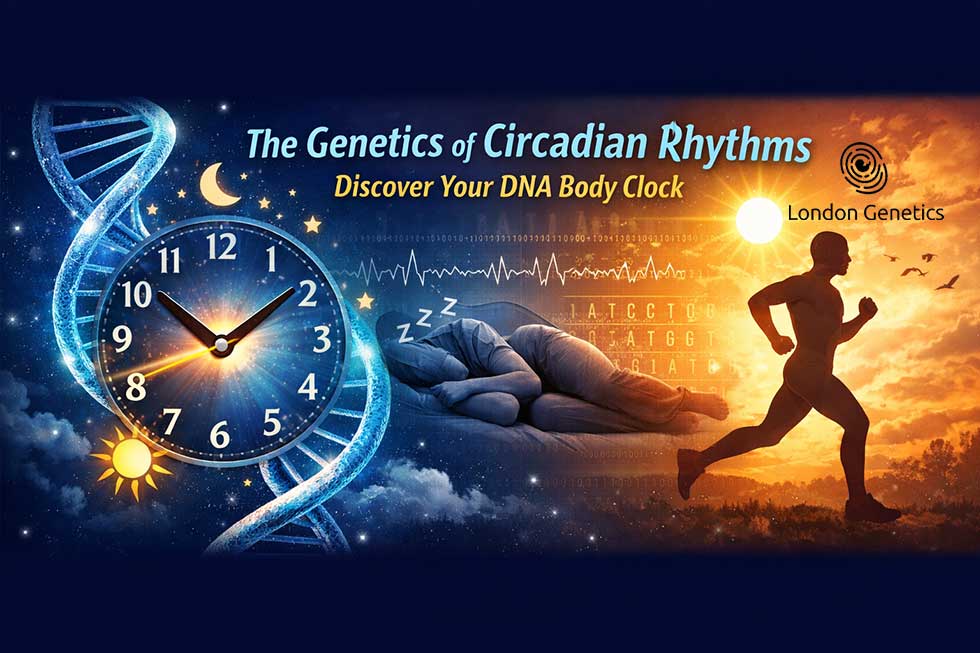
Introduction: Living Against Your Biological Clock
In the relentless, 24-hour environment of modern London, productivity is often measured by how early we start our commute or how late we push through a deadline. However, for many Londoners, this constant hustle leads to a state of permanent “social jetlag”—a chronic misalignment between our lifestyle demands and our internal biological timing. Science now reveals that our energy levels, cognitive focus, and even our metabolic resilience are not just matters of willpower; they are governed by the Genetics of Circadian Rhythms.
At London Genetics, we see many clients who struggle with persistent fatigue and “brain fog” simply because they are living against their inherited biological design. Through our comprehensive Genetic Wellness & Lifestyle services, we help individuals identify their unique “Chronotype”—the DNA-driven clock that dictates when the body is naturally primed for rest, work, and peak physical performance. By understanding the Genetics of Circadian Rhythms, you can stop fighting your biology and start optimising your life for maximum efficiency. Whether you are looking for Sleep Genetics insights or a bespoke performance plan, aligning your routine with your genetic clock is the ultimate step in personalised health.
The PER3 Gene: Are You a Morning Lark or a Night Owl?
The Genetics of Circadian Rhythms are governed by an intricate system of molecular “clock genes” that regulate your internal 24-hour cycle.
Among the most influential is the PER3 (Period Circadian Regulator 3) gene, which plays a central role in determining your natural sleep–wake rhythm.
The PER3 gene works closely with other clock genes, such as CLOCK,
to synchronise essential biological functions.
Together, they regulate hormone release, core body temperature,
alertness, and sleep timing across the 24-hour day.
Variations in the length and structure of the PER3 gene influence
your chronotype—whether you naturally wake early or feel most alert late at night.
Longer PER3 variants are often linked to early risers who require more sleep,
while shorter variants are associated with night owls who adapt more easily
to late schedules but struggle with early mornings.
Feeling “out of sync” with a traditional 9-to-5 routine is not a lack of discipline—
it reflects your underlying genetic programming.
Understanding your circadian genetics provides a scientific explanation
for energy peaks and troughs, allowing you to work with your biology
rather than against it.
Key Takeaway:
Your sleep–wake preferences are deeply rooted in your DNA.
By understanding the role of the PER3 gene and circadian genetics,
you can stop comparing your rhythm to others
and begin aligning your lifestyle with your natural biological tempo—
improving wellbeing, productivity, and long-term health.
Performance Timing: When Should You Train?
One of the most transformative applications of understanding the Genetics of Circadian Rhythms is the ability to synchronise physical exertion with your natural peak in physiological strength. It is a common misconception that all athletes should train at dawn; in reality, your DNA Body Clock dictates when your body is most resilient and capable of explosive power or sustained endurance.
Scientific studies have shown that muscle function, joint flexibility, and even lung capacity fluctuate according to your circadian profile. For instance, individuals whose Genetics of Circadian Rhythms lean towards a “morning” profile often hit their peak body temperature and grip strength in the early afternoon. Conversely, “night owls” may not reach their maximum anaerobic power until much later in the evening. Attempting a heavy lifting session when your DNA Body Clock is at its biological trough can lead to subpar results and an increased risk of injury.
At London Genetics, we integrate these chronobiological insights into our Fitness & Performance Genetics service. By knowing precisely when your “performance window” opens, you can structure your workouts to achieve maximum gains. This approach builds upon the principles we discussed in our article on How DNA Testing Optimises Athletic Performance, where we explore how identifying your genetic predispositions allows for a truly professional level of precision. Aligning the Genetics of Circadian Rhythms with your gym schedule ensures you are training at your most potent, not just when the clock on the wall says so.
Deep Sleep Optimisation: More Than Just Eight Hours
Sleep quality is not defined by duration alone.
The Genetics of Circadian Rhythms show that *when* you sleep is just as important as *how long* you sleep.
Your DNA Body Clock controls the timing of melatonin release,
determining when your brain is biologically prepared for deep, restorative rest.

Hover over each box to understand how genetics influence deep sleep quality.

Your genetic body clock dictates when melatonin signals the brain
to enter recovery mode.
Sleeping outside your genetically optimal window reduces
REM and slow-wave sleep—compromising the brain’s ability
to restore, repair, and reset overnight.

Genetic variants influence how quickly your brain clears adenosine—
the chemical that drives sleep pressure throughout the day.
For some individuals, late-night sleep is not a preference
but a biological requirement for reaching deep,
restorative sleep phases.

Forcing a mismatched schedule prevents the brain
from performing essential cellular “housekeeping”
that only occurs during deep sleep.
Identifying your optimal sleep window allows cognition,
mood, and metabolic health to recover fully—night after night.
Key Takeaway:
Deep sleep is not about sleeping longer—it is about sleeping smarter.
By aligning rest with your DNA Body Clock,
sleep becomes biologically efficient rather than exhausting.
Understanding your circadian genetics is the first step
toward waking up genuinely refreshed, focused, and restored.
Mental Resilience: The Link Between Circadian Rhythms and Stress
There is a profound and often overlooked connection between the Genetics of Circadian Rhythms and our psychological health. Our DNA Body Clock does not only regulate sleep; it acts as the master conductor for the daily fluctuation of neurotransmitters and hormones, such as cortisol, dopamine, and serotonin. When your lifestyle in a high-pressure environment like London is consistently out of sync with your genetic timing—a condition known as circadian misalignment—it triggers a persistent state of physiological stress. This mismatch directly erodes your mental resilience and makes you more vulnerable to burnout.
Scientific research into the Genetics of Circadian Rhythms has shown that chronic disruption of these internal cycles can impair the prefrontal cortex, the area of the brain responsible for emotional regulation and decision-making. This is why individuals whose DNA Body Clock is naturally inclined toward being a “Night Owl” often report higher levels of anxiety when forced into a standard 9-to-5 world. Their biology is in a state of constant conflict with their environment, making it significantly harder for the brain to “reset” or recover after a stressful event.
The Impact of Circadian Misalignment on Mental Health
To better understand how the Genetics of Circadian Rhythms influences your daily mood and stress response, consider the following table which compares a “Synced” versus a “Misaligned” DNA Body Clock:
| Biological Factor | Synced DNA Body Clock | Misaligned DNA Body Clock |
| Cortisol Response | Sharp morning peak to drive alertness. | Flat or delayed peak; daytime “slumps”. |
| Emotional Regulation | High resilience; balanced mood. | Increased irritability and anxiety. |
| Neurotransmitter Level | Optimal serotonin and dopamine cycles. | Reduced focus and motivation. |
| Stress Recovery | Fast recovery from daily pressures. | Chronic “fight or flight” state. |
| Cognitive Flexibility | Clear thinking and problem-solving. | Brain fog and indecisiveness. |
By understanding your specific Genetics of Circadian Rhythms, you can implement “Biohacking” strategies to protect your mental wellbeing. At London Genetics, we address these challenges through our Stress & Mental Health Genetic Insights. We help you use your DNA Body Clock to your advantage, such as optimising light exposure or the timing of stressful meetings to align with your natural “calm windows.”
This builds upon our previous work on How Stress Affects Your Genes, illustrating that mental resilience is not merely a personality trait, but a biological process that can be fine-tuned. When you align your daily demands with the Genetics of Circadian Rhythms, you provide your mind with the biological stability it needs to thrive in a demanding world.
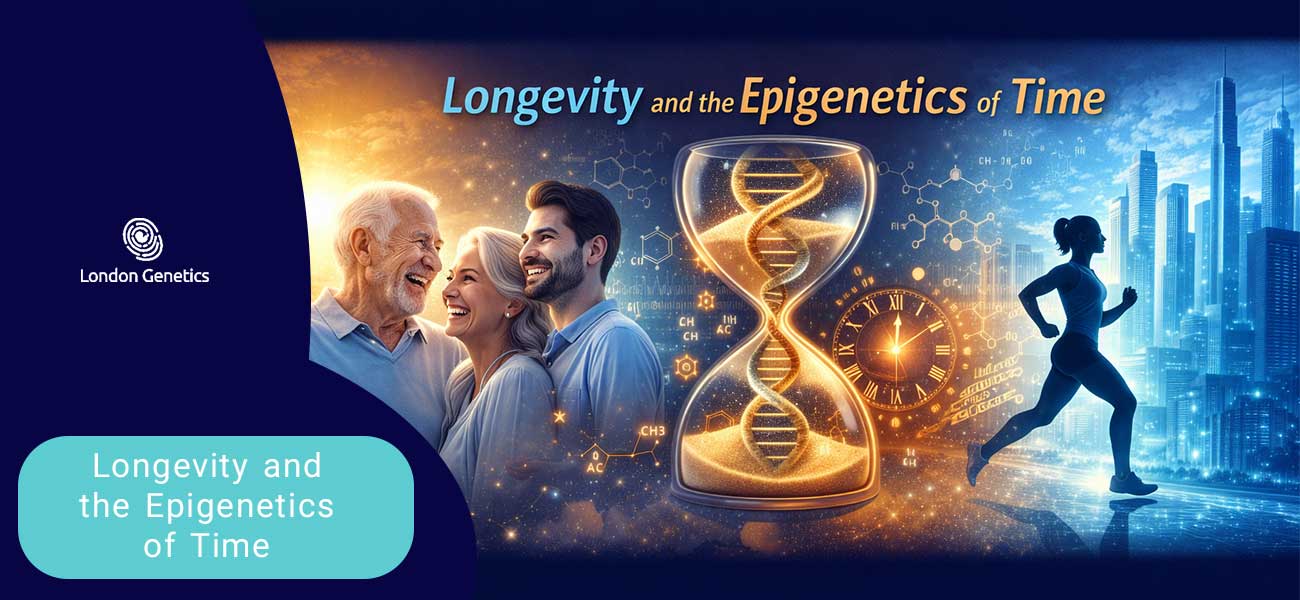
Longevity and the Epigenetics of Time
When we think of longevity, we often focus on nutrition and exercise. However, emerging research into the Genetics of Circadian Rhythms suggests that the “timing” of our biological processes is just as important as the actions themselves. Every cell in your body contains a DNA Body Clock that governs essential repair mechanisms, such as DNA damage repair, protein folding, and cellular detoxification. When these rhythms are disrupted, these vital “maintenance” tasks are neglected, leading to accelerated cellular aging and a shorter “healthspan.”
The Circadian-Aging Connection
At the molecular level, the Genetics of Circadian Rhythms are inextricably linked to the sirtuin family of genes (SIRT1), which are well-known regulators of longevity. These genes function most effectively when the body is in a state of circadian synchrony. If your DNA Body Clock is chronically misaligned due to poor sleep timing or late-night blue light exposure, your sirtuin activity drops, hindering the body’s ability to defend itself against age-related decline.
To illustrate the critical role of timing in cellular health, consider how the Genetics of Circadian Rhythms influence these key longevity factors:
| Longevity Factor | Impact of a Synced DNA Body Clock | Impact of Circadian Disruption |
| DNA Repair | High activity during restorative sleep phases. | Accumulation of genetic mutations. |
| Autophagy | Efficient “cellular cleaning” during fasting/night. | Build-up of toxic cellular waste. |
| Mitochondrial Function | Optimal energy production and less oxidative stress. | Increased free radical damage and fatigue. |
| Telomere Maintenance | Better protection of the ends of chromosomes. | Faster shortening of telomeres (accelerated aging). |
By leveraging our Longevity & Anti-Aging Genetics service, Londoners can move beyond generic anti-aging advice. We use the Genetics of Circadian Rhythms to determine your “Longevity Blueprint,” advising you on the optimal timing for meals (chrononutrition), supplements, and rest to ensure your cells stay youthful and resilient.
As we explored in our previous discussion on Why Some People Age Slower Than Others, the secret to a long life is often found in the harmony between your lifestyle and your DNA Body Clock. Aligning your daily habits with your internal time is not just about feeling better today—it is about protecting your future self through the science of epigenetics.
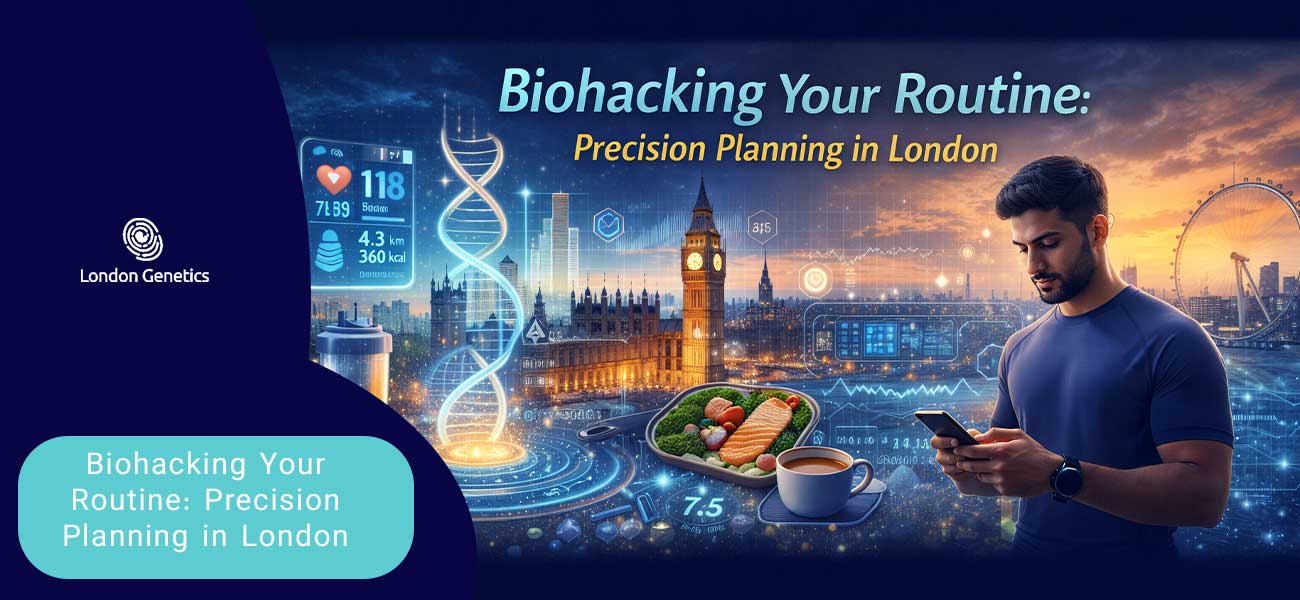
Biohacking Your Routine: Precision Planning in London
For the high-achiever in London, “Biohacking” is not about following the latest social media trend; it is about the meticulous, data-driven optimisation of your unique biology. By understanding the Genetics of Circadian Rhythms, you can move beyond guesswork and implement a precision-timed routine that maximises your cognitive and physical output. Under the expert guidance of Dr Ehsan Ghayoor Karimani, we help you translate your DNA Body Clock into a practical, daily schedule.
The Scientific Roadmap to Peak Performance
Biohacking your routine requires a multi-faceted approach, focusing on the external “Zeitgebers” (time-givers) that signal to your Genetics of Circadian Rhythms how to behave:
-
Light Manipulation: Based on your DNA Body Clock, we determine the precise windows for high-intensity blue light exposure to drive alertness and exactly when to transition to amber or red tones to trigger natural melatonin production.
-
Chrononutrition: We align your metabolic window with your genetics. For many, eating in sync with the Genetics of Circadian Rhythms can improve insulin sensitivity and weight management, as explored in our guide to Genetic Obesity.
-
Strategic Deep Work: We identify your “Cognitive Peak.” For a “Morning Lark,” this might mean tackling complex financial models at 8:00 AM, while a “Night Owl” may be coached to save their creative problem-solving for after the sun sets.
-
Temperature Regulation: Utilising your DNA Body Clock insights, we can advise on the timing of cold immersion or heat therapy (sauna) to assist in shifting your rhythm or deepening your recovery phases.
Expert Oversight by Dr Ehsan Ghayoor Karimani
At London Genetics, this process is led by Dr Ehsan Ghayoor Karimani, who ensures that every biohack is grounded in rigorous clinical evidence. Rather than a one-size-fits-all approach, Dr Karimani reviews your full genetic profile to identify unique optimisation points. Whether it is adjusting the timing of your nootropics or fine-tuning your caffeine intake based on your Genetics of Circadian Rhythms, you receive a bespoke biological roadmap designed to unlock your inherent potential.
By biohacking your DNA, you stop being a passenger to your environment and become the architect of your own vitality. It is the ultimate expression of Biohacking DNA, allowing London residents to push the boundaries of human capability safely and scientifically.
Conclusion: Syncing Your Life with London Genetics
In the fast-paced heart of London, peak energy, mental clarity, and long-term health
are not achieved by working harder—but by working smarter in harmony with the Genetics of Circadian Rhythms.
Your DNA Body Clock governs sleep quality, emotional resilience, and cellular longevity,
and when these signals are ignored, chronic fatigue and burnout become falsely accepted as “normal.”
By aligning your lifestyle with your genetic rhythm, you can:
- Restore sustained energy and mental clarity without burnout
- Strengthen emotional resilience and long-term cognitive health
- Synchronise daily demands with your internal biological clock
From Living Out of Sync to Peak Flow:
– Decode how your DNA Body Clock shapes sleep, focus, and recovery.
– Replace generic wellness advice with a personalised genetic strategy.
– Build daily habits that support long-term vitality and performance.
Why Personalised Circadian Insight Matters:
The secret to sustainable wellbeing is not found in trends or quick fixes,
but in aligning your external lifestyle with your internal biology.
When genetic insight is paired with clinical expertise,
wellness becomes precise, measurable, and enduring.
Your Next Step:
Stop fighting your biology and start mastering your time.
Under the clinical expertise of Dr Ehsan Ghayoor Karimani and the London Genetics team,
you can transform genetic insight into a bespoke roadmap
for peak performance, restorative sleep, and lifelong resilience.